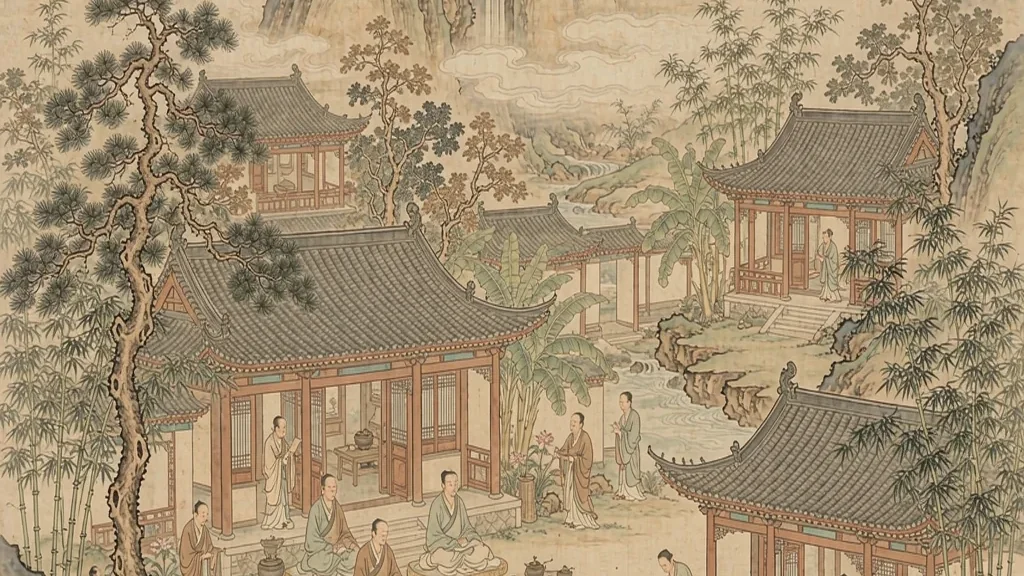
At 3:30 AM, while the cities of China are still dark and silent, a wooden board strikes three times in the meditation hall, and in disciplined response, a community of monks rises from their thin mats. The day of a Chinese Buddhist monastic begins not with breakfast or conversation but with cold water on the face and the first sitting of meditation. From this dark hour until the last bell at 9:00 PM, every moment of a monk's life is regulated by the monastic code, every action an opportunity for practice. Life in a Chan Buddhist monastery is not a retreat from reality but a systematic confrontation with it — a thousand small disciplines designed to wear away the ego and reveal the Buddha-nature within.
The Daily Schedule: Bells, Bowls, and Bows
The monastery day is governed by the sound of bells. A large bell awakens the community before dawn. The assembly gathers in the meditation hall for the first sitting period, which lasts about an hour. After meditation comes morning chanting (早课, zǎo kè), featuring the Heart Sutra, the Shurangama Mantra, and other key texts. The chanting is performed in unison, in a distinctive melodic style that has been passed down for generations.
Breakfast follows chanting. The meal is eaten in silence in the dining hall, with bowls arranged in a specific pattern on the table. Monks chant a series of verses before eating, reflecting on the food's origin, the donors who provided it, and the purpose of sustaining the body for practice. The meal itself is simple — typically congee, pickled vegetables, and steamed bread. No one speaks, and every movement is mindful: lifting the bowl, using the chopsticks, chewing, swallowing.
The morning continues with work practice (出坡, chū pō). In traditional Chan monasteries, manual labor is an integral part of training, not something delegated to servants. Monks sweep the courtyards, tend the gardens, repair buildings, and cook meals. This tradition, established by Chan patriarchs like Baizhang (百丈), who declared "A day without work is a day without food," ensures that monastic life is not merely contemplative but engaged with the material realities of existence.
The Monastic Code: Vinaya in Chinese Buddhism
Chinese Buddhist monastics follow the Dharmaguptaka Vinaya (四分律, sì fēn lǜ), which prescribes 250 rules for monks and 348 rules for nuns. These rules cover every aspect of life: clothing (robes must be patched and dyed a subdued color), food (no eating after noon), money (personal ownership is restricted), and conduct (no singing, dancing, or entertainment). The rules are studied, recited, and confessed regularly.
Twice a month, on the new moon and full moon, the monastic community gathers for the posadha (布萨, bù sà) ceremony. The vinaya rules are recited, and monks are expected to confess any violations. This ritual of confession and purification maintains the integrity of the sangha and provides a regular opportunity for accountability. The posadha is a legal as well as a spiritual proceeding, reflecting the Buddhist understanding that ethical discipline is the foundation of meditative attainment.
In addition to the vinaya, Chinese monasteries follow a "pure rules" (清规, qīng guī) code that adapts the ancient Indian rules to Chinese conditions. The most famous of these is Baizhang's "Pure Rules for Chan Monasteries" (百丈清规), which established the administrative structure of Chan monasteries — including the roles of the abbot, the cook, the precentor, and the various officers who manage the community. This code balanced the demands of vinaya with the practical needs of a large, self-sufficient institution.
Transmission: Becoming a Monk
Entering the monastic life is a gradual process. A candidate typically begins as a lay volunteer, living at the monastery and performing work while observing basic precepts. After a period of observation — often several months — the candidate may request to become a novice (沙弥, shā mí). The novice shaves their head, receives the ten precepts, and begins formal training in chanting, ritual, and meditation.
Full ordination (具足戒, jù zú jiè) requires a minimum age of 20 and must take place at an ordination platform (戒坛, jiè tán) during a formal ordination ceremony. The ceremony, which lasts several days, involves a triple-platform ordination: the novice receives the vows of a monk, the bodhisattva precepts, and then the full vinaya. The ceremony is presided over by a precept-abbot, two instructors, and seven witness monks. Once ordained, the monk is a full member of the sangha.
The path for nuns follows the same structure but with additional requirements. The bhikshuni (比丘尼, bǐ qiū ní) ordination requires the presence of both a monastic and a dual sangha (monks and nuns), reflecting the tradition's concern for proper transmission. In recent decades, there has been a revival of full bhikshuni ordination in Chinese Buddhism, including international ordination ceremonies that bring together nuns from different traditions.
The Meditation Hall: The Heart of the Monastery
The meditation hall (禅堂) is the most important building in a Chan monastery. It is a long, open hall with raised platforms on each side where monks sit in assigned positions. The hall is kept simple — no images, no decorations, nothing to distract from the work of sitting. The only furnishings are the sitting cushions, the walking path, and the incense clock that marks the periods.
Life in the meditation hall is governed by strict protocols. Monks enter and leave in a specific order. They walk in a clockwise direction. They sit facing the wall. The hall is supervised by the meditation master (维那, wéi nà), who maintains discipline and provides individual guidance. During intensive retreat periods, monks may spend up to twelve hours per day in the hall, breaking only for meals, work, and brief rest.
The meditation hall is also the site of formal interviews (小参, xiǎo cān), where monks present their understanding to the master. These interviews are private, intense, and often confrontational. The master may shout, strike, or dismiss the monk. The interview is not a discussion but a test — the master's response is the teaching, and the monk's only task is to see clearly.
The Contemporary Monastic: Tradition and Change
Chinese monasticism has undergone profound changes in the modern era. Since the 1980s, however, Chinese Buddhism has experienced a remarkable revival. Hundreds of monasteries have been rebuilt, thousands of men and women have taken ordination, and monastic education has been reestablished.
Contemporary Chinese monks face challenges unknown to their predecessors. They must navigate the relationship with a secular state that controls religious activity. They must engage with a rapidly modernizing society that offers unprecedented material temptations and distractions. They must respond to a global audience that includes both devoted practitioners and curious tourists.
Yet the essential structure of monastic life has remained remarkably stable. The 3:30 AM wake-up, the silent meals, the long hours of sitting, the cycle of work and ritual — these continue to shape the lives of Chinese Buddhist monastics. The forms are ancient, but the purpose is timeless: to transform the raw material of human consciousness into the clarity and compassion of awakening. In the meditation halls of China, that work continues, day after day, bell after bell.
Meals and the Discipline of Eating
Eating in a Chinese monastery is itself a form of practice. Meals are taken in silence, often from a single bowl, with prescribed gestures of gratitude and the rule of finishing every grain to avoid waste. Following the Vinaya, most monastics eat before midday and take nothing solid afterward, a rhythm that keeps the body light for meditation. In China the kitchen became a celebrated department, run by a meal chief who trained for years, because feeding the community was seen as feeding the Dharma. The vegetarian kitchen, with its ingenious mock-meat dishes, turned a precept of non-harm into a refined cuisine. Far from a mere necessity, the monastic meal teaches mindfulness, equality, and restraint at the most basic human level.
A Self-Sufficient World
A traditional monastery was almost a small republic. Within its walls lived not only monks but cooks, gardeners, builders, and caretakers, all organized by the monastic code and the Chinese pure rules refined by Baizhang. Land, workshops, and sometimes tenant farmers supported the community, while the rule, a day without work is a day without food, bound even the abbot to labor. This self-reliance let monasteries survive as centers of learning, medicine, and charity through troubled times. Pilgrims and visitors received food and lodging, and the temple served the surrounding village as school, clinic, and granary. Understanding the monastery as a working community, not a retreat from the world, explains both its endurance and its deep roots in local society.
Study and the Training of the Mind
Beyond chanting and labor, the monastery is a school. Novices memorize core sutras and liturgies, learn the precepts by heart, and progressively study commentary, philosophy, and the histories of the schools. In the Chan tradition this textual learning was balanced against direct meditation, yet even the most Zen of masters had to master the canonical texts before teaching. Larger monasteries ran lecture halls where senior monks expounded the Dharma to assembled practitioners, and the best students might be sent to famous centers to broaden their training. Literacy, calligraphy, and the ability to lead ritual were marks of a formed monk. In this way the monastery preserved and transmitted not only faith but a whole learned culture across the generations. Monks who mastered this curriculum could go on to teach, lead rituals, or write commentaries of their own.
❓ Frequently Asked Questions
📝 Chinese Vocabulary
早课 — : Morning chanting; the daily liturgical service.
出坡 — : Work practice; manual labor as part of monastic training.
清规 — : Pure rules; the administrative codes of Chinese Chan monasteries.
具足戒 — : Full ordination; the complete set of monastic vows.
百丈清规 — : Baizhang's Pure Rules; the foundational Chan monastic code.
沙弥 — : Shami, a novice monk who has taken the initial precepts but not yet the full ordination.
安居 — : The summer retreat, a three-month rainy-season period of settled residence and intensified practice for monastics.
方丈 — : Fangzhang, the abbot who heads a monastery and traditionally occupies a small ten-foot chamber.
🎉 Fun Facts
- The monk Baizhang (百丈, 720–814 CE) established the famous principle: "A day without work is a day without food," making manual labor mandatory for all Chan monastics.
- Monks sleep on their right side, in the "lion's posture," with their legs together and their left hand resting on the left thigh — a position believed to promote alertness.
- The Chinese Buddhist precept against eating after noon is based on the Indian monastic tradition, where the last meal of the day is taken before midday.
- New monks typically begin with menial duties, sweeping, cooking, or tending the garden, as a way of learning humility before formal study.
- The morning bell and evening drum are not merely decorative; their rising and falling tones once told an entire town the rhythm of the monastery's day.
- Monasteries often keep a vegetarian kitchen garden and a small pharmacy, since monks traditionally cared for their own food and minor illnesses.