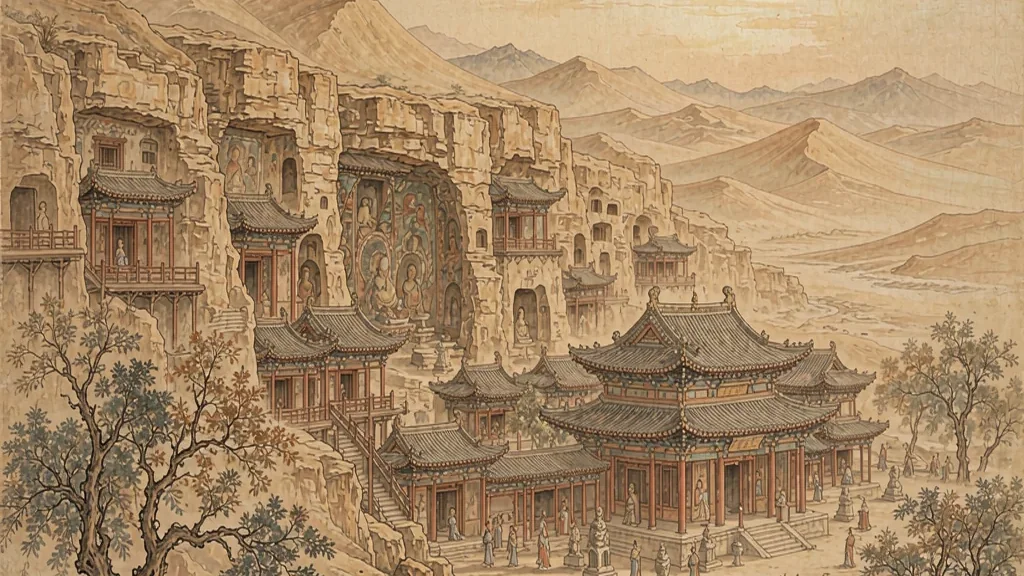
At the edge of the Gobi Desert, where the Silk Road once carried caravans laden with spices, silks, and scriptures, a cliff face honeycombed with hundreds of caves holds one of the greatest treasures of Buddhist civilization. The Mogao Caves (莫高窟, mò gāo kū), also known as the Thousand Buddha Grottoes, represent a millennium of continuous Buddhist artistic creation — a gallery of devotion that spans the Northern Wei through the Yuan dynasties. The story of Mogao is the story of Buddhism's journey across Asia, told in clay, pigment, and gold leaf.
The Vision of the Monk Yuezun
According to tradition, the first cave at Mogao was excavated in 366 CE by a Buddhist monk named Yuezun (乐尊). Traveling along the Silk Road, Yuezun saw a vision of a thousand Buddhas shimmering on the cliff face, bathed in golden light. Interpreting this as a divine sign, he began carving a cave for meditation and worship. Other monks followed, and over the centuries, the site grew from a single hermitage into the largest concentration of Buddhist art in the world.
The site's location was strategic. The oasis town of Dunhuang (敦煌), near the caves, was a major Silk Road crossroads where Chinese, Indian, Persian, Tibetan, and Central Asian cultures converged. Mogao became a spiritual service station for travelers: merchants commissioned cave paintings to earn merit for safe journeys, monks used the caves for retreat, and local rulers sponsored grand projects to demonstrate their piety and power.
The Library Cave: A Time Capsule of Medieval Asia
In 1900, a Daoist monk named Wang Yuanlu (王圆箓) discovered what would become the most sensational Buddhist find in modern history. Inside a sealed cave — now known as Cave 17, or the Library Cave — he found a hidden chamber packed with over 50,000 manuscripts, paintings, and textiles. This cache, sealed around the 11th century, contained texts in Chinese, Tibetan, Sanskrit, Sogdian, Uighur, and many other languages, representing the full diversity of Silk Road Buddhism.
The Library Cave was a library in the truest sense. It contained Buddhist sutras, commentaries, and liturgies, but also Daoist texts, Nestorian Christian documents, Manichaean scriptures, and secular contracts, letters, and tax records. The Diamond Sutra — dated to 868 CE — was found here, making it the world's oldest dated printed book. The cave was a cross-section of medieval Asian civilization, frozen in time.
The discovery attracted European explorers who, by the standards of the time, "collected" the manuscripts for Western museums. Aurel Stein, Paul Pelliot, and others removed thousands of items to London, Paris, Berlin, and St. Petersburg. Chinese scholars later criticized these expeditions as looting, and the dispersal of the Dunhuang manuscripts remains a sensitive issue in Sino-Western cultural relations. Today, the manuscripts are studied by scholars worldwide, and digitization projects are gradually making them accessible online.
The Evolution of Chinese Buddhist Art
The Mogao Caves document the evolution of Chinese Buddhist art across ten centuries. The earliest caves, from the Northern Wei (5th–6th centuries), show strong Indian and Central Asian influence. The Buddhas have round faces, heavy drapery, and the abhaya mudra (fearless gesture) typical of Gandharan and Mathuran sculpture. The murals depict jatakas — stories of the Buddha's previous lives — in vivid, crowded compositions that owe much to Indian painting traditions.
The Sui dynasty (581–618 CE) brought a shift toward Chinese aesthetics. The Buddhas become slimmer, the faces more elongated, the drapery more fluid. Ceiling decorations developed the complex "aperture ceiling" (zaojing) designs that would become a hallmark of Chinese Buddhist architecture. The short-lived Sui dynasty was a period of intense cave construction at Mogao, as the reunification of China stimulated religious patronage.
The Tang dynasty (618–907 CE) represents the golden age of Mogao. The caves grew larger and more elaborate, with monumental statues, intricate murals, and sophisticated iconographic programs. Cave 45, with its magnificent sculpture group of the Buddha and attendant bodhisattvas, exemplifies Tang artistry. The murals depict Pure Land scenes of breathtaking beauty — paradise imagined as a Chinese palace with lotus ponds, flying musicians, and radiant Buddhas.
After the Tang, the quality of Mogao art declined, though construction continued under Tibetan, Uighur, and Mongol rule. The Yuan dynasty (1271–1368) added a few caves in Tibetan Buddhist style, with fierce protector deities and mandala designs. By the Ming dynasty, the Silk Road had declined, Dunhuang was abandoned, and Mogao faded into obscurity, preserved by the desert climate that would ultimately save it for the modern world.
The Cave as Pilgrimage Destination
Throughout its active history, Mogao was not only a site of artistic creation but a living pilgrimage destination. Monks and lay devotees traveled for weeks across the desert to circumambulate the caves, make offerings before the Buddha images, and participate in the grand ceremonies that marked the Buddhist calendar. The caves were spaces of encounter — between the human and the divine, between the merchant and the monk, between the Chinese heartland and the cultures of the Silk Road.
The pilgrimage to Mogao was itself a form of practice. The arduous journey across the Gobi Desert, the arrival at the oasis of Dunhuang, the approach to the cliff face glowing in the setting sun — each stage of the pilgrimage was imbued with spiritual significance. For the pilgrim, the caves were not merely repositories of art but living presences of the Buddha, bodhisattvas, and celestial beings who inhabited the painted walls. To stand before a mural of the Western Pure Land was to glimpse paradise itself.
Preservation and the Modern Era
The Mogao Caves face constant threats from natural and human causes. Wind erosion undermines the cliff face. Salt crystallization damages the murals. Tourists bring humidity and carbon dioxide that accelerate deterioration. The Chinese government, in partnership with UNESCO and the Getty Conservation Institute, has implemented extensive preservation measures, including controlled visitor access, environmental monitoring, and structural reinforcement of the cliff.
Modern technology has become an ally in preservation. High-resolution digital photography has documented every cave in extraordinary detail, creating a virtual archive that serves both scholarship and public access. The "Digital Dunhuang" project allows anyone with an internet connection to explore the caves online, reducing the need for physical visits while expanding global awareness of the site.
Mogao was designated a UNESCO World Heritage site in 1987, recognizing its "unique artistic achievement" and "exceptional testimony to the civilization of ancient China." The site receives hundreds of thousands of visitors annually, each one walking the same corridors that monks, merchants, and pilgrims have walked for over sixteen centuries.
The Jataka and Sutra Murals
Mogao's walls are a picture-Bible of Buddhist narrative. Jataka tales show the Buddha's past lives of generosity — sacrificing his body to a hungry tigress, his blood to a pigeon — while 'sutra transformation' murals (经变) illustrate texts like the Lotus and the Pure Land sutras as vast celestial palaces. These images served as visual sermons for lay audiences who could not read, letting a pilgrim 'see' the doctrine at a glance. Their crowded, glowing compositions are among the most ambitious narrative paintings in world art. The murals thus functioned as a kind of public education, teaching karma, compassion, and the splendor of the buddha-lands to watchers who might never hear a sermon preached in words. The murals taught karma and compassion to watchers who might never hear a preached sermon in words.
Technique and Materials
The painters of Mogao ground lapis and malachite into the mineral blues and greens that still glow after a millennium, laying them over fluent ink outlines. They learned body-shading from India and Central Asia but rendered faces and drapery with Chinese brush freedom. Layers of repainting across centuries mean some caves hide earlier art beneath later overlays, a palimpsest scholars now study with imaging. The dry climate fixed these pigments, giving us a near-intact workshop of medieval Buddhist technique. To stand before a Tang-period wall at Mogao is to see a color and a line essentially as the painter laid them down, a rarity that makes the site a laboratory for the history of Asian painting. To stand before a Tang wall at Mogao is to see a color essentially as the painter first laid it.
Mogao in the Wider Network
Mogao was one node of a cave-temple tradition stretching across the Tarim basin and into the heartland at Yungang and Longmen. Its connection to the Silk Road brought Gandharan, Kashmiri, and Tibetan forms that were then localized, even as its own styles flowed back west in copied manuscripts. Pilgrims en route to India stopped at Dunhuang to copy and commission, making the cliff a way-station of the whole Buddhist world. This networked role is why the site speaks to both Chinese and Central Asian art history at once. The same wind that buried the Library Cave also preserved the paintings, so that a single oasis holds both the books and the pictures of a continent's faith. The same wind that buried the Library Cave also preserved the pictures, binding books and images in one oasis.
❓ Frequently Asked Questions
📝 Chinese Vocabulary
莫高窟 — : Mogao Caves; the "Peerless Caves" of Dunhuang.
敦煌 — : Dunhuang; the Silk Road oasis city near Mogao.
藏经洞 — : Library Cave; Cave 17, where thousands of manuscripts were found.
飞天 — : Flying celestial beings (apsaras); a common motif in Mogao murals.
本生故事 — : Jataka tales; stories of the Buddha's previous lives.
乐僔 — : monk Yuezun, traditional founder of the first cave
经变 — : jingbian, mural illustrations of sutras
供养人 — : donor portraits painted in the caves
🎉 Fun Facts
- The murals at Mogao, if laid flat, would cover about 45,000 square meters — roughly the size of six soccer fields.
- The oldest surviving Buddhist painting on paper was found at Mogao — a 5th-century illustration of the Buddha preaching.
- Pigments used at Mogao included lapis lazuli from Afghanistan, cinnabar from China, and gold leaf — making the caves breathtakingly colorful when first painted.
- The murals' jataka tales depict the Buddha's past lives of self-sacrifice, a genre Chinese painters developed to great narrative richness at Mogao.
- Donor portraits at Mogao record real Tang costumes and faces, a rare visual archive of medieval Chinese society.
- The site's art moved through phases — Northern Wei serenity, Tang opulence, and later Tibetan-Tangut styles — a millennium of taste on one cliff.