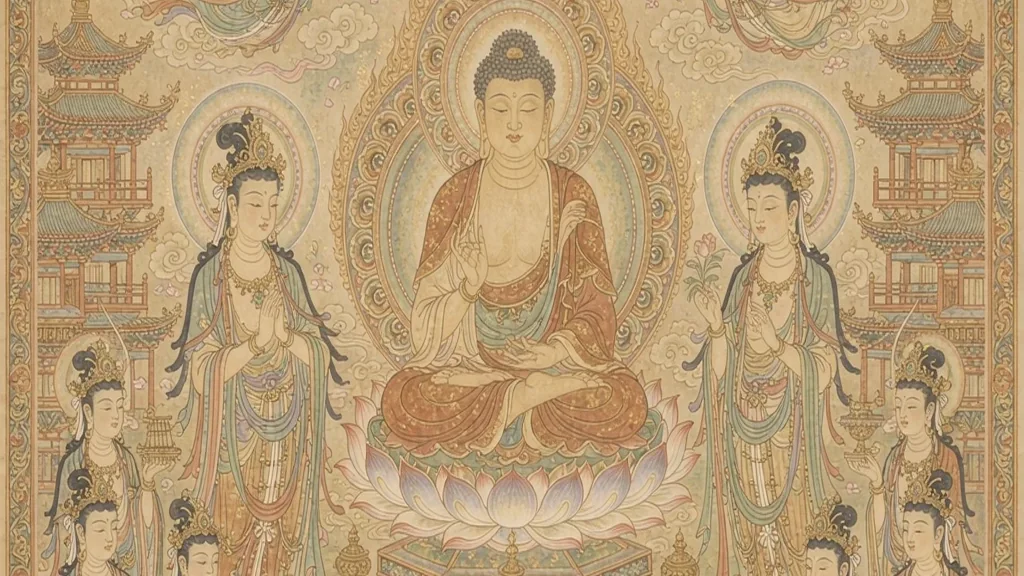
A Chinese Buddhist temple is not merely a place of worship — it is a total work of art, where architecture, sculpture, painting, and calligraphy converge to create an environment that is both aesthetically sublime and spiritually transformative. From the guardian kings who glare at the entrance to the serene Buddha who presides over the main hall, every element of the Buddhist temple is designed with a single purpose: to lead the visitor from the world of distraction into the presence of the sacred. Chinese Buddhist art is not art for art's sake; it is art as a vehicle of awakening, a visual Dharma that speaks directly to the heart.
The Buddha Image: From Symbol to Presence
The earliest Buddhist art avoided depicting the Buddha directly. In Indian aniconic tradition, the Buddha was represented by symbols — a footprint, a throne, a bodhi tree, a wheel. It was only in the Gandharan period (1st–5th centuries CE), under Greek-influenced sculptors in modern-day Afghanistan and Pakistan, that the Buddha began to be shown in human form. This Hellenistic Buddhist art traveled the Silk Road to China, where it underwent a profound transformation.
Chinese sculptors adapted the Indian Buddha image to Chinese aesthetic sensibilities. The round face, full cheeks, and serene expression of the Tang dynasty Buddhas reflect Chinese ideals of beauty and spiritual attainment. The mudras (hand gestures) were standardized: the earth-touching mudra (bhumisparsha), the meditation mudra (dhyana), the teaching mudra (dharmachakra), and the reassurance mudra (abhaya). Each posture and gesture has a specific meaning, creating a visual language that any educated Buddhist can read.
The iconography of Chinese Buddhist sculpture is remarkably consistent. The Buddha is always depicted with the 32 major marks of a great being (三十二相, sān shí èr xiāng), including the cranial protuberance (ushnisha), the urna (a curl of hair between the eyebrows), elongated earlobes (from his princely earrings), and webbed fingers. These marks are not merely decorative; they are visual representations of the qualities of Buddhahood — wisdom, compassion, omniscience, and the perfection of all virtues.
The Temple as Mandala: Architecture and Space
Chinese Buddhist temple architecture follows a highly codified plan. The temple complex is arranged along a north-south axis, with gates, halls, and pagodas placed in sequence. The visitor passes through multiple thresholds — the mountain gate (山门), the heavenly king hall (天王殿), the main Buddha hall (大雄宝殿), and finally the sutra library (藏经楼) — each threshold representing a stage on the Buddhist path.
The main hall is the architectural and spiritual heart of the temple. It houses the principal Buddha image — typically Sakyamuni, Amitabha, or Vairocana — flanked by bodhisattvas, disciples, and protectors. The ceiling is often decorated with a magnificent "aperture" (藻井, zǎo jǐng), a multi-layered square or octagonal design that draws the eye upward, symbolizing the aspiration toward enlightenment. The entire hall is designed as a three-dimensional mandala — a sacred diagram of the enlightened universe.
Chinese temple architecture is also deeply ecological. Temples are traditionally built in harmony with the natural landscape — nestled against mountains, facing water, and incorporating natural features such as springs, rocks, and ancient trees into the design. The Chinese Buddhist temple is not a building imposed on the landscape but a dialogue with it, a recognition that nature itself is a manifestation of the Dharma.
Pure Land Painting: Paradise Visualized
The most spectacular achievements of Chinese Buddhist painting are the Pure Land murals that adorn the walls of temples and cave temples. These paintings depict the Western Pure Land of Amitabha Buddha — a paradise of lotus ponds, jeweled trees, celestial music, and radiant light, where beings are born into the final stages of enlightenment. The murals are not merely illustrations; they are visualization aids, designed to help the practitioner imagine the Pure Land so vividly that they develop the faith and aspiration to be reborn there.
Tang dynasty Pure Land paintings, preserved at the Mogao Caves and elsewhere, are among the greatest works of Chinese art. The compositions are complex but harmonious, with hundreds of figures arranged in symmetrical patterns around the central Buddha. The colors — mineral blues, greens, reds, and gold — are astonishingly vibrant even after 1,200 years. The flying celestial beings (飞天) who scatter flowers and play music create a sense of joyful motion within the static image.
The technique of Chinese Buddhist painting was sophisticated. Artists used brushes made from animal hair, pigments ground from minerals and plants, and gold leaf for halos and ornaments. The murals were executed on plastered walls using the fresco secco technique — painting on dry plaster with a binding medium. Despite the fragility of the materials, the survival of these paintings is a testament to both the skill of the artists and the arid climate of the Silk Road region.
Calligraphy: The Art of the Sacred Word
Chinese Buddhist art is not limited to images. Calligraphy — the art of writing characters with brush and ink — holds a privileged place in Buddhist practice. The copying of sutras by hand (抄经, chāo jīng) is itself a meditative practice, a way of absorbing the Dharma through the body as well as the mind. The brush stroke, the ink flow, the rhythm of the character — all are forms of mindfulness training.
The Buddhist canon was transmitted largely through calligraphy. Before the invention of printing, every sutra was copied by hand, and monastic scriptoria employed skilled calligraphers who produced thousands of scrolls. The manuscripts discovered at Dunhuang reveal the extraordinary range of Chinese Buddhist calligraphy, from the meticulous regular script of professional scribes to the expressive cursive of Chan masters.
In the Chan tradition, calligraphy became a form of teaching. Masters like the Tang dynasty monk Huaisu (怀素) created wild cursive calligraphy that expressed the spontaneous, unconstrained nature of awakened mind. The erratic strokes, the uneven spacing, the ink that runs dry and then flows again — these are not accidental but intentional, a visual record of the mind's natural activity. Chan calligraphy is not about making beautiful characters but about expressing true nature.
Buddhist Art in the Modern World
Chinese Buddhist art continues to evolve. Contemporary artists work in both traditional and modern media, from ink painting and stone carving to installation art and digital media. The Beijing-based artist Xu Bing created Book from the Ground, a novel written entirely in pictograms that draws on Buddhist ideas about the universality of visual language. The Taiwan-based artist Li Chen produces bronze sculptures that reimagine Buddhist iconography in a contemporary idiom.
The preservation of traditional Buddhist art is a major priority. The Dunhuang Academy, the Datong Yungang Grottoes Research Institute, and the Longmen Grottoes Management Office employ teams of conservators who work to stabilize the ancient paintings and sculptures. Digital documentation projects create high-resolution records that will preserve these works for future generations even if the physical originals cannot be saved.
Chinese Buddhist art has also become a global heritage. Major museums in Europe, America, and Japan hold extensive collections of Chinese Buddhist sculpture and painting. The repatriation of looted Buddhist art remains a contentious issue, but the international appreciation of Chinese Buddhist art has also fostered cross-cultural understanding. In its highest expressions — the serene smile of a Tang Buddha, the cosmic vision of a Huayan mandala, the wild strokes of a Chan monk's calligraphy — Chinese Buddhist art speaks a universal language of beauty and awakening.
The Sinicization of the Buddha Image
Early Chinese Buddhist statues clearly show foreign roots. The first images followed the Gandhara and Mathura styles of northwestern India, with wavy hair, a toga-like robe, and strongly modeled bodies carried east along the Silk Road. As local workshops matured, artists softened these features: the face grew rounder and more Chinese, the robe fell in straight, flattened folds, and the expression turned serene and otherworldly. By the Tang dynasty the ideal Buddha was unmistakably East Asian, sometimes even modeled on imperial physiognomy. This slow transformation reveals a deeper process, the translation of an Indian faith into a Chinese visual language. The same image that once looked like a Mediterranean sage came to look like a local awakened being, at home in Chinese halls and hills.
The Expanding Pantheon
Chinese Buddhist art is crowded with figures far beyond the historical Buddha. Bodhisattvas such as Guanyin and Samantabhadra appear in flowing robes as beings of mercy and vow, while arhats, the enlightened disciples, are shown as individualized old monks with weathered faces and distinct moods. Guardian kings stand at temple gates in armor and fury, and celestial musicians spiral across ceilings. This rich cast grew as Buddhism absorbed local deities and as new scriptures promoted new protectors. Unlike the spare early Indian canon, Chinese temples became vast theatrical spaces where every being in the cosmos had a face and a place. The result is an art of abundance, inviting viewers into a populated sacred world rather than contemplation of a single form.
Cave Temples and the Sacred Landscape
Some of China's greatest Buddhist art was carved not in cities but into remote cliffs. At Dunhuang, Yungang, Longmen, and Maijishan, generations of monks and patrons cut chapels, statues, and painted corridors into living rock, turning mountainsides into scripture made stone. These sites were chosen for solitude and spiritual power, and their scale turned the natural landscape itself into a sacred text. Pilgrims traveled to them as to holy places, and the caves preserved art that city temples, repeatedly rebuilt, could not. Today they rank among the supreme achievements of Chinese art and are studied as records of changing style, devotion, and international exchange along the Silk Road. Their survival in the dry cliff environment is a gift to the modern world.
❓ Frequently Asked Questions
📝 Chinese Vocabulary
佛教艺术 — : Buddhist art.
三十二相 — : The 32 major marks of a Buddha.
藻井 — : Aperture ceiling; the decorated recessed ceiling of a Buddha hall.
飞天 — : Flying celestial beings (apsaras) in Buddhist art.
抄经 — : Sutra copying; the practice of hand-copying Buddhist texts.
石窟 — : Rock-cut cave temples, such as those at Dunhuang and Yungang, where Buddhist art was carved and painted into cliffs.
罗汉 — : Arhats, enlightened disciples of the Buddha often shown in groups of sixteen or five hundred in Chinese temple art.
经变 — : Jingbian, large narrative wall paintings that illustrate the stories and visions of a particular sutra.
🎉 Fun Facts
- The largest stone Buddha in the world is the Leshan Giant Buddha in Sichuan — 71 meters tall, carved in the 8th century from a cliff face.
- The colors used in Dunhuang murals were made from minerals like lapis lazuli (blue), malachite (green), cinnabar (red), and orpiment (yellow) — some imported from as far as Afghanistan.
- Chan master Huaisu (737–799 CE) was known to write calligraphy while drunk, producing some of the most admired "wild cursive" examples in Chinese history.
- The Yungang Grottoes in Shanxi preserve more than 50,000 Buddhist images, carved into sandstone cliffs by imperial workshops during the 5th century.
- Buddhist sculpture introduced the calm seated meditation pose and the radiant halo, visual ideas that later shaped Chinese portrayals of sages, immortals, and rulers.
- Many colossal Buddha statues were cut directly into a cliff face and designed to be walked around, turning the act of circumambulation into a miniature journey through the Buddhist cosmos.