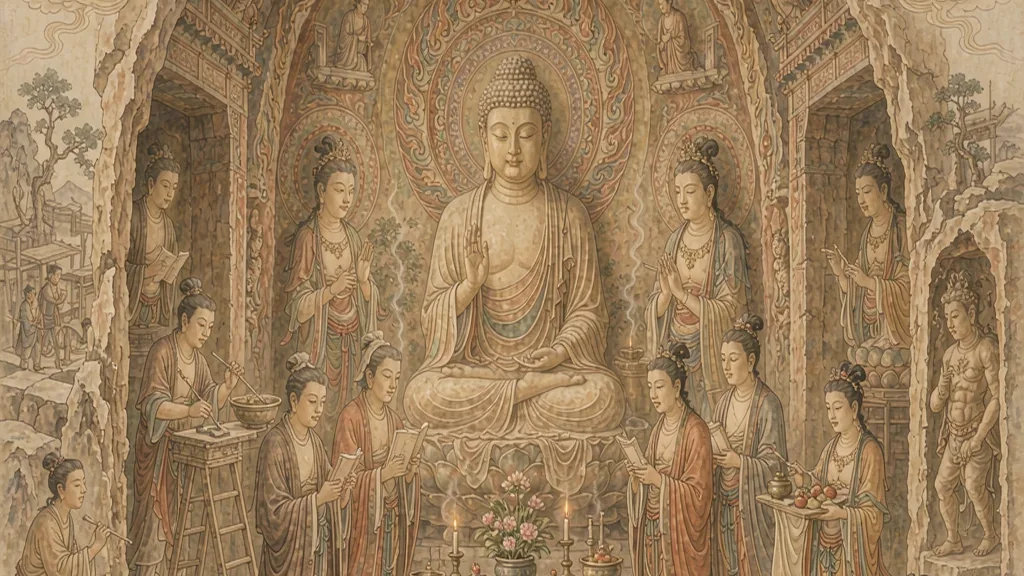
The cliffs outside the ancient city of Datong bear the marks of an empire's faith, carved into sandstone with a devotion that borders on obsession. The Yungang Grottoes (云冈石窟, yún gāng shí kū) are the surviving testament of the Northern Wei dynasty (386–534 CE), a non-Chinese ruling house that adopted Buddhism as its state religion and then set about rendering that faith in monumental stone. Here, against all expectations of Chinese artistic tradition, colossal Buddhas stare out from the rock face with an intensity that has not dimmed in fifteen centuries.
The Northern Wei: Barbarian Kings and the Buddha Dharma
The Northern Wei dynasty was founded by the Tuoba clan of the Xianbei people, a nomadic confederation from the steppes north of China. As foreign rulers of a Chinese population, the Tuoba emperors faced a persistent legitimacy problem. They turned to Buddhism as a universalizing ideology that transcended ethnic boundaries. Unlike Confucianism, which was deeply tied to Chinese identity and ancestral ritual, Buddhism offered a cosmopolitan faith that could unite Xianbei rulers, Chinese subjects, and Central Asian allies under a single Dharma.
Emperor Daowu (道武帝), the first Wei ruler, established Buddhism as the state religion in 398 CE. His successors built temples, patronized monks, and commissioned massive Buddhist projects. But it was Emperor Wencheng (文成帝, r. 452–465 CE) who, after a brief persecution, launched the Yungang project as a statement of Buddhist resilience. Under the guidance of the monk Tan Yao (昙曜), work began on what would become five caves of unprecedented scale — the famous Tan Yao Caves.
The Five Tan Yao Caves: Emperors as Buddhas
The five caves carved under Tan Yao's supervision (Caves 16–20) are the heart of Yungang. Each cave contains a colossal Buddha statue, ranging from 13 to 17 meters in height, that was consciously designed to resemble a reigning Northern Wei emperor. This was not mere flattery — it was political theology. The emperor was presented as a living Buddha, a cakravartin (universal monarch) who ruled the Dharma as well as the state.
Cave 20, the most photographed of the Yungang statues, depicts the seated Buddha Vairocana — the cosmic Buddha who illuminates the universe. The statue's face is broad, the eyes wide and staring, the drapery heavy and geometric. These features show strong Central Asian and Gandharan influence, a reminder that Northern Wei Buddhism was part of a transcontinental network of Buddhist culture stretching from India to China.
The identification of emperor with Buddha was not merely symbolic. The Northern Wei had recently experienced a violent persecution of Buddhism under Emperor Taiwu, and the Tan Yao Caves were designed to assert that Buddhism was indestructible — that even an emperor who destroyed temples could be succeeded by an emperor who was himself a Buddha. The caves were political theology carved in stone.
Chinese and Central Asian Fusion
Yungang's artistic style is distinct from other Chinese Buddhist cave sites because of the Northern Wei's Central Asian connections. The Yungang Buddhas have fuller faces, wider noses, and more pronounced facial features than the sinicized Buddhas of later periods. The mandorlas (aureoles) behind the statues are decorated with flames and small Buddha figures in a style derived from Gandharan art of modern-day Pakistan and Afghanistan.
The cave interiors are carved with thousands of smaller Buddhas, bodhisattvas, celestial musicians (apsaras), and donor figures. The famous "thousand Buddha" motif — rows of identical small Buddhas covering entire walls — creates an overwhelming sense of cosmic presence. The carved pillars and stupas within the caves show a fusion of Indian chaitya-hall architecture with Chinese wooden building traditions.
As the Northern Wei dynasty sinicized over the 5th and 6th centuries — adopting Chinese dress, language, and customs — the art at Yungang began to change. Later caves show slimmer Buddhas, more Chinese facial features, and drapery that follows the "wet cloth" style of Chinese Buddhist sculpture. Yungang thus documents the gradual transformation of a foreign religion into a Chinese one.
The Move to Longmen
In 494 CE, the Northern Wei moved their capital from Datong to Luoyang, deep in the Chinese heartland. With the capital moved, imperial patronage shifted to the Longmen Grottoes, which would become the next great Buddhist cave project. Yungang's period of intensive construction lasted only about 60 years (460–520 CE), making it a remarkably concentrated burst of artistic energy.
The move to Luoyang was part of the Northern Wei's broader sinicization policy. By relocating to the traditional Chinese heartland, the Tuoba rulers signaled their transformation from steppe conquerors to Chinese emperors. Yungang, located near the old northern capital, represented the earlier, more hybrid phase of this transition — a Buddhism that was still deeply connected to Central Asia.
After the Northern Wei split into Eastern and Western Wei in 534 CE, Yungang lost its imperial patrons. The site was used by local monks and occasional visitors but never again received state-sponsored construction. The elements gradually weathered the exposed sandstone, and many of the smaller carvings were eroded or obscured by later plaster and paint.
Rediscovery and Preservation
Yungang was largely forgotten by the wider world until the early 20th century, when foreign explorers and Japanese scholars surveyed and photographed the site. The Japanese Buddhist scholar Tokiwa Daijo and the art historian Sekino Tadashi published extensive documentation of Yungang in the 1920s, introducing the site to international scholarship.
The Chinese government undertook major preservation efforts in the 1950s and again in the 2000s. A protective shelter was built over Cave 20 to shield the iconic colossal Buddha from rain and wind. Modern environmental monitoring tracks the effects of pollution from Datong's industrial zone, which has accelerated the erosion of the soft sandstone. The site was designated a UNESCO World Heritage site in 2001.
Today, Yungang attracts over a million visitors annually. The contrast between the towering Buddhas and the gray industrial skyline of Datong is jarring, but it also highlights the enduring power of these sculptures. They were built as political and religious statements by a dynasty that has long since vanished. That they still stand, still staring into the distance, is a testament to the faith that carved them and the sandstone that preserved them.
Imperial Patronage and the Buddha-Kings
Yungang was a state project of the Northern Wei, a dynasty of Xianbei (Tabgach) origin that used Buddhism to legitimize foreign rule over Chinese subjects. The monk Tan Yao persuaded the court to carve the 'five caves' with enormous buddhas explicitly modeled on five reigning and past emperors, fusing kingship and buddhahood. This political theology — the ruler as living buddha — gave the caves their monumental scale and their urgency, making Yungang less a devotional site than a monument to dynastic authority sanctified by the faith. The colossi thus wear the calm faces of emperors, a bold claim that heavenly and earthly sovereignty were one and the same in the person of the ruler. The colossi wear the calm faces of emperors, a bold claim that heavenly and earthly sovereignty were one.
Technique and Decoration
The soft sandstone of the Yungang cliff let carvers achieve extraordinary detail, from the pleated robes of the colossi to the crowded bands of flying apsaras and jataka scenes in the later caves. Many surfaces were once painted and gilded, and the cave ceilings carry apsara and floral motifs borrowed from Central Asia. The cave-temple format — a central pillar or a seated Buddha in a rock-cut chamber — follows Indian prototypes adapted to local taste. The result is a workshop where imported and native habits of carving meet stone by stone. Because the stone was both workable and weather-prone, Yungang preserves a vivid but fragile record of how a frontier empire learned to render the Buddha in its own image.
From Yungang to Longmen
As the Northern Wei shifted its capital from Pingcheng (Datong) to Luoyang in 494, imperial patronage moved south, and the great age of Yungang carving gave way to the Longmen caves. Yet Yungang did not simply end; later, smaller caves were added under local and aristocratic sponsors, and the site remained active. Its early style became a reference point for Longmen's Northern Wei phases. Rediscovered and studied in the modern era, Yungang was named a UNESCO World Heritage site in 2001 as a key link in the chain of Chinese Buddhist rock art. The cliff thus marks a precise moment of transition, the place where the imported Buddha began, visibly, to become Chinese. The cliff marks the precise moment when the imported Buddha began, visibly, to become Chinese.
❓ Frequently Asked Questions
📝 Chinese Vocabulary
云冈石窟 — : Yungang Grottoes; the Northern Wei cave temples near Datong.
昙曜 — : Tan Yao; the monk who supervised the construction of the first five caves.
北魏 — : Northern Wei dynasty; the Tuoba Xianbei dynasty that built Yungang.
露天大佛 — : The "Open-Air Great Buddha" of Cave 20; Yungang's iconic image.
大同 — : Datong; the city where Yungang is located.
昙曜五窟 — : the five Tan Yao caves
石刻 — : stone carving
犍陀罗 — : Gandhara, the source of the western style
🎉 Fun Facts
- The smallest carvings at Yungang are only 2 centimeters tall, while the largest is 17 meters — a size difference of 850 times.
- Yungang's sandstone was originally painted in bright colors — red, blue, green, and gold — traces of which can still be seen in protected areas.
- The Northern Wei emperors who commissioned Yungang were themselves of Tuoba Xianbei ethnicity and wore distinctive nomadic dress, but they had themselves depicted as Buddhas in Chinese-style robes.
- The 'five Tan Yao caves' were carved under the monk Tan Yao with imperial funds as portraits of five Northern Wei emperors as buddhas.
- Yungang's earliest colossi show strong Gandharan and Central Asian features — wavy hair, robust bodies — before a Chinese style emerged.
- The site was cut into a sandstone cliff near the Northern Wei capital Pingcheng (modern Datong), using local soft stone easy to carve.