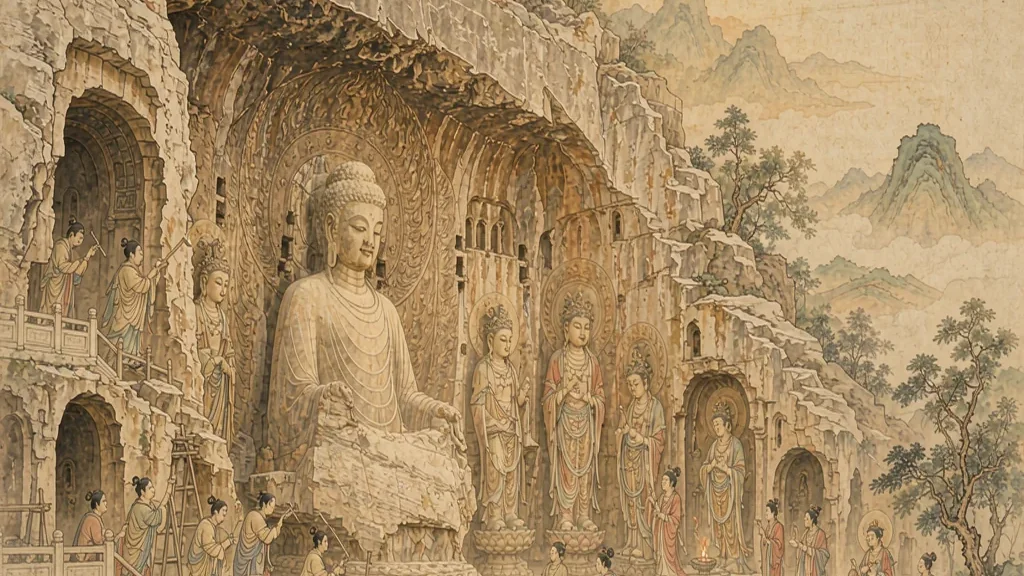
The Yi River flows silently past the southern outskirts of Luoyang, and on its western bank, a limestone cliff face has been transformed into a gallery of Buddhist devotion that rivals any monument on earth. The Longmen Grottoes (龙门石窟, lóng mén shí kū), carved over four centuries from the Northern Wei to the Tang dynasty, represent Chinese Buddhist art at its most refined. Unlike the fierce, monumental Buddhas of Yungang, the Longmen statues embody grace, serenity, and the confident sophistication of the Tang empire at its height.
The Northern Wei Foundation: Binyang and the Central Binyang Cave
When the Northern Wei dynasty moved its capital from Datong to Luoyang in 494 CE, the center of Buddhist cave construction shifted southward. The first major Longmen project was the Three Binyang Caves, commissioned by Emperor Xuanwu to honor his parents. The Central Binyang Cave (宾阳中洞) is the finest Northern Wei cave at Longmen, with a magnificent seated Buddha flanked by two bodhisattvas and two disciples in a composition of perfect symmetry.
The Binyang cave shows a marked stylistic evolution from Yungang. The Buddhas are slimmer, the faces more elongated and Chinese in feature, the smiles more subtle. The drapery falls in parallel pleats reminiscent of Chinese court robes rather than Indian monastic garb. The transformation of Buddhist art from Central Asian to Chinese idioms is complete here, in the early sixth century.
A tragic detail: the Binyang caves originally contained a massive relief panel depicting the imperial procession — emperor, empress, and courtiers — approaching the Buddha. In the 1930s, the panel was cut into pieces and sold abroad. Parts of it now reside in the Metropolitan Museum of Art in New York, the Nelson-Atkins Museum in Kansas City, and other Western museums, a painful reminder of a century of cultural losses.
The Tang Flowering: Fengxian Temple and the Vairocana Buddha
The crowning glory of Longmen is the Fengxian Temple (奉先寺), an open-air cave carved in the 670s under the patronage of Emperor Gaozong and his wife, the future Empress Wu Zetian. The central figure is a colossal seated Vairocana Buddha, 17.14 meters tall, that dominates the entire site. The face is serene, the eyes downcast, the lips curved in a faint smile that has been called the "Mona Lisa of Chinese sculpture."
The Vairocana at Longmen is more Chinese than Indian. The proportions are classical Chinese: the round face, the full cheeks, the arched brows, the small mouth. The drapery folds follow Tang dynasty courtly fashion rather than Indian monastic conventions. This is a Buddha who looks like a Tang emperor — which was precisely the intention. Contemporary inscriptions record that Empress Wu contributed a large sum of her cosmetic allowance to fund the statue, linking her piety directly to the greatest artistic achievement of Chinese Buddhism.
Flanking the central Buddha are two towering bodhisattvas, two disciples, and two celestial kings, each over 10 meters tall. The ensemble creates a heavenly court that mirrors the earthly court of the Tang emperors. The kings, with their armor and fierce expressions, protect the Dharma just as Tang generals protected the empire. The bodhisattvas, elegant and refined, represent the compassionate activity of enlightened beings in the world.
The Thousand Buddha and Ten Thousand Caves
Beyond the grand imperial caves, Longmen is filled with thousands of smaller niches, many commissioned by ordinary individuals — merchants, soldiers, monks, and nuns — who paid for a small Buddha image to earn merit for themselves or their families. The Longmen site contains over 2,300 caves and niches, 2,800 inscribed stelae, and more than 100,000 carved statues, ranging from the colossal Vairocana to figures only a few centimeters tall.
The practice of carving donor images was deeply rooted in Mahayana Buddhist merit culture. Every niche was accompanied by an inscription recording the donor's name, the date, and the intention — for the welfare of parents, for the rebirth of a deceased relative, for the peace of the empire. These inscriptions are invaluable historical sources, providing precise dates and personal details that allow scholars to trace the development of Buddhist practice across social classes.
The "Medical Prescription Cave" (药方洞, Cave Y) is one of the most unusual features at Longmen. This Tang dynasty cave contains over 140 inscribed medical prescriptions carved into the walls, covering treatments for everything from colds to mental illness. The combination of Buddhist images and medical texts reflects the intimate connection between monasteries and healing in medieval China, where monks often served as physicians.
Inscriptions and the Calligraphy of Faith
Longmen is famous not only for its sculpture but also for its inscriptions, which are considered masterpieces of Chinese calligraphy. The "Twenty Works of Longmen" (龙门二十品) are a selection of Northern Wei votive inscriptions that have been studied by calligraphers for centuries. The characters are carved with bold, angular strokes that show the transition from clerical to regular script in Chinese writing.
These inscriptions record the names, titles, and donations of Northern Wei aristocrats and officials. They also document official titles, family relationships, and Buddhist institutional structures, providing a detailed picture of how Buddhism operated at the highest levels of Wei society. For historians, the Longmen inscriptions are a database of medieval Chinese social and religious life in stone.
The Tang dynasty continued the inscription tradition. A famous tablet at the Fengxian Temple records the construction of the Vairocana Buddha, mentioning the involvement of Empress Wu and the names of the monks and officials who supervised the project. The calligraphy of the Tang inscriptions is more flowing and elegant than the Northern Wei examples, reflecting the changing tastes of Chinese literati culture.
Longmen in the Modern Age
Longmen suffered severe damage in the late 19th and early 20th centuries. Many heads were removed from statues and sold to collectors. Some figures were completely destroyed.
Today, Longmen is a UNESCO World Heritage site (designated 2000) and one of China's most visited cultural attractions. The site faces challenges from tourism, air pollution, and natural erosion. A major conservation program, supported by international partners, monitors the condition of the statues and implements protective measures. The site is equipped with a sophisticated environmental monitoring system that tracks temperature, humidity, and vibrations.
Despite the damage and the crowds, the Vairocana Buddha at Longmen remains one of the most powerful works of art ever created. Its serene smile, half-closed eyes, and perfect composure have inspired Buddhist practitioners and art lovers for over 1,300 years. In that smile, Tang dynasty China found its highest expression of the Buddhist ideal: wisdom and compassion united in perfect stillness.
The Binyang Caves
The Binyang complex, begun under the Northern Wei and finished with Tang patronage, is among Longmen's most important groups. Its central images and the famous 'Emperor's Procession' and 'Empress's Procession' relief slabs show rulers and courtiers in solemn devotion, blending political legitimation with piety. The carving is refined and the iconography follows the Northern Wei taste for slender, spiritualized figures. These caves demonstrate how the grottoes served not only worship but also the public display of imperial authority sanctified by Buddhism. The procession slabs in particular are prized as rare, large-scale images of Tang court life, a glimpse of emperors and empresses rendered not in paint but in enduring stone. The procession slabs are a rare, large-scale glimpse of Tang court life rendered in enduring stone.
Technique and Patronage
Longmen's sculptures were cut by teams of imperially sponsored artisans, monk-artists, and wealthy donors who paid for niches as merit. The hard limestone cliff allowed crisp detail but demanded great labor, and the scale of the work tracks the dynasty's wealth. Inscriptions record the names and wishes of patrons, from emperors to humble families, turning the cliff into a social document. This organized, state-linked production distinguishes Longmen from more spontaneously developed cave sites and explains its polished, courtly style. Where a site like Mogao grew from individual devotion along a desert cliff, Longmen was from the start an instrument of government, its buddhas shaped as much by chancery as by chapel. Where Mogao grew from devotion, Longmen was from the start an instrument of government and its gods.
Longmen After the Tang
After the Tang, Longmen's carving slowed as political centers shifted and later persecutions damaged monasteries. Yet the site remained a place of pilgrimage and, in the modern era, of scholarship and conservation. Many smaller later images and repairs were added, and the grottoes suffered from weathering and, in the early twentieth century, from looting of portable pieces. Designated a UNESCO World Heritage site in 2000, Longmen is now protected and studied as one of the supreme achievements of Chinese Buddhist stone art. The cliff today is both a museum of a thousand years of patronage and a cautionary record of how fragile even imperial piety becomes once the dynasty that sponsored it has fallen. The cliff is both a museum of patronage and a record of how fragile even imperial piety becomes.
❓ Frequently Asked Questions
📝 Chinese Vocabulary
龙门石窟 — : Longmen Grottoes; the "Dragon Gate" cave temples of Luoyang.
奉先寺 — : Fengxian Temple; the open-air cave with the giant Vairocana.
卢舍那佛 — : Vairocana Buddha; the Cosmic Buddha at Longmen.
宾阳洞 — : Binyang Cave; the main Northern Wei cave at Longmen.
龙门二十品 — : The Twenty Works of Longmen; famous Northern Wei calligraphic inscriptions.
北魏 — : Northern Wei dynasty, the caves' founders
唐代 — : Tang dynasty, the period of the great sculptures
武则天 — : Empress Wu, linked to the Fengxian colossus
🎉 Fun Facts
- The Fengxian Temple Buddha is over 17 meters tall, but its ears alone are 1.9 meters long.
- Empress Wu Zetian donated "two years of her cosmetic allowance" (a phrase recorded in the temple inscription) to complete the Vairocana statue.
- Longmen contains a "Medicine Cave" with over 140 ancient prescriptions carved in stone, offering treatments that included herbal remedies and Buddhist chanting.
- The Fengxian Temple's colossal Vairocana Buddha is traditionally said to be modeled on the face of Empress Wu Zetian.
- Longmen's 'Twenty Pieces' (龙门二十品) are among the most studied calligraphic inscriptions in Chinese art history.
- The site's cliff once held tens of thousands of carved Buddhist images, reflecting rulers' belief that piety secured the state.