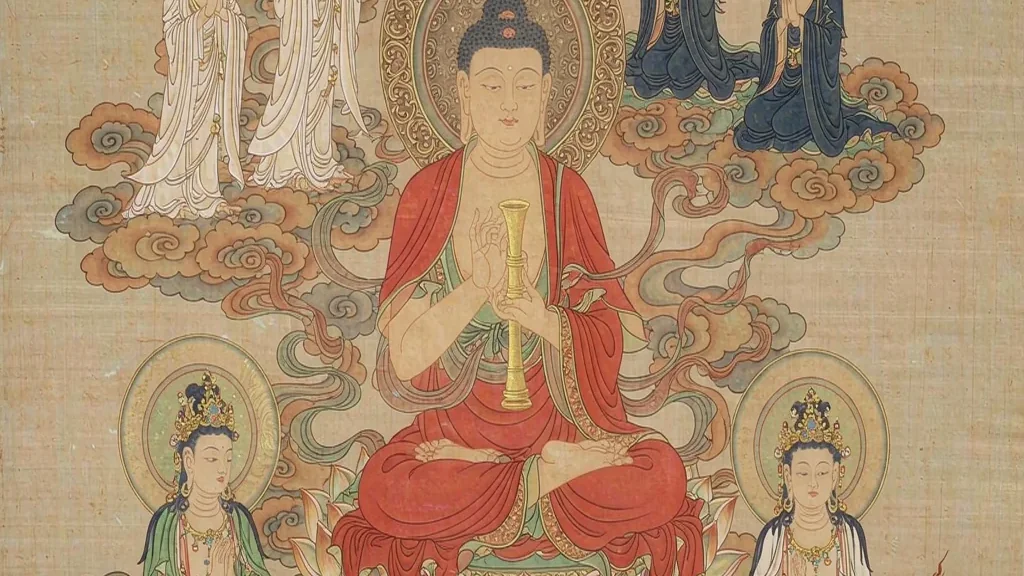
Chinese Buddhism did not arrive in a vacuum — it arrived with a full code of monastic law, and from the very beginning, Chinese Buddhists argued about how to follow it. The Vinaya school (律宗, lǜ zōng) centered on the precise observation of the vinaya, the monastic disciplinary code attributed to the historical Buddha. While other schools debated philosophy and enlightenment, the Vinaya masters focused on the seemingly mundane details of ordination, robe-wearing, meal times, and confession — because they believed that liberation itself depended on getting the rules exactly right.
The Four Major Vinaya Traditions in China
As Buddhist monasticism spread from India to China, several different vinaya recensions arrived, each claiming to represent the authentic tradition of the Buddha. Four major vinaya texts were translated into Chinese: the Dharmaguptaka Vinaya (四分律, Four-Part Vinaya), the Mahasamghika Vinaya, the Sarvastivada Vinaya, and the Mahishasaka Vinaya. The Dharmaguptaka Vinaya, translated by Buddhayashas and Zhu Fonian in 410 CE, eventually became the standard throughout East Asia.
The Dharmaguptaka Vinaya contains 250 precepts for fully ordained monks (bhikshus) and 348 precepts for nuns (bhikshunis), covering everything from prohibitions against killing and stealing to rules about the proper size of a monk's dwelling and the correct way to accept alms. These rules are divided into categories based on the severity of the offense, with the most serious — the four parajika offenses of killing, stealing, sex, and false claims of spiritual attainment — resulting in permanent expulsion from the order.
Daoxuan and the Founding of the Vinaya School
The Vinaya school as a distinct Chinese tradition was founded by Daoxuan (道宣, 596–667 CE), a monk of extraordinary erudition who established his community on Mount Zhongnan near Chang'an. Daoxuan wrote the Four-Part Vinaya Commentary (四分律删繁补阙行事钞), a massive work that clarified every aspect of vinaya practice for Chinese monastics. His commentary addressed practical questions that the Indian original had not anticipated: Could Chinese monks farm land? Could they own property? How should they interact with the imperial court?
Daoxuan's interpretation was notable for its rigor without rigidity. He recognized that the vinaya was a living tradition that required adaptation to Chinese conditions, and he provided principles for determining when strict adherence was necessary and when accommodation was permissible. His work became the standard text for vinaya study throughout China, Korea, and Japan. Daoxuan was also a historian of Buddhism — his Continued Biographies of Eminent Monks is an indispensable source for Tang Buddhist history.
Ordination and the Transmission of the Lineage
For the Vinaya school, the central ritual was the ordination ceremony (shòu jiè, 受戒), in which a candidate received the precepts from a quorum of fully ordained monks. The ceremony required a "three-fold invocation" and a valid boundary (sima) marking the sacred space. Without proper ordination, no one could legitimately claim to be a monk. The Vinaya school thus controlled the very definition of monastic identity in Chinese Buddhism.
Few issues proved more divisive in Chinese Buddhist history than the question of valid ordination lineages. During periods of persecution, when monasteries were destroyed, the transmission of precepts was broken. Some monks argued that valid ordination required an unbroken lineage of masters going back to the Buddha; others accepted "self-ordinations" or emergency procedures. The Vinaya school insisted on lineal continuity, and its masters traveled throughout China to conduct ordination ceremonies at monasteries lacking qualified preceptors.
The Bodhisattva Precepts: Expanding the Vinaya
In addition to the monastic vinaya, Chinese Buddhism developed a parallel tradition of bodhisattva precepts (púsà jiè, 菩萨戒), based on the Brahma Net Sutra (梵网经). These precepts were available to both monastics and laypeople and emphasized the bodhisattva's vow to save all beings. The ten major precepts — including not killing, not stealing, not lying, not slandering, and not praising oneself — were interpreted more broadly than their monastic counterparts.
The Vinaya school integrated the bodhisattva precepts into its ordination system, creating a two-tier structure: first, a candidate received the monastic precepts (biqiū jiè), and then they received the bodhisattva precepts as a mark of their Mahayana commitment. This synthesis of Hinayana vinaya and Mahayana ethics became the standard ordination procedure throughout East Asian Buddhism, showing that the Vinaya school was not merely preserving ancient rules but adapting them to larger spiritual goals.
The Vinaya School's Decline and Modern Revival
The Vinaya school reached its peak during the Tang dynasty but declined as an independent institution after the persecution of 845 CE. However, vinaya study never disappeared — it was incorporated into the training of monks in all schools, including Chan and Tiantai. Every monk needs to know the precepts. Even today, in Chinese Chan monasteries, the vinaya is studied during the first five years of monastic training before a monk is allowed to teach meditation.
In the twentieth century, the Vinaya school experienced a revival through the efforts of masters like Hongyi (弘一大师), who was a renowned artist and musician before becoming a monk and dedicating his life to vinaya study. His commentaries and his personal example of scrupulous discipline inspired a generation of Chinese monastics to take the precepts seriously. Today, the Baohua Mountain (宝华山) monastic center in Jiangsu Province continues as a major center for vinaya ordination, hosting mass ordination ceremonies multiple times each year.
The Four-Part Vinaya
The Vinaya school rests on the Four-Part Vinaya (四分律), a Dharmaguptaka code of monastic rules translated into Chinese that became the authoritative basis for ordination. It details the training rules for monks and nuns, the procedures for confession and restoration, and the layout of communal life. Daoxuan wrote commentaries that interpreted these rules for Chinese conditions, balancing strict fidelity to the Indian text with practical adaptation. The code's survival as the standard made the Chinese sangha's discipline continuous and recognizable across regions. Because the same rulebook trained monastics from Chang'an to Nagasaki, the Vinaya school quietly supplied the shared grammar of monastic life throughout East Asia. Because the same rulebook trained monastics from Chang'an to Nagasaki, the Vinaya supplied a shared grammar of life.
Precepts as Practice
Central to the school is the claim that the precepts are not a burden but the very form of the awakened life. Daoxuan taught that to keep the vow pure is already to manifest buddha-nature, so discipline and wisdom are one. The school also integrated the bodhisattva precepts (菩萨戒) with the monastic ones, so a monk trained both as a renunciant and as a compassionate savior of beings. This elevation of ethics turned rule-keeping into a contemplative path rather than dry legalism. The Vinaya master's daily recitation of the precepts became, in this view, a meditation on the shape of an awakened mind made visible as conduct. The daily recitation of the precepts became, in this view, a meditation on the shape of an awakened mind.
Ordination and Lineage Today
The Vinaya school's greatest lasting gift is the ordination lineage it preserved. Its ceremonies for 'receiving the precepts' (受戒) remain the model by which monks and nuns enter the order across the East Asian Mahayana world. Though the school as a separate institution declined after the Tang, its discipline survived inside every other tradition, and modern revival efforts have re-emphasized rigorous training at monasteries such as those on Mount Zhongnan. The precepts thus outlived the school that championed them. When a novice today receives the robe and the vow, the hands that place them are the inheritors of a line Daoxuan helped to fix fifteen centuries ago. When a novice receives the robe today, the hands that place it inherit a line Daoxuan helped fix centuries ago.
❓ Frequently Asked Questions
📝 Chinese Vocabulary
律宗 — : Vinaya School; the tradition focused on monastic discipline.
戒律 — : precepts and rules; the broader category of Buddhist ethical discipline.
比丘戒 — : monastic precepts; the full ordination vows for monks.
菩萨戒 — : bodhisattva precepts; the Mahayana ethical code for both monastics and laity.
受戒 — : receiving the precepts; the ordination ceremony.
道宣 — : Daoxuan, the founder of the Vinaya school
南山宗 — : the Nanshan (Southern Mountain) Vinaya school
四分律 — : the Four-Part Vinaya
🎉 Fun Facts
- Master Hongyi, the great modern vinaya revivalist, was also a pioneering Chinese oil painter and the composer of the famous song "Farewell" (送别).
- The Four-Part Vinaya used in China was preserved in a cave near Dunhuang and is one of the oldest complete vinaya manuscripts in existence.
- In some Chinese monasteries, monks still perform the "confession of transgressions" ritual every two weeks, as required by the vinaya — a practice unbroken for over 1,500 years.
- The Vinaya school is built on the Four-Part Vinaya (四分律), the version of monastic rules that became standard in China.
- Its founder Daoxuan also systematized the forms of Buddhist images and is honored as a regulator of monastic art.
- The school holds that observing the precepts purely is itself a path to awakening, not merely outward discipline.