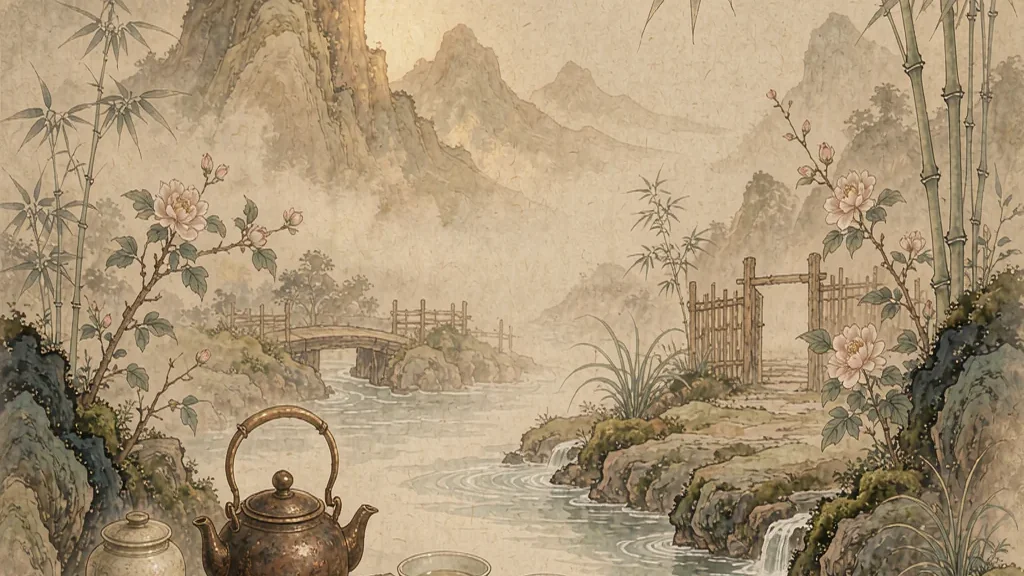
In a Chan monastery, the most ordinary act — that is, the act of drinking tea — is transformed into a ritual of awakening, a direct expression of the mind of the Buddha. The connection between tea and Chan Buddhism is so intimate that generations of Chinese scholars and monks have considered them two sides of the same coin: tea is Chan in liquid form, and Chan is the taste of tea. From the Tang dynasty to the present day, the tea ceremony has served as a vehicle for meditation, a medium for teaching, and a metaphor for the awakened life itself.
The Tang Dynasty: Lu Yu and the Tea Classic
The formal connection between tea and Chan was established during the Tang dynasty, a golden age for both. The pivotal figure was Lu Yu (陆羽, 733–804 CE), an orphan raised by a Chan monk at the Longgai Temple in Jingling. Lu Yu's experience of monastic tea culture inspired him to write the Classic of Tea (茶经, chá jīng), the world's first comprehensive treatise on tea. The work describes every aspect of tea — cultivation, processing, brewing, utensils, and drinking — with a systematic precision that reflects the influence of Buddhist scholarship.
Lu Yu's tea classic elevated tea drinking from a mundane practice to a refined art. He prescribed specific methods for each step: the water should be taken from a mountain spring, boiled to the precise stage where it resembles "fish eyes" (small bubbles) or "string of pearls" (larger bubbles), poured over the tea powder in a specific pattern, and drunk from a bowl of a particular color and shape. These detailed instructions created a ritual framework that would later develop into the formal tea ceremony.
Chan monasteries were the primary incubators of this tea culture. Monks drank tea to stay awake during long meditation sessions, and the preparation of tea became itself a form of meditation practice. The discipline of tea — measuring, heating, pouring, serving — required the same precise attention as seated meditation. Tea was not a break from practice but a continuation of it by other means.
Tea as Chan Teaching: The Taste of Awakening
Chan masters used tea as a teaching device. The famous saying "one taste of tea, one taste of Chan" (茶禅一味, chá chán yī wèi) expresses the identity of the two experiences. Both tea and Chan require direct, embodied experience: you cannot understand either by reading about them. You must taste them yourself. The simplicity of tea — just hot water and leaves — mirrors the simplicity of Chan: just awareness itself, without complications.
Many Chan teaching stories involve tea. A master might offer a student a cup of tea as a form of instruction. The way the student receives it — with grasping, with hesitation, with gratitude — reveals the state of their mind. The tea is not a metaphor for the teaching; the tea is the teaching. In the hands of a master, the act of pouring and receiving tea becomes a koan, a direct transmission of Dharma that bypasses words.
The Chan emphasis on "everyday mind" — the teaching that enlightenment is not a special state but the ordinary mind functioning freely — found its perfect expression in tea. Drinking tea when you are thirsty, sitting when you are tired, attending to each moment with complete presence — this is Chan. And there is no better training for this than the simple, repeated act of making and drinking a cup of tea.
The Tea Rooms of the Monasteries
Chan monasteries had dedicated tea rooms (茶寮, chá liáo) where monks gathered for formal tea ceremonies. These rooms were deliberately simple — often just a small building with a low table, cushions on the floor, and a few carefully chosen utensils. The simplicity was not poverty but intentional restraint, a visual expression of the Chan value of non-attachment.
The tea ceremony in a Chan monastery followed a strict protocol. The tea master prepared the tea with slow, deliberate movements — washing the utensils, measuring the leaves, pouring the water in a continuous stream. The monks received their bowls with both hands, bowed, and drank in silence. The ceremony might last an hour or more, with the same pot of tea yielding multiple infusions, each with a slightly different character.
The utensils themselves were objects of contemplation. The tea bowl, the bamboo whisk, the iron kettle, the ceramic tea caddy — each was chosen for its aesthetic qualities: the irregular glaze of a Jian ware bowl, the patina of an aged iron pot, the texture of a bamboo scoop. These objects were not luxury items but expressions of wabi-sabi — the beauty of imperfection, impermanence, and incompleteness that Chan aesthetics celebrated.
The Japanese Transmission: From Chan to Zen to Tea
The link between tea and Chan was transmitted to Japan along with Buddhism itself. Japanese monks who studied in Chinese Chan monasteries brought back not only the teachings but the tea practices they had learned. The great Japanese tea master Sen no Rikyu (千利休, 1522–1591 CE) systematized these practices into the Japanese tea ceremony (chanoyu), explicitly grounding it in Zen Buddhist principles.
Rikyu's tea ceremony embodies the Zen values of harmony (wa), respect (kei), purity (sei), and tranquility (jaku). Every aspect of the ceremony — the tiny tearoom, the rustic utensils, the prescribed movements, the shared bowl of tea — is designed to create a space in which host and guest can encounter each other and the moment with complete presence. The tea ceremony is, in Rikyu's words, nothing other than "boiling water, making tea, and drinking it" — but done with such attention that the ordinary becomes sacred.
The Japanese tea ceremony is a descendant of the Chinese Chan tea tradition, but it developed distinctive features: the separate teahouse, the garden path (roji), the kneeling posture, the thick and thin tea preparations. These differences reflect the Japanese aesthetic sensibility, but the spiritual foundations remain Chan. The student of tea, like the student of Chan, must learn to do less, to be more, and to taste directly.
Chinese Tea and Chan Today
In contemporary China, the connection between tea and Chan continues to be cultivated. Many monasteries still hold formal tea ceremonies, and lay practitioners often incorporate tea practice into their daily meditation. The revival of interest in traditional Chinese culture has brought new attention to the tea-Chan connection, with teahouses and tea schools offering courses in "Chan tea" (禅茶, chán chá).
The practice of "Chan tea" emphasizes mindfulness and presence over aesthetic perfection. The focus is not on performing the ceremony correctly but on being fully present in each moment — feeling the warmth of the bowl, smelling the fragrance of the leaves, tasting the first sip as if it were the first taste of your life. This is not a performance for others but a private practice of awakening.
For modern Chinese Buddhists, tea remains what it has been for over a millennium: a portable practice that can be done anywhere, a tool for mindfulness that is always available, a reminder that the awakened mind is not found in a special state but in the simple act of attending to this moment. As the old Chan saying goes: "When you drink tea, just drink tea."
Tea and the Body: Alertness in Practice
Chan monks did not drink tea for pleasure alone. Long sessions of seated meditation, often stretching past midnight, brought drowsiness and stiff limbs, and warm tea, mildly caffeinated and gently warming, was a practical remedy sanctioned by the rule against alcohol. The serving of tea became woven into the rhythm of the hall: a cup between sits revived the body and marked the passage of time without breaking concentration. In this modest way a plant from the southern hills entered the core of monastic discipline. Tea thus bridged physiology and spirituality, a daily medicine that also became a daily reminder to return to the present moment with the same care one gives a fragile bowl. What began as a practical antidote to sleep thus grew into a small daily sacrament of attention.
The Aesthetics of Chan Tea
The Chinese Chan approach to tea favored plainness over display. Bowls were often humble, glazed in dark earthy tones, and the setting was a quiet room rather than an ornate hall. The act was valued precisely because it was ordinary: boiling water, placing the leaves, pouring, and drinking, each done with unhurried attention. This appreciation for simplicity, spontaneity, and natural materials later fed directly into the Japanese tea ceremony, yet in China it remained closer to everyday life, practiced by monks and lay scholars alike without fixed ritual form. The aesthetic was not about beauty for show but about the quality of presence, the same principle that shaped Chan painting, calligraphy, and garden design. The plain tea bowl, in this view, was itself a kind of icon, honored precisely because it asked for nothing and pretended to be nothing.
Chan Tea in Literature and Society
Beyond the monastery, the bond between tea and Chan spread through Chinese culture. Scholar-officials adopted the monk's habit of tea as a companion to poetry, conversation, and quiet reflection, and Lu Yu's Classic of Tea gave the drink its first literate codification. Tea houses became places where literati met to compose verse and debate ideas in an atmosphere of restrained calm. Zen-inflected sayings such as tea and Zen are one flavor entered common speech, linking the beverage to a mood of composed awareness. In later centuries the trade in famous teas turned this spiritual association into an economic one, yet the old ideal persisted: a bowl of tea as a small, repeatable lesson in attention. The habit that began on the meditation cushion long outgrew the temple wall.
❓ Frequently Asked Questions
📝 Chinese Vocabulary
茶禅一味 — : "Tea and Chan are one taste"; the essential unity of tea and meditation.
茶经 — : The Classic of Tea; Lu Yu's treatise on tea.
陆羽 — : Lu Yu; the Tang dynasty tea master who wrote the Classic of Tea.
禅茶 — : Chan tea; tea preparation practiced as meditation.
茶寮 — : Tea room; the space in a monastery dedicated to tea ceremony.
吃茶去 — : Go have tea, the famous reply of the Chan master Zhaozhou to every question, used as a pointer to ordinary awakening.
赵州 — : Zhaozhou, a Tang-dynasty Chan master renowned for the have you had tea dialogue that became a classic teaching.
点茶 — : Diancha, the Song-dynasty whisked-tea preparation in which powdered tea is beaten with hot water into a froth.
🎉 Fun Facts
- The Japanese tea master Sen no Rikyu said that the tea ceremony is simply "boiling water, making tea, and drinking it" — but doing so with complete presence is enlightenment itself.
- Lu Yu's Classic of Tea describes thirty-two different types of tea utensils, including twenty-four that he considered essential for proper tea preparation.
- The Jian ware tea bowls preferred by Chan monks have a dark, glossy glaze that contrasts beautifully with the green tea — and the pattern of the glaze reveals whether the bowl was fired in a wood or coal kiln.
- Chinese folk wisdom lists seven daily necessities, firewood, rice, oil, salt, soy sauce, vinegar, and tea, with tea the only one also treated as an aid to meditation.
- In Chan monasteries a tea server moved through the meditation hall between sitting periods, offering a warm cup to keep practitioners alert through the long night.
- A Chan monastery often appointed a tea prefect whose sole duty was to prepare and serve tea to the community, a task regarded as genuine practice rather than mere chores.