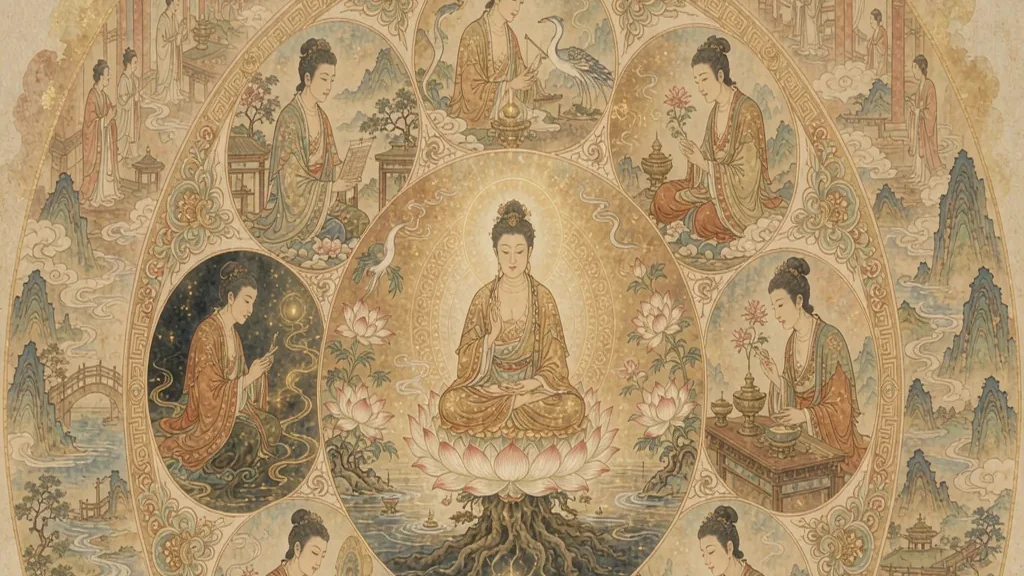
What if the entire world — mountains, rivers, stars, other people, even your own body — is nothing but a projection of your mind? This startling claim was not made by a science fiction writer but by the Weishi school (唯识宗, wéi shí zōng), also known as the Consciousness-Only or Yogacara school. Weishi developed a meticulous analysis of the mind that anticipated modern cognitive science by over a thousand years, mapping the architecture of consciousness into eight distinct levels and arguing that what we call "reality" is constructed entirely from mental impressions.
The Eight Consciousnesses: A Map of the Mind
Weishi's most distinctive teaching is the doctrine of the Eight Consciousnesses (bā shí, 八识). The first five are familiar: visual, auditory, olfactory, gustatory, and tactile consciousness — our sensory awareness of the world. The sixth is the mind-consciousness (mano-vijñana), which integrates sensory data into coherent perceptions, thinks, judges, and remembers. These six operate in the realm we normally experience as conscious awareness.
The seventh consciousness, called manas (末那识, mò nà shí), is the deep-seated sense of self — the persistent "I" that takes the eighth consciousness as its object and mistakenly identifies it as a permanent self. The eighth is the alaya-vijñana (阿赖耶识, ā lài yé shí), the storehouse consciousness, which contains all the seeds (bīja) of past actions — karma — that will ripen into future experiences. This eighth consciousness is the fundamental ground of existence, a streaming continuum of mental potentialities that manifests the entire world.
The Storehouse Consciousness and Karmic Seeds
The alaya-vijñana is perhaps the most sophisticated psychological concept in pre-modern Asian thought. It functions as a kind of karmic database: every action, word, and thought plants a seed in the storehouse. These seeds remain latent until conditions are right for them to sprout — that is, until the appropriate circumstances arise for the karmic result to manifest. The storehouse is not static; seeds are constantly being planted by current actions, and old seeds are constantly ripening into experiences.
This means that the world we experience is not external to us — it is the ripening of our own karmic seeds. Two people can be in the same physical location and have completely different experiences because their storehouse consciousnesses contain different seeds. A human being and an ant inhabit, in a real sense, different worlds — not because the external world is different but because their karmic conditioning causes them to perceive different aspects of it.
Xuanzang and the Transmission of Yogacara
The Weishi school in China is inextricably linked with the great pilgrim Xuanzang (玄奘, 602–664 CE). Xuanzang traveled to India not to find relics or magical powers but to resolve doctrinal disputes that had arisen from incomplete translations of Yogacara texts. He spent seventeen years in India, studying at the great monastery of Nalanda under the master Silabhadra, and returned to Chang'an with 657 Buddhist texts, including the foundational Yogacara works.
Upon his return, Xuanzang established a translation bureau, supported by Emperor Taizong, that set new standards for accuracy. His translation of Asanga's Yogacara-bhumi-sastra and Vasubandhu's Thirty Verses on Consciousness-Only became the core texts of Chinese Weishi. Xuanzang's disciple Kuiji (窥基, 632–682 CE) systematized the school's teachings, writing commentaries that defined Weishi orthodoxy for subsequent generations.
The Debate with Chinese Philosophy
Weishi's radical idealism provoked intense debate both with other Buddhist schools and with Chinese philosophical traditions. The claim that external objects do not exist — that a rock is merely a perception generated by the mind — conflicted with common sense, with the scientific worldview of the time, and with the realist assumptions of Confucianism. Weishi philosophers developed elaborate arguments to defend their position, distinguishing between the "seeds" that produce perceptions and the "manifestations" that appear as objects.
Critics from the Tiantai and Huayan schools argued that Weishi was too dualistic, positing a fundamental split between consciousness and its objects. They preferred a non-dualistic approach in which mind and world were mutually interpenetrating rather than one being the projection of the other. Chan masters simply dismissed the entire elaborate system as intellectual busywork: why analyze the mind into eight consciousnesses when the goal was to see through the mind altogether?
The Decline and Rediscovery of Weishi
Weishi flourished in the seventh century but declined rapidly after the death of Kuiji. Its complex taxonomy and demanding logical training made it a school for specialists, with little appeal to lay practitioners. The school virtually disappeared from China after the Tang persecution and was not revived for over a thousand years. Ironically, Weishi survived in Japan, where it was transmitted as the Hosso school, based at Kofukuji Temple in Nara.
In the late nineteenth and early twentieth centuries, Chinese Buddhists rediscovered Weishi through Japanese sources and through the work of scholars like Yang Renshan (杨仁山), who republished Weishi texts and established the "Consciousness-Only Studies" movement. Modern Chinese scholars have found striking parallels between Weishi's analysis of consciousness and Western phenomenology, cognitive science, and idealist philosophy, making the school a focus of renewed academic interest.
The Three Natures
Weishi explains experience through the 'three natures' (三性). The 'imagined nature' superimposes false distinctions on things; the 'dependent nature' is the mere rising of appearances from causes; the 'perfected nature' is reality as it is when illusion ceases. By analyzing how the mind constructs a seeming world, the school shows that emptiness is not nothingness but the absence of the false imaginings we project. This framework let Chinese Buddhists reconcile the Madhyamaka teaching of emptiness with a positive account of mind and liberation. The three natures gave the tradition a diagnostic tool: to see, in any moment, which layer of construction one was mistaking for the real, and so where to loosen the grip. The three natures gave the tradition a diagnostic tool for seeing which layer of construction one mistook for real.
Xuanzang's Synthesis
The monk Xuanzang (玄奘) is the school's carrier. After a perilous journey to India, he returned with a huge cargo of Yogacara texts and, with his disciple Kuiji, built a systematic Chinese exposition. His 'Cheng Weishi Lun' (Treatise on the Establishment of Consciousness-Only) became the school's cornerstone, organizing the eight consciousnesses and the three natures into a single architecture. Xuanzang's authority and translations gave Weishi a precision unmatched by earlier, looser transmissions of Indian psychology. The treatise remains the clearest statement of how a mind that seems to perceive an outer world is in fact weaving that world from its own stored tendencies, a claim as unsettling now as then. The treatise remains the clearest statement of how a mind weaves the world from its own stored tendencies.
Why Weishi Declined and Returned
Weishi was dense and demanding, and after the Tang it lost ground to the simpler, more devotional paths of Chan and Pure Land. Yet its categories never vanished: they reappeared in Huayan and Chan analyses of mind, and in the modern era the school was rediscovered by scholars as the most rigorous Buddhist psychology. Today its texts are studied for their detailed map of perception, memory, and karma, and 'consciousness-only' ideas inform contemporary discussions of mind and meditation across the Buddhist world. The school's fate is a reminder that a tradition can disappear as an institution yet survive as a vocabulary, quietly shaping how later Buddhists think about the self. Weishi's fate shows a school can vanish as an institution yet survive as a vocabulary that shapes later thought.
❓ Frequently Asked Questions
📝 Chinese Vocabulary
唯识宗 — : Consciousness-Only School; the Chinese Yogacara tradition.
阿赖耶识 — : alaya-vijñana; the storehouse consciousness.
八识 — : the eight consciousnesses; the Weishi map of the mind.
种子 — : bija or seed; karmic potentialities stored in the alaya.
玄奘 — : Xuanzang; the great translator and pilgrim who brought Weishi to China.
识 — : consciousness
转依 — : turning the basis, the goal of practice
三性 — : the three natures
🎉 Fun Facts
- Xuanzang's journey to India inspired the classic Chinese novel Journey to the West, in which he travels with the Monkey King, a pig demon, and a river monster.
- Weishi's concept of the storehouse consciousness has been compared to Carl Jung's idea of the collective unconscious, though the two theories have very different implications.
- Kuiji, Xuanzang's chief disciple, was known as the "Great Venerable Kuiji" and was rumored to have been a child prodigy who could recite sutras at age three.
- The school's name 'Weishi' means 'mere consciousness,' the claim that all experience arises from the transformations of mind alone.
- Xuanzang's journey to India and back was motivated largely by the need to master Yogacara theory and bring its texts to China.
- The 'storehouse consciousness' (阿赖耶识) is said to hold karmic seeds from beginningless time, like a vast repository shaping every rebirth.