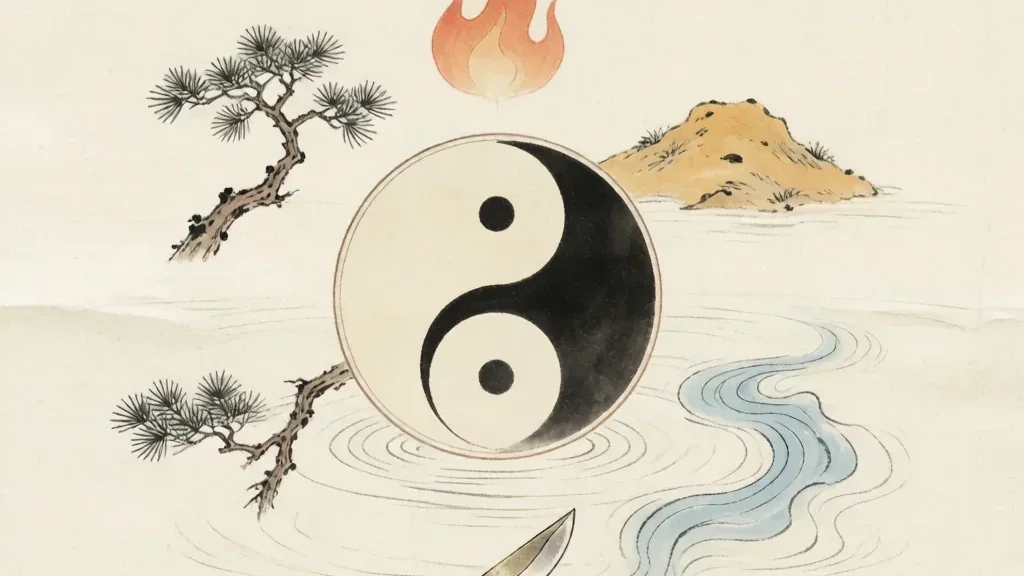
At the heart of Chinese thought lies a worldview so elegant, so intuitively compelling, that it has shaped everything from medicine to martial arts, from architecture to agriculture. This is the philosophy of Yin-Yang and the Five Elements (阴阳五行, yīn yáng wǔ xíng) — not a religion, not a superstition, but a systematic framework for understanding how the universe works. For over two millennia, it has offered a way of seeing the world not as a collection of separate things but as a web of dynamic relationships, where everything is connected, everything is in motion, and balance is the key to health, harmony, and wisdom.
Yin and Yang: The Dance of Opposites
The concept of Yin (阴) and Yang (阳) is one of the most recognizable symbols of Chinese culture. Yet its simplicity is deceptive. Yin and Yang are not dualistic opposites locked in eternal combat — they are complementary aspects of a unified whole. The original meaning of the characters is telling: Yin referred to the shady side of a mountain, Yang to the sunny side. The same mountain has both; they are not separate entities but different faces of the same reality.
This insight — that opposites are interdependent rather than antagonistic — is captured in the famous Taiji symbol (太极图, Tàijí tú), the swirling circle of black and white. Within the dark Yin half lies a dot of white Yang, and within the white Yang half lies a dot of black Yin. This represents the truth that nothing is purely one or the other: night contains the seed of dawn, rest prepares the body for activity, and every strength, carried to its extreme, becomes a weakness.
Yin is associated with darkness, cold, rest, receptivity, interiority, the moon, water, and the feminine. Yang is associated with light, heat, activity, creativity, exteriority, the sun, fire, and the masculine. But these are not fixed categories — they are relational. A cup is Yin relative to the hot tea it contains, but Yang relative to the cold table on which it rests. Context determines classification, and classification is always provisional.
The dynamics of Yin and Yang follow four fundamental principles: opposition (they are distinct), interdependence (each requires the other), mutual consumption (each can grow at the expense of the other), and mutual transformation (each can turn into the other). These principles govern everything from the changing of seasons to the rhythms of the human body. Winter (Yin) transforms into summer (Yang), which transforms back into winter. Activity (Yang) exhausts energy and creates the need for rest (Yin). The wise person learns to read these rhythms and harmonize with them rather than fight against them.
The Five Elements: A Dynamic System
If Yin-Yang describes the fundamental polarity of existence, the Five Elements (五行, wǔ xíng) describe the patterns by which things interact, transform, and relate to one another. The term xíng means "movement" or "phase" rather than a static "element" — a better translation might be "Five Phases" or "Five Processes." The Five Elements are not substances but dynamic states through which energy cycles.
The five are: Wood (木, mù), associated with spring, growth, the color green, the direction east, and the emotion of anger; Fire (火, huǒ), associated with summer, transformation, the color red, the direction south, and the emotion of joy; Earth (土, tǔ), associated with late summer, stability, the color yellow, the center, and the emotion of worry; Metal (金, jīn), associated with autumn, contraction, the color white, the direction west, and the emotion of grief; and Water (水, shuǐ), associated with winter, storage, the color black or dark blue, the direction north, and the emotion of fear.
The Generating and Overcoming Cycles
The Five Elements interact through two primary cycles: the Generating Cycle (相生, xiāng shēng) and the Overcoming Cycle (相克, xiāng kè). Understanding these cycles is essential to grasping how Chinese philosophy applies the elements to practical problems.
In the Generating Cycle, each element nourishes the next: Wood fuels Fire (you burn wood to make fire), Fire creates Earth (ash becomes soil), Earth bears Metal (ores are mined from the earth), Metal carries Water (metal surfaces condense water, and metal buckets carry it), and Water nourishes Wood (trees need water to grow). This cycle represents growth, support, and the natural progression of life — like a mother nurturing her child. When the generating cycle is functioning well, systems thrive.
In the Overcoming Cycle, each element controls another: Wood parts Earth (tree roots break through soil), Earth absorbs Water (dams and levees contain floods), Water extinguishes Fire, Fire melts Metal, and Metal chops Wood. This cycle represents restraint, regulation, and the necessary checks that prevent any one force from dominating. It is not destructive in a negative sense — think of it as the pruning that allows a tree to grow stronger, or the immune system that keeps pathogens in check. Without the overcoming cycle, systems become unbalanced and chaotic.
There is also a Weakening Cycle (相侮, xiāng wǔ), sometimes called the "insulting" cycle, which occurs when the normal order is reversed. If Water is too powerful, it can overwhelm Earth's ability to contain it (flooding). If Fire is too strong, it can evaporate Water faster than it can be replenished. This cycle describes pathological states — what happens when balance is lost.
Applications in Traditional Chinese Medicine
Perhaps the most sophisticated application of Yin-Yang and Five Elements theory is in Traditional Chinese Medicine (中医, zhōngyī). In TCM, health is defined as the harmonious balance of Yin and Yang within the body and the smooth flow of Qi (气, vital energy) through the meridian system. Disease arises when this balance is disrupted — too much Yang (excess heat, inflammation, restlessness) or too much Yin (cold, stagnation, lethargy).
The Five Elements are mapped onto the body's organ systems: Wood corresponds to the liver and gallbladder, Fire to the heart and small intestine, Earth to the spleen and stomach, Metal to the lungs and large intestine, and Water to the kidneys and bladder. A TCM diagnosis often involves identifying which element is out of balance. For example, someone with chronic digestive issues (Earth element) might be treated by strengthening the Fire element (which "generates" Earth in the generating cycle) or by addressing an overactive Wood element (which "overcomes" Earth in the controlling cycle).
This framework also informs dietary therapy, acupuncture, herbal medicine, and lifestyle recommendations. Foods are classified by their energetic properties — warming (Yang) or cooling (Yin) — and prescribed according to the patient's constitution and condition. An acupuncturist selects points along meridians associated with specific organs and elements, aiming to restore the proper flow of Qi. What appears from the outside as a collection of folk remedies is, in fact, a remarkably consistent theoretical system that has been refined over thousands of years of clinical observation.
Feng Shui, Martial Arts, and Daily Life
Beyond medicine, Yin-Yang and Five Elements theory permeates many other domains of Chinese culture. Feng Shui (风水, fēng shuǐ), the art of placement, uses these principles to harmonize buildings with their natural environment. The orientation of a house, the arrangement of rooms, the colors used in decoration — all are chosen to optimize the flow of Qi and balance the Five Elements. A south-facing door (Fire) brings warmth and vitality; a water feature in the east (Wood) promotes growth and new beginnings.
In martial arts, the interplay of Yin and Yang is fundamental. Tai Chi (太极拳, Tàijí quán) takes its very name from the Taiji symbol, and its slow, flowing movements embody the principle of softness overcoming hardness. A practitioner yields to an opponent's force (Yin) and redirects it (Yang), using minimal effort to achieve maximum effect. The Five Elements also appear in advanced martial arts systems — Xingyi Quan (形意拳), for example, has five fundamental movements, each corresponding to an element and its associated qualities.
Even in daily life, the Five Elements offer a framework for understanding ourselves and our relationships. The Chinese zodiac assigns an element to each year, creating a 60-year cycle (12 animals × 5 elements). People born in a Wood year are said to be creative and expansive; those born in a Metal year, disciplined and precise. Our Five Elements Calculator can help you discover your own elemental profile. The philosophy also influences cooking (balancing hot and cold foods), seasonal living (adjusting activities to the energy of each season), and even business strategy (knowing when to push forward with Yang energy and when to retreat and consolidate with Yin).
The Wisdom of Balance
What makes Yin-Yang and Five Elements philosophy so enduring is not its specific claims — many of which are pre-scientific — but its core insight: that reality is relational, dynamic, and interconnected. In a world that often seems fragmented and polarized, this ancient framework offers a different way of seeing. It suggests that opposites are partners rather than enemies, that change is natural rather than threatening, and that the highest wisdom lies not in choosing one side over another but in finding the dynamic balance between them.
As the Tao Te Ching reminds us: "Know the masculine, but keep to the feminine. Know the white, but keep to the black." This is not passivity — it is strategic wisdom. It is the recognition that to be effective in the world, one must understand the full spectrum of forces at play and learn to move with them rather than against them. Two and a half millennia after these ideas first took shape, they continue to offer a compelling vision of how to live — not by dominating nature, but by dancing with it.
The Turning of the Year
The yin-yang rhythm is written into the Chinese year. The traditional calendar marks twenty-four solar terms, from the first sprouts of spring to the depth of winter, each a step in the slow exchange of light and cold, growth and rest. Farming, festival, and diet followed this clock: plant when yang rises, gather and store as yin deepens, pause at the solstices to mark the turn. The scheme is not mystic arithmetic but close observation of a temperate land, codified so communities could act in season. It also trained a habit of mind, expecting decline to follow rise and rise to follow decline, so no fortune or misfortune was taken as final. To live by the turning year was to stay in step with the pair of forces said to move everything, a calendar that was also a cosmology worn lightly in daily habit.
A World Seen as Process
Seen broadly, yin-yang and the five phases offer a way of looking, a habit of reading any situation as a balance of moving qualities rather than a pile of fixed things. Heat and cold, activity and rest, fullness and emptiness are treated as relative and interchangeable, shifting with time and context. A thing is never simply good or bad but timely or untimely, in excess or in want. This made Chinese thought supple and relational: illness, politics, and weather could all be described in the same vocabulary of flux and proportion. The danger, critics note, is vagueness, a scheme that explains everything and predicts little. Yet its strength is exactly that plasticity, a reminder to seek the middle, to watch the trend, and to expect reversal. As a lens, it has outlasted the cosmology that birthed it, still shaping how the culture thinks about health and harmony.