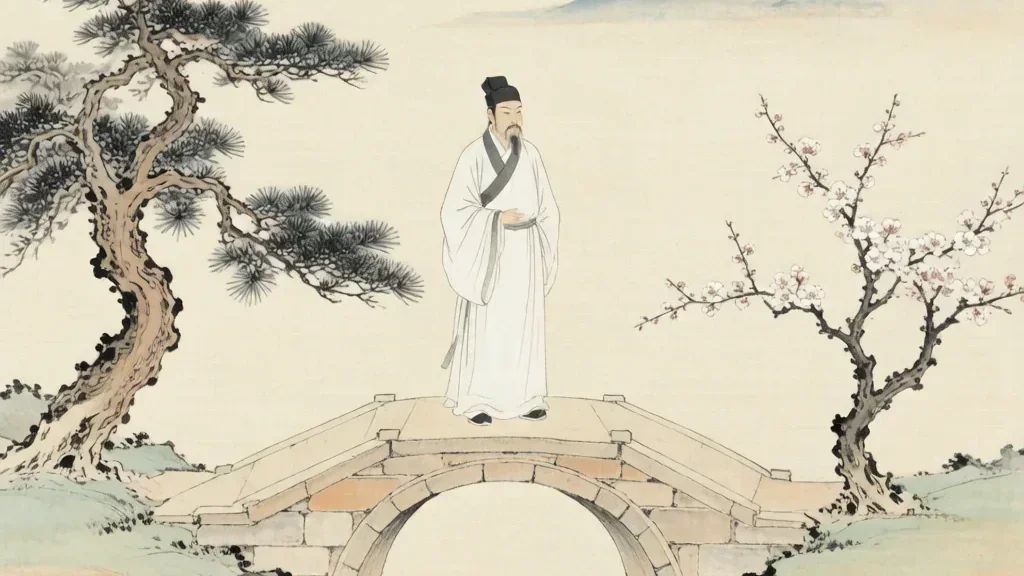
The Zhongyong (中庸), translated as "The Doctrine of the Mean" or "The State of Equilibrium and Harmony," is one of the most profound and philosophically dense texts in the Confucian canon. Originally a chapter in the Book of Rites (礼记), it was elevated to independent canonical status by the Song dynasty Neo-Confucian master Zhu Xi (1130–1200), who made it one of the "Four Books" (四书) that formed the core of Chinese education for nearly 700 years. Attributed to Zisi (子思, c. 483–402 BCE), Confucius's grandson, the Zhongyong articulates a vision of cosmic harmony in which the cultivated human being becomes a partner of Heaven and Earth, capable of transforming the world through the perfection of inner equilibrium. Far from the simple moderation that the English phrase "Doctrine of the Mean" might suggest, the Zhongyong presents a dynamic, creative philosophy of balance that influenced not only ethics and politics but also Chinese aesthetics, medicine, and spiritual practice for over two millennia.
Zisi and the Composition of the Zhongyong
The Zhongyong is traditionally attributed to Zisi (子思, c. 483–402 BCE), the grandson of Confucius and a pivotal figure in the early Confucian tradition. According to the "Records of the Grand Historian" by Sima Qian, Zisi studied under Confucius's disciple Zengzi (曾子) and later served as a teacher to Mencius, the second great Confucian philosopher. The text was originally one of the chapters of the "Book of Rites" (礼记, Liji), a massive compilation of ritual texts from the Warring States period. For over a thousand years it remained embedded in this larger work, studied primarily by specialists in ritual learning. The transformation of the Zhongyong from a minor ritual text to a central philosophical work was the achievement of Zhu Xi. Writing during the Song dynasty, Zhu Xi identified the Zhongyong as one of four essential texts that encapsulated the core of Confucian teaching. He extracted it from the Book of Rites, wrote a detailed commentary, and established it — together with the Analects, Mencius, and Great Learning — as the foundation of the civil service examination curriculum. This elevation of the Zhongyong was itself an act that embodied the text's spirit: the proper response to the intellectual crisis of the Song dynasty was not to abandon tradition nor to cling rigidly to it but to find the creative middle path that would revitalize the tradition for a new age.
The Philosophy of the Mean: Balance Without Stagnation
The term "zhongyong" describes an ideal that is neither mere moderation nor compromise but a dynamic equilibrium that responds appropriately to every situation. The text opens with a famous definition: "Before the feelings of pleasure, anger, sorrow, and joy are aroused, this is called equilibrium (中). When these feelings are aroused and each attains due measure and degree, this is called harmony (和). Equilibrium is the great root of the world, and harmony is its universal path." The zhongyong is thus not a fixed midpoint between extremes but a living, responsive attunement to the demands of each moment. The concept of "excess is as bad as deficiency" (过犹不及), famously articulated by Confucius in the Analects, finds its full elaboration in the Zhongyong. The text argues that virtues pushed to excess become vices: generosity without discrimination becomes favoritism; courage without wisdom becomes recklessness; caution without decisiveness becomes timidity. The zhongyong is the art of navigating between these poles, not by rigidly adhering to a mathematical midpoint but by developing the sensitivity to discern, in each unique situation, what the appropriate action requires. This requires a kind of practical wisdom that cannot be reduced to rules — it must be cultivated through study, reflection, and experience. The Zhongyong compares this wisdom to the skill of the archer: "The superior person's way is like archery — when the archer misses the center of the target, he turns inward and seeks the cause in himself."
The Five Relationships and the Graduated Path of Cultivation
The Zhongyong grounds its cosmic philosophy in the concrete realities of human relationship. The text identifies five universal relationships (五达道): ruler and minister, parent and child, husband and wife, elder and younger sibling, and friend and friend. For each relationship, the appropriate virtue is specified — benevolence between parent and child, righteousness between ruler and minister, distinction of roles between husband and wife, precedence between elder and younger, and trust between friends. These five relationships form the entire moral universe of Confucian ethics. The Zhongyong argues that the way to participate in the cosmic order is through the proper cultivation of these relationships — one does not transcend the human to reach the divine but enters into human life with the fullness of one's being. The ethical cultivation described in the Zhongyong proceeds through a graduated series of stages: self-discipline (修身), regulating the family (齐家), ordering the state (治国), and bringing peace to the world (平天下). This sequence became the foundational paradigm of Neo-Confucian moral cultivation and was adopted as the organizational framework for the "Great Learning" (Daxue), another of the Four Books. The Zhongyong's contribution to this paradigm is its insistence that each stage is not superseded but preserved: the sage who brings peace to the world remains the same person who cultivates discipline over his own thoughts and emotions. The universal is realized through the most intimate and personal. The text's most famous statement on this point is remarkably simple: "The Way is not separate from human beings; when human beings follow a Way that is separate from them, it is not the Way" (道不远人).
Modern Applications: Zhongyong in Contemporary Life
In the 20th century, the Zhongyong was criticized by Chinese reformers as a philosophy of compromise that had sapped Chinese vitality and encouraged passive acceptance of injustice. Lu Xun, the great modern Chinese writer, blamed the Confucian tradition for creating a culture of obedient conformity that had left China vulnerable to foreign exploitation. These criticisms have merit — the zhongyong ideal has been misused throughout history to justify conformity and suppress dissent. However, recent scholarship has offered a more nuanced assessment, recognizing that the Zhongyong's vision of dynamic equilibrium is very different from the static conformity for which Confucianism was criticized. In contemporary China, the concept of "harmonious society" (和谐社会) promoted by the Chinese government draws heavily on the Zhongyong's language of balance and social harmony, while environmental activists have found in the text a resource for thinking about humanity's relationship to nature. Psychologists and life coaches have adopted the zhongyong as a framework for emotional regulation and work-life balance. In business ethics, the Zhongyong's emphasis on balanced judgment and long-term perspective over short-term gain has been recognized as a valuable corrective to the extremes of unrestrained capitalism. The text's core insight — that true balance is not static but dynamic, requiring constant adjustment and fine-tuning in response to changing circumstances — speaks directly to the challenges of navigating a complex, rapidly changing world where rigid ideologies of left and right, tradition and progress, self and community all fail to capture the nuanced reality of human experience.
Sincerity as Cosmic Principle: The Metaphysics of Cheng
The Zhongyong's most distinctive philosophical contribution is its metaphysics of "cheng" (诚), translated as "sincerity," "authenticity," or "integrity." The text makes the astonishing claim that sincerity is not merely a human virtue but a cosmic principle: "Sincerity is the Way of Heaven; the attainment of sincerity is the Way of humanity." The universe itself is sincere — it does not pretend, it does not deviate from its nature, it is perfectly what it is. The sage who achieves sincerity aligns with this cosmic principle and becomes a "third power" alongside Heaven and Earth, capable of "assisting in the transforming and nourishing processes of Heaven and Earth" (参赞天地之化育). This is not mysticism in the sense of escaping the world but the opposite: it is the fullest possible engagement with the world, a state in which the sage's actions are so perfectly attuned to the nature of things that they become a force of creation. For nearly 700 years, from Zhu Xi's canonization of the Four Books in the 12th century until the abolition of the civil service examinations in 1905, every educated Chinese person memorized the Zhongyong, and its concepts — equilibrium, harmony, sincerity, the mean — permeated Chinese political philosophy, ethics, aesthetics, and daily life, offering a vision of human life as a dynamic, creative participation in the harmony of the cosmos.