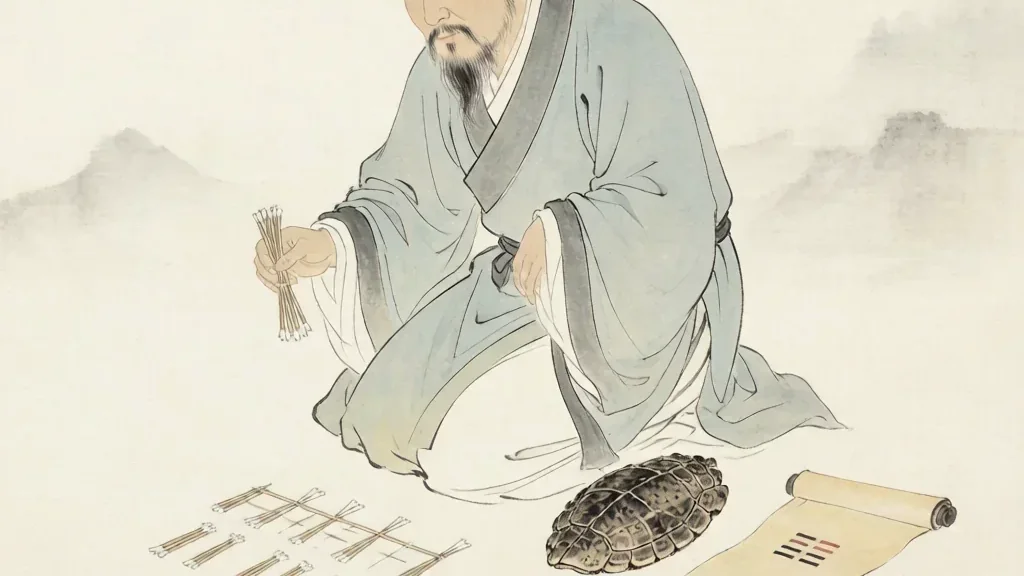
The Yijing (易经), or "Book of Changes," is the oldest of the Chinese classics and arguably the most influential text in the entire Chinese philosophical tradition. Originating as a divination manual during the Western Zhou dynasty (c. 1046–771 BCE), the Yijing evolved over centuries into a comprehensive cosmology that integrates mathematics, ethics, psychology, and metaphysics into a single unified system. Built around 64 hexagrams — figures composed of six lines, each either broken (yin) or solid (yang) — the text maps the fundamental patterns of change that govern the universe, human society, and individual life. For over 3,000 years, scholars, emperors, artists, and ordinary people have consulted the Yijing not merely to predict the future but to understand their place within the ceaseless flow of transformation. The text's remarkable endurance across millennia testifies to its extraordinary flexibility — it has been interpreted as a divination manual, a cosmological treatise, an ethical guide, and a source of poetic inspiration, adapting to the needs of each age while retaining its core insight into the nature of change.
The Origins of the Yijing and the 64 Hexagrams
The Yijing's origins lie in the divination practices of Bronze Age China. The earliest Chinese writing — the oracle bone inscriptions of the Shang dynasty (c. 1600–1046 BCE) — records questions posed to ancestors and deities through the cracking of heated turtle shells and ox scapulae. The Yijing represents a radical innovation: instead of reading cracks in bone, it uses a numerical system based on the manipulation of 50 yarrow stalks (蓍草) to generate one of 64 hexagrams. Each hexagram is composed of two three-line trigrams (卦), which are themselves combinations of yin (broken) and yang (solid) lines. The eight trigrams — Heaven (乾), Earth (坤), Thunder (震), Water (坎), Mountain (艮), Wood/Wind (巽), Fire (离), and Lake (兑) — represent the fundamental forces of the cosmos, and their pairing in the 64 hexagrams creates a complete vocabulary for describing every possible situation in human experience. The system is elegant in its economy: from just two principles (yin and yang) and three positions (bottom, middle, top) come eight trigrams; from eight trigrams combined in pairs come 64 hexagrams; and from the interactions between the six lines of each hexagram come the judgments and line statements that comprise the text. Tradition credits three culture heroes with the text's creation: Fu Xi (伏羲), the mythical first emperor, who devised the eight trigrams after observing the patterns of heaven and earth; King Wen of Zhou (周文王), who arranged them into 64 hexagrams while imprisoned by the Shang tyrant and composed the hexagram judgments; and the Duke of Zhou (周公), who added the line statements. While historians recognize that the text was composed by multiple anonymous authors over centuries, these traditional attributions express the text's status as a revelation of cosmic order channeled through China's wisest sages.
Yin-Yang Philosophy and the Logic of Change
The Yijing is the foundational text of yin-yang philosophy, the theory that all reality arises from the dynamic interplay of two complementary principles. Yin represents the receptive, dark, feminine, yielding, and contracting aspects of existence; yang represents the creative, light, masculine, firm, and expanding aspects. But yin and yang are not static categories or opposing forces — they are phases of a continuous process of transformation. Day turns into night, yang turns into yin; summer turns into winter, yang turns into yin; growth turns into decay, yang turns into yin. And within every yin condition, the seed of yang is already present, and vice versa — a truth symbolized by the dot of opposite color within each half of the taijitu (太极图), the familiar yin-yang symbol. The Yijing hexagrams capture this dynamic interplay at the level of specific situations. The first hexagram, Qian (乾, The Creative), composed of six unbroken yang lines, represents pure creative energy — but even within this supremely yang configuration, the movement of the hexagram's changing lines reveals the inevitability of transition. The sixth line's judgment — "Arrogant dragon will have cause to regret" — warns that yang pushed to its extreme must turn into its opposite. Similarly, the second hexagram, Kun (坤, The Receptive), composed of six broken yin lines, represents pure receptive power — but its top line speaks of dragons fighting in the wild, signaling the emergence of yang even within the deepest yin. This dialectical logic — that every situation contains the seed of its own opposite, that extreme development of any quality triggers its transformation into its complement — is the philosophical core of the Yijing and the basis of its enduring power as a tool for understanding change.
Divination Methods: From Yarrow Stalks to Coins
The traditional method of consulting the Yijing uses 50 yarrow stalks (蓍草), though most modern practitioners use three coins — a method introduced during the Han dynasty. The yarrow stalk method is a complex ritual procedure that takes approximately 20 minutes per consultation. Forty-nine stalks are used (one is set aside to represent the undifferentiated Dao), and through a series of divisions and counting, the hexagram is built line by line from bottom to top. The coin method is simpler: three coins are tossed six times, and each toss generates one line based on the balance of heads and tails — three heads produces a yang changing line, two heads and one tail produces a yang line, one head and two tails produces a yin line, and three tails produces a yin changing line. The practice of "moving lines" adds another dimension: if a line is "changing" (old yang or old yin), it transforms into its opposite, generating a second hexagram that shows the direction of change. The first hexagram represents the present situation; the second represents the emerging future. This transformation mechanism is the heart of the Yijing's system — it captures the insight that every situation contains the seeds of its own transformation. The moment of change is considered the most meaningful and revealing point in the consultation, as it identifies the specific forces actively reshaping the situation.
The Influence of the Yijing on Chinese Culture and Beyond
The Yijing's influence pervades every aspect of traditional Chinese civilization. In Chinese medicine, the theory of yin-yang and the five phases derived from Yijing cosmology forms the basis of diagnosis and treatment. In Chinese martial arts, Tai Chi Chuan's movements are directly inspired by the Yijing's hexagrams, and the push-hands practice of feeling and responding to an opponent's energy is a direct application of Yijing principles of yielding and redirection. In Chinese painting and calligraphy, the brushstrokes are described in terms of yin and yang qualities — the firm, angular strokes of yang and the soft, flowing strokes of yin. The text also shaped Chinese political theory, where the "Mandate of Heaven" (天命) — the idea that rulers could lose the right to govern through misrule — is derived from the Yijing's teaching that excessive yang (tyranny) must turn into yin (collapse). Beyond China, the Yijing captured the imagination of thinkers worldwide. Gottfried Wilhelm Leibniz (1646–1716) saw in the hexagrams' binary structure a confirmation of his binary arithmetic, writing to a Jesuit missionary in China: "This is the key to all science." Carl Jung (1875–1961) wrote a celebrated foreword to the Richard Wilhelm translation, interpreting the Yijing through his concept of synchronicity. The composer John Cage used the Yijing to generate musical scores, while physicist Niels Bohr found in the yin-yang symbol a perfect representation of his complementarity principle. In the 20th and 21st centuries, the Yijing has been embraced by Western counterculture, psychotherapists seeking alternatives to Freudian analysis, business strategists looking for flexible decision-making frameworks, and a global audience of individuals seeking wisdom and self-understanding. The text's remarkable adaptability — its capacity to speak to readers across vast cultural and historical distances — confirms its central teaching: that change is the only constant, and wisdom lies not in resisting transformation but in learning to ride the currents of change with clarity, courage, and grace.