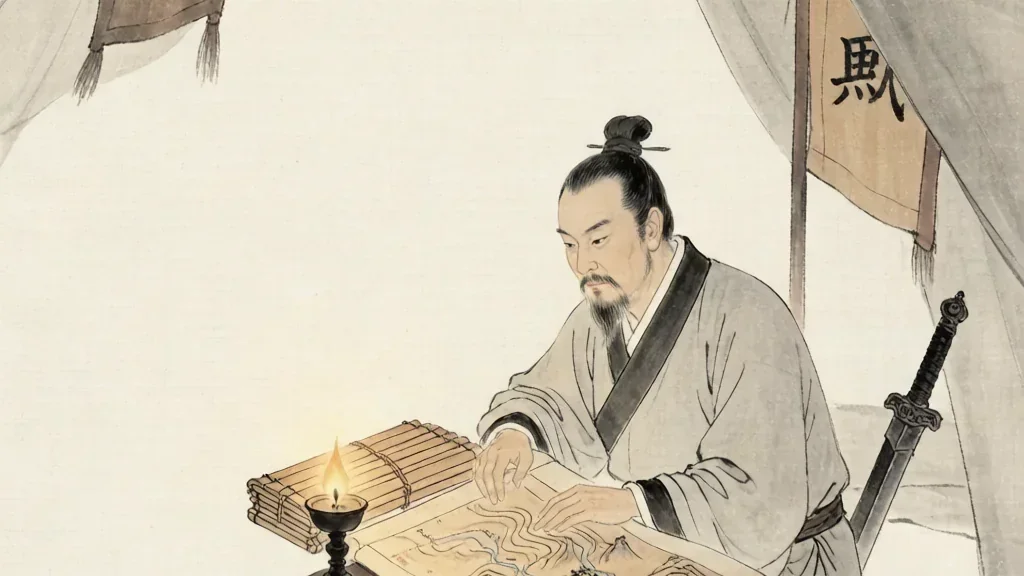
The Sunzi Bingfa (孙子兵法), known universally as "The Art of War," is the most influential military treatise ever written and one of the most widely read books in the world. Attributed to the Chinese general and strategist Sun Wu (Sun Tzu), who lived during the late Spring and Autumn period (c. 544–496 BCE), this compact text of just 13 chapters and approximately 6,000 Chinese characters has shaped military thinking across East Asia for two and a half millennia and, since its introduction to the West in the 18th century, has influenced everyone from Napoleon to modern Silicon Valley CEOs. Its genius lies not in tactical details — it contains no diagrams of formations or specifications for weapons — but in its profound insights into the psychology of conflict, the nature of information, and the art of winning without fighting. The text's remarkable endurance across three millennia and countless social transformations testifies to the universality of its strategic insights, which speak to any situation in which competing wills must navigate uncertainty, deception, and risk.
The Thirteen Chapters: A Systematic Framework for Strategy
The Art of War is organized into thirteen chapters, each addressing a distinct aspect of military strategy in a logical sequence that mirrors the process of planning and executing a campaign. Chapter 1, "Estimates" (始计), establishes the five fundamental factors — the Way, Heaven, Earth, Command, and Method — that must be assessed before any military action. Chapter 2, "Waging War" (作战), addresses the economic costs of conflict, emphasizing the importance of speed: "There has never been a protracted war from which a country has benefited." Chapter 3, "Attack by Stratagem" (谋攻), contains the text's most famous strategic principle: to subdue the enemy without fighting is the highest excellence. Chapters 4 and 5, "Tactical Dispositions" (军形) and "Strategic Military Power" (兵势), develop the relationship between form (xing) and force (shi) — the visible configuration of forces and the invisible potential energy that can be released through skillful positioning. Chapter 6, "Weak and Strong Points" (虚实), teaches the art of attacking vulnerabilities while concealing one's own weaknesses. Chapters 7 through 11 address the practical challenges of maneuvering, adapting to changing circumstances, and fighting on different types of terrain. Chapter 12, "The Attack by Fire" (火攻), discusses the use of fire weapons and, more importantly, the ethical restraint that must govern the use of destructive force. Chapter 13, "The Use of Spies" (用间), concludes with a sophisticated analysis of intelligence gathering that identifies five categories of spies and insists that the highest achievement of generalship is to "know the enemy" through human intelligence.
Know Yourself, Know Your Enemy: The Foundation of Victory
The Art of War's most famous dictum, "Know the enemy and know yourself, and in a hundred battles you will never be in peril" (知彼知己,百战不殆), encapsulates its epistemology of warfare: victory is primarily a function of information and self-awareness, not brute force. The principle operates on multiple levels. At the most basic level, it means gathering intelligence about the enemy's dispositions, capabilities, and intentions. But Sunzi extends "knowing" far beyond factual intelligence. To "know yourself" means understanding your own forces' strengths and weaknesses, the state of your logistics, the morale of your troops, and the degree of your ruler's support. To "know the enemy" means understanding not only their numbers and positions but their commander's character, their morale, their alliances, and their strategic assumptions. Sunzi even extends the principle to encompass knowing the terrain, the weather, and the timing of operations — a holistic assessment that anticipates modern concepts of situational awareness. The corollary of this emphasis on knowledge is a corresponding emphasis on deception: if knowledge is the key to victory, then the denial of knowledge to the enemy is equally important. "All warfare is based on deception" (兵者,诡道也) opens the chapter on strategic assessments, advising that a capable commander feigns incapacity, a near army appears distant, and bait is offered to lure the enemy into mistakes. Deception is understood not as a morally questionable tactic but as a rational response to the fundamentally uncertain nature of conflict.
Winning Without Fighting: The Supreme Excellence
Sunzi's most radical principle is the doctrine of "winning without fighting" (不战而屈人之兵): "To win a hundred victories in a hundred battles is not the highest skill; to subdue the enemy without fighting is the highest skill." This principle operates at every level of strategy. At the highest level, it means achieving one's objectives through political, diplomatic, or economic means that render armed conflict unnecessary — the ideal outcome is to break the enemy's resistance before a battle is ever fought. At the operational level, it means using maneuver, deception, and psychological operations to create conditions in which the enemy surrenders or retreats without a costly engagement. At the tactical level, it means concentrating overwhelming force at the decisive point so that resistance is futile. The philosophical foundation of this principle is Sunzi's understanding of war as a means to an end, not an end in itself. War is costly, uncertain, and destructive, and even victory can be a form of defeat if the costs exceed the gains. The highest form of generalship is therefore to achieve the strategic objective — the submission of the enemy's will — with the minimum expenditure of resources. This principle has found profound resonance in modern contexts ranging from nuclear deterrence theory to non-violent resistance movements to corporate competitive strategy. The Cold War doctrine of Mutually Assured Destruction — in which the threat of overwhelming retaliation prevented direct conflict between superpowers — was a direct application of Sunzi's insight that the highest strategic achievement is to create conditions under which war is never actually fought.
Business Applications: Sunzi in the Boardroom
The Art of War's application in business strategy has been particularly extensive and has transformed Sunzi into one of the most frequently cited authors in management literature. The text's emphasis on knowing both oneself and one's competition became foundational to the SWOT analysis framework (Strengths, Weaknesses, Opportunities, Threats) that dominates MBA curricula worldwide. Sunzi's principle of winning without fighting has inspired business strategists to seek competitive advantages that make direct competition unnecessary, such as creating new market spaces or cultivating customer loyalty that insulates against competitors' attacks. The Chinese e-commerce founder Jack Ma has explicitly cited Sunzi as an influence, noting that Alibaba's strategy of competing with eBay in China — by focusing on small and medium enterprises rather than copying eBay's auction model — reflected Sunzi's principle of avoiding the enemy's strengths and attacking their weaknesses. In negotiations and sales, Sunzi's emphasis on deception and information asymmetry has been adapted into frameworks for managing competitive intelligence and strategic signaling. The chapter on "Weak and Strong Points" has proven especially influential, with business strategists applying its insights about avoiding strength and attacking weakness to everything from product positioning to market entry. The Japanese electronics giant Matsushita (Panasonic) required all managers to study The Art of War, and the text's influence is visible in Japanese business practices ranging from just-in-time inventory (a strategy of speed and flexibility that Sunzi would recognize) to the emphasis on long-term market position over short-term profit. Sunzi's test for competition — "If you know the enemy and know yourself, you need not fear the result of a hundred battles" — has become a mantra in corporate strategy rooms from Beijing to Boston, applied to everything from product launches to hostile takeovers.
Global Influence: From Battlefield to Boardroom
The Art of War was transmitted to Japan as early as the 8th century, where it profoundly influenced the samurai military tradition — Takeda Shingen, the great 16th-century warlord, adopted Sun Tzu's phrase "swift as the wind, gentle as a forest, fierce as fire, immovable as a mountain" as his battle standard. The text reached Europe in 1772 through a French translation by the Jesuit missionary Joseph-Marie Amiot, and Napoleon is said to have studied it. During the Vietnam War, General Vo Nguyen Giap applied Sun Tzu's insights to defeat both French and American forces. In the 21st century, the text's principles continue to be studied at military academies worldwide and have found applications in fields as diverse as sports coaching, political campaigning, and game theory. The Art of War's global popularity — it has been translated into over 30 languages and appears on recommended reading lists from the US Army War College to the Harvard Business Review — testifies to the enduring power of Sun Tzu's strategic insights and the remarkable adaptability of principles derived from the study of conflict to almost any domain of competitive human activity.