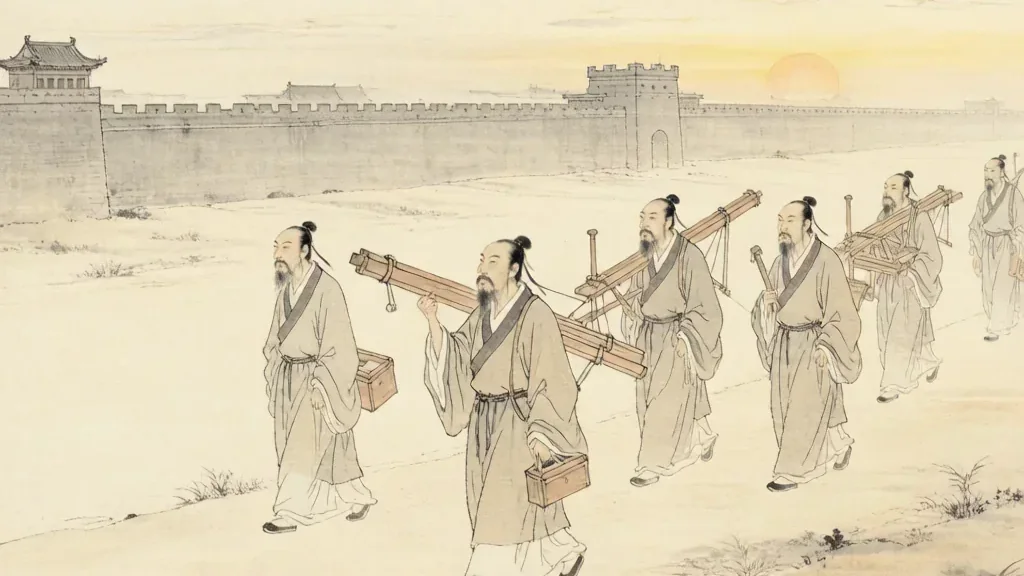
Imagine a school of philosophy whose followers were willing to walk hundreds of miles to stop a war, who developed sophisticated theories of optics and mechanics centuries before the Scientific Revolution, and who preached a doctrine of impartial love so demanding that even their rivals admired their integrity. This was Mohism (墨家思想, Mòjiā sīxiǎng), one of the most fascinating and tragically short-lived movements in Chinese intellectual history. For a brief but brilliant period during the Warring States era, Mohism rivaled Confucianism as the dominant philosophy of China — before vanishing so completely that its texts were nearly lost forever.
Mozi: The Carpenter-Philosopher
The founder of Mohism, Mozi (墨子, Mòzǐ), lived during the 5th century BCE, roughly a generation after Confucius. His background could not have been more different from that of the aristocratic-minded Confucius. While Confucius came from the lower nobility and moved in courtly circles, Mozi appears to have been a craftsman — possibly a carpenter or wheelwright — from the lower classes. This working-class origin profoundly shaped his philosophy. Where Confucius focused on the cultivation of the gentleman scholar, Mozi spoke for artisans, peasants, and soldiers — the ordinary people who bore the brunt of the era's endless warfare.
Mozi's teachings are preserved in the eponymous Mozi, a text compiled by his followers that blends philosophical argument, practical advice, and technical treatises. It is a unique document in the classical Chinese corpus — at once a work of moral philosophy, a manual of defensive warfare, and a pioneering text in logic and natural science. The man behind it emerges as a figure of extraordinary moral seriousness: someone who believed that ideas must be judged by their practical consequences and that the purpose of philosophy is to reduce suffering in the world.
Jian Ai: Universal Love
The core of Mohist ethics is the principle of Jian Ai (兼爱, jiān ài), usually translated as "universal love" or "impartial caring." Mozi argued that all the suffering in the world — war, theft, oppression, fraud — stems from partiality: people care more about their own family, their own state, their own interests than about others. The solution, he proposed, is to care equally for everyone. One should love another person's father as one's own father, another's country as one's own country.
This was a radical departure from Confucianism, which held that love should be graded — strongest for family, then for community, then for strangers — and that filial piety was the root of all virtue. Confucian thinkers attacked Jian Ai as unnatural and even dangerous. Mencius, the great Confucian philosopher, famously accused Mozi of denying the special bond between father and son, calling him a "beast." Mozi, however, was undeterred. He argued that impartial love was not only morally right but also practically beneficial: if everyone practiced it, social harmony would naturally follow. "When everyone regards others' states as their own," he wrote, "who will attack? When everyone regards others' families as their own, who will harm?"
Fei Gong: Opposition to Aggressive War
Closely related to Jian Ai was Fei Gong (非攻, fēi gōng), the condemnation of aggressive warfare. The Mohists were not absolute pacifists — they recognized the right to self-defense — but they passionately opposed wars of conquest. In an era when ambitious rulers routinely launched campaigns to expand their territory at enormous human cost, the Mohists stood as a lonely voice of protest.
Their opposition was not merely rhetorical. The Mohists organized themselves into a disciplined, quasi-military order, led by a Grand Master, whose members were trained in the arts of defensive fortification. When they learned that a state was planning to attack another, Mohist engineers would travel to the threatened state and help construct its defenses. Stories from the period describe Mohist delegations walking for days on worn sandals, eating the simplest food, to arrive in time to dissuade an aggressor or fortify a city. This combination of moral conviction and practical expertise made the Mohists uniquely effective — and uniquely respected, even by their enemies.
The Mohist Achievement in Logic and Science
Perhaps the most astonishing aspect of Mohism is its contribution to logic, optics, and mechanics. The later Mohist chapters of the Mozi — known as the "Mohist Canons" — contain systematic discussions of geometry, mechanics, and the behavior of light that have no parallel in any other premodern Chinese text. The Mohists developed a sophisticated theory of optics, correctly describing how light travels in straight lines, how a pinhole camera forms an inverted image, and how concave and convex mirrors produce different reflections. They explored problems in mechanics involving levers, pulleys, and the concept of the center of gravity.
Equally impressive is their work in logic and epistemology. The Mohists developed a rigorous method of argumentation, distinguishing between different types of knowledge (by hearsay, by inference, by direct observation) and formulating standards for evaluating claims. They insisted that any proposition must be tested against three criteria: its basis in the deeds of ancient sage-kings, its correspondence to the direct experience of ordinary people, and its practical consequences when implemented as policy. This proto-scientific approach was centuries ahead of its time — and deeply at odds with the intuition-based, tradition-oriented reasoning favored by other Chinese schools.
Why Did Mohism Decline?
For a philosophy that once rivaled Confucianism in influence, Mohism's disappearance is one of the great puzzles of Chinese intellectual history. By the Han Dynasty (206 BCE–220 CE), Mohism had effectively ceased to exist as a living tradition. Several factors contributed to its decline.
First, Mohism's demands were extraordinarily rigorous. Its adherents lived lives of severe simplicity — wearing coarse clothing, eating plain food, and dedicating themselves entirely to service. While this asceticism attracted devoted followers, it limited the movement's appeal to the broader population. Second, Mohism's rationalistic, utilitarian approach clashed with the more poetic and intuitive sensibilities that would come to dominate Chinese culture. The Mohists had little patience for ritual, tradition, or aesthetic pleasure — things that deeply mattered to both Confucians and Taoists. Third, after the unification of China under the Qin and Han dynasties, the kind of independent, paramilitary organization that the Mohists had built was seen as a threat by the imperial state and was systematically suppressed.
Most profoundly, Mohism failed because its core principle — impartial love — proved too difficult for most people to sustain. Graded love, as the Confucians argued, feels more natural: we do, in fact, care more about our own children than about strangers. The Mohist demand to love all equally, while morally admirable, asked human beings to transcend their deepest instincts. Yet in another sense, Mohism never truly died. Its spirit — the belief that reason, compassion, and practical action can reduce human suffering — lives on in every humanitarian movement, every peace activist, and every engineer who designs systems to protect rather than destroy.
Thrift Over Display
Mohism preached a stern economy. Mozi condemned the lavish tombs, long mourning, and costly music favoured by rulers and rivals, arguing that such display drained the wealth needed to feed the hungry and clothe the cold. His ideal was useful spending: a roof that keeps out rain, a meal that sustains labour, a wall that stops an enemy. Extravagance was not merely wasteful but unjust when others lacked bread. This put him squarely against the Confucians, for whom rite and music bound society together and deserved devotion. The disagreement was practical as much as moral, about where a community's scarce resources should go. Modern readers may find the Mohist programme joyless, yet its logic was consistent with universal love: if you truly care for all, you will not spend on show while any suffer. Thrift, for Mozi, was simply love made fiscal.
Against Fatalism
Mozi attacked the belief that human fortune is fixed by fate. If people are told that wealth, hunger, and disorder are destined, he warned, they will stop trying, rulers will neglect their duties, and workers will slack, blaming heaven for what effort could change. He urged instead that outcomes follow from action and policy, so a diligent state prospers and a negligent one fails. This was a moral as much as a metaphysical claim: fatalism, by emptying effort of meaning, undermines the very care for others Mohism demands. Determining truth here, Mozi said, required looking at the deeds of the ancient sage kings and the benefit to the people, not at comforting sayings. His anti-fatalism thus defended human responsibility, a strikingly modern note in a world prone to read every ill as heaven's will.
Exalting the Worthy
Mohism's answer to nepotism was shang xian, 'exalt the worthy.' Offices and honours should go to ability and virtue, Mozi argued, not to noble birth or favour. A carpenter who builds well should lead the works; a farmer who governs justly should rise to court, however low his start. This was radical in a hereditary age and directly served the school's care for the public good, since a state run by the capable would feed and protect its people better. The Mohist order practised what it preached, choosing its own leaders by merit and binding members in disciplined service. The ideal later echoed in the exam system's promise that a poor boy might outrank lords. Though Mohism faded, its meritocratic instinct survived, a quiet thread of the claim that worth, not blood, should decide who rules.
❓ Frequently Asked Questions
📝 Chinese Vocabulary
墨家 — — The Mohist school; literally "the school of Mo"
兼爱 — — Universal love or impartial caring; the central Mohist virtue
非攻 — — Condemnation of aggressive warfare
墨子 — — Master Mo; the founder of Mohism
尚贤 — — Elevating the worthy; Mozi's call for meritocracy
非命 — : Against fatalism, the Mohist rejection of the belief that human fortune is fixed by destiny.
节用 — : Moderation in expenditure, the Mohist call to avoid wasteful display and spend on what benefits the people.
节葬 — : Moderation in burial, the Mohist critique of lavish funerals and prolonged mourning.
🎉 Fun Facts
- The Mohists were the first in China to develop a theory of the camera obscura — a dark room with a small hole that projects an inverted image — predating similar discoveries in the West by centuries.
- Mozi's followers were so disciplined that they would walk through fire or onto sword blades at their Grand Master's command, earning them a reputation as the most devoted disciples in Chinese history.
- The Mohist text was nearly lost to history. For over a thousand years, it was virtually unread — until Qing Dynasty scholars rediscovered it in the 18th century and recognized its scientific and philosophical importance.
- Mohist writings debated logic and language with rare precision, asking how a name properly applies to a thing and how classes should be divided.
- The school ran as a tight commune in which members shared what they had and followed a leader chosen for ability rather than birth.
- Mozi's attack on wasteful funerals set him against the Confucians, who treasured elaborate rites, one of several sharp splits between the two schools.