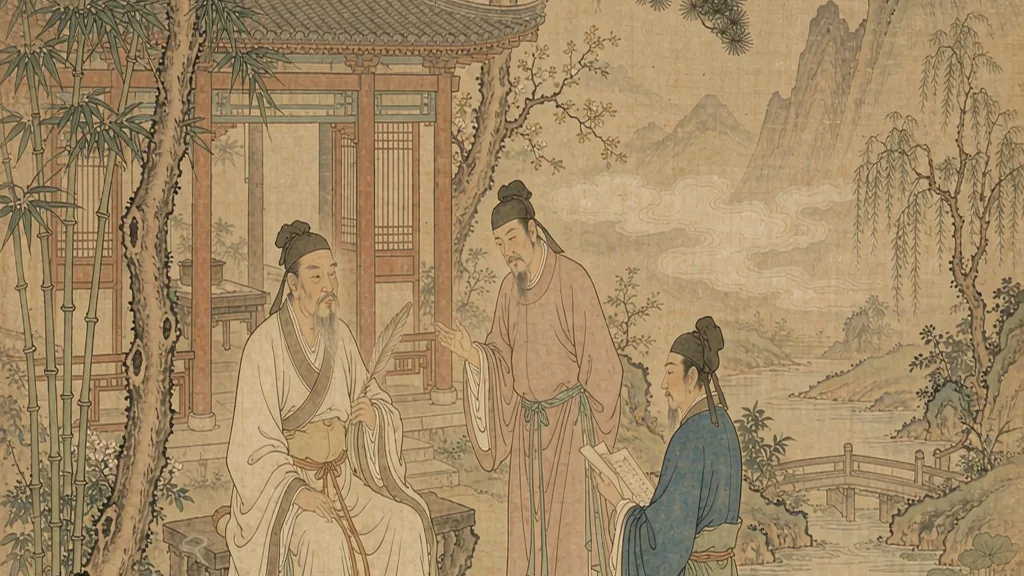
The Sui and Tang dynasties (late sixth through ninth century) were the period when Chinese calligraphy was codified into the classical standards still taught today. After centuries of division, the reunified empire produced masters who fused northern strength and southern grace into a settled regular script, and who raised running and cursive to new heights. This era’s masters—Ouyang Xun, Yu Shinan, Chu Suiliang, Yan Zhenqing, Liu Gongquan, and the cursive geniuses Zhang Xu and Huai Su—form the backbone of the whole later tradition.
The Sui Reunification and Its Artistic Meaning
The Sui dynasty briefly reunited China and, with the political reunion, began merging the calligraphic streams that had diverged during the Northern and Southern period. Sui writers such as Zhiyong, a descendant of Wang Xizhi, bridged the old Jin elegance and the emerging monumental manner, producing regular script that already feels “classical” rather than regional.
Zhiyong is famous for copying the “Thousand-Character Classic” hundreds of times and for his “Eight Methods of the Wild Goose Tail” notes on brushwork. His calm, balanced hand became a direct conduit from Wang Xizhi’s tradition to the Tang, and his students carried the manner into the new capital’s academies.
The Early Tang “Four Masters”
The early Tang is associated with four great regular-script masters: Ouyang Xun, Yu Shinan, Chu Suiliang, and Xue Ji. Each had a personal accent—Ouyang taut and rigorous, Yu gentle and reserved, Chu lithe and refined, Xue competent and fluent—but all shared a commitment to ordered, teachable regular script.
These men were court officials and teachers, and their prestige fixed regular script as the empire’s official hand. Their steles became classroom models, and the very idea that calligraphy could be systematically taught owes much to their codifying work. Together they set the frame within which later Tang masters would innovate.
Yu Shinan and Chu Suiliang
Yu Shinan was admired for a restrained, almost shy elegance and for his learning; the emperor Taizong revered him and, after his death, missed his calligraphy at court. His manner emphasizes evenness and inner calm, a southern-derived grace turned dignified.
Chu Suiliang took the style further toward slender, rhythmic beauty, with strokes that breathe. He was also a key figure in authenticating and copying Wang Xizhi’s works for the imperial collection, so his influence ran through both creation and preservation. The early Tang thus balanced invention with reverent study of the ancient masters.
Yan Zhenqing and the Monumental Turn
Mid-Tang brought Yan Zhenqing, whose regular script grew from disciplined study into a grand, full-bodied manner that became one of the two great Tang standards (with Liu). Yan’s characters are generous and monumental, built on a broad central axis, conveying both strength and warmth.
Yan’s life as a loyal official who died resisting rebellion gave his upright script a moral aura, and his running-script “Draft for the Nephew” is among the most moving works in the whole art. He shows the Tang at its mature confidence: regular script no longer just correct, but heroic.
Liu Gongquan and Discipline
Liu Gongquan completed the Tang regular-script achievement with a lean, bony manner contrasting Yan’s fullness. Paired with Yan as “Yan-Liu,” he gave the tradition its other pole—restraint, precision, and a famous moral saying that a correct heart makes a correct brush.
With Yan and Liu the Tang had supplied both the breadth and the tightness a student needs, and later calligraphers measured themselves against this pair above all. The two remain the first names a beginner meets when copying regular script from stone.
Cursive Masters: Zhang Xu and Huai Su
The Tang was not only the age of regular script; it was also the golden age of wild cursive. Zhang Xu, the “Crazy Zhang,” turned cursive into ecstatic performance, sometimes writing with a brush held in his hair after drinking. Huai Su, the monk, carried the manner to its lightning extreme in the “Autobiography” scroll.
Together “Zhang the Crazy and Huai the Drunk” represent the liberated pole of Tang art, the counterpart to the disciplined regular-script masters. Their existence shows the era’s range: a civilization that could codify rules and then delight in breaking them with supreme control.
Running Script and the Literati Foretaste
Running script (xingshu) flourished in the Tang as a middle path between regular and cursive, used for letters and casual works. Yan’s “Draft for the Nephew” is running script of overwhelming feeling, proving that the semi-cursive hand could carry the strongest emotion without abandoning legibility.
This balance pointed toward the Song dynasty, when running script would become the favored voice of the literati. The Tang thus bequeathed not only the regular-script standard but the running-script model that later scholar-officials would make their own.
Why the Sui-Tang Masters Endure
The Sui-Tang masters endure because they did the foundational work: they turned a long, varied evolution into a set of models clear enough to teach and rich enough to last. Almost every later calligrapher—Song, Yuan, Ming, Qing, and modern—learned first from Tang steles and only later sought a personal voice against that background.
Their works also survive in a uniquely transmissible form. Carved on stone and circulated as rubbings, the great Tang inscriptions outlived their paper originals and reached every province and neighboring country. That combination of artistic authority and physical durability is why the Sui-Tang era remains the classroom of Chinese calligraphy.
❓ Frequently Asked Questions
Why are Sui-Tang masters so important?
They codified Chinese calligraphy into classical standards—especially regular script—that later generations learned from, making the era the tradition’s classroom.
Who were the early Tang four masters?
Ouyang Xun, Yu Shinan, Chu Suiliang, and Xue Ji, each with a personal accent but all committed to ordered, teachable regular script.
What did Zhiyong contribute?
A Sui monk descendant of Wang Xizhi, he bridged Jin elegance and Tang monumentality and transmitted the manner to the new capital’s academies.
How did Yan Zhenqing change regular script?
He developed a grand, full-bodied manner that became one of the two great Tang standards and lent regular script a heroic, moral weight.
Who were the Tang cursive masters?
Zhang Xu (“Crazy Zhang”) and Huai Su (“Drunk Huai”), whose wild cursive represents the liberated pole of Tang calligraphy.
How did their works survive so widely?
Great works were carved on stone and circulated as rubbings, outliving the paper originals and reaching every province and neighboring countries.