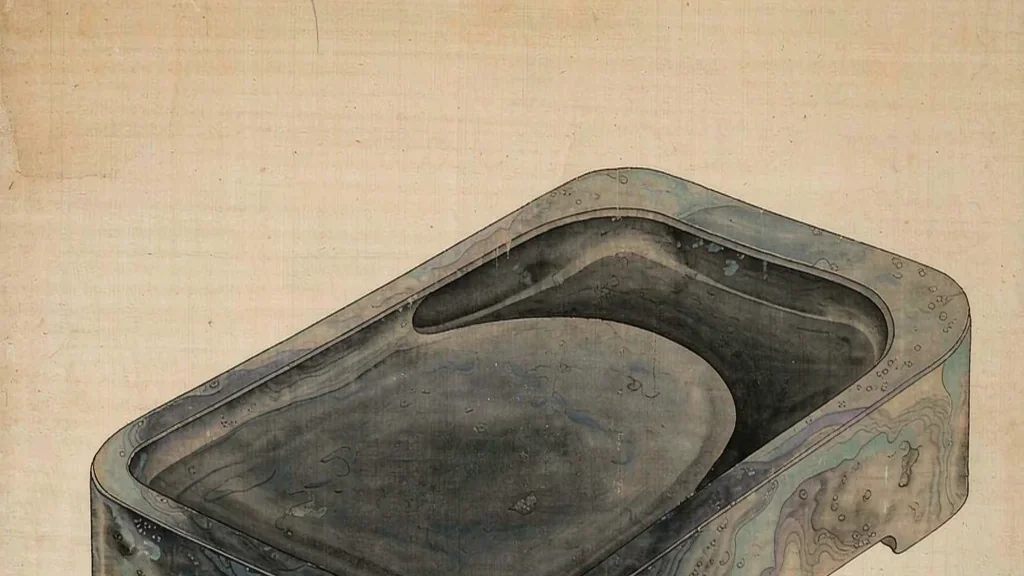
The ink stone (砚, yàn) is the shallow, sculpted stone on which Chinese calligraphers and painters grind an ink stick with water to make liquid ink. As one of the Four Treasures of the Study, it is the quiet workhorse of the scholar's desk — less glamorous than a fine brush yet essential, and often the most durable and collectible of the four. A good ink stone draws no color of its own, holds water without seeping, and offers a surface that grinds ink smoothly and quickly. This article explains the stone's role, the famous quarries, and how to choose and care for one.
The Ink Stone's Job
Unlike a Western inkwell, a Chinese ink stone is not a container of ready ink but a grinding surface. The calligrapher pools a little water in its shallow well, then rubs the ink stick in circles until the liquid thickens. The stone must be hard enough to abrade the stick yet fine enough not to scratch or leave grit in the ink.
The stone also tempers the ink. Its slight porosity helps control water, and its cool surface can keep ink from drying too fast in warm weather. In daily use the ink stone is the partner that turns a solid stick into living black.
What Makes a Good Stone
Connoisseurs judge an ink stone by several traits. It should be fine-grained, so the ink comes out smooth; it should "take ink" quickly, meaning a few minutes of grinding yield usable liquid; and it should "hold ink" without the water sinking away or the surface cracking.
A subtle sign of quality is the "oil shine": when breathed on or wiped, a fine stone shows an even, moist luster rather than dry patches. The best stones feel heavy for their size and sound a low, dull note when tapped, not a sharp ring.
Famous Ink-Stone Quarries
Several regions became famous for their stone. Duan stone from Guangdong and She stone (also called Longwei stone) from Anhui are the two most celebrated, each with quarries worked for many centuries. Duan stones are prized for their warm color and natural "eyes" — concentric mineral spots valued as beauty marks.
Other noted sources include Tao river stone and various local stones, but Duan and She dominate the high-end market and the collector's shelf. The specific quarry face and age of a stone greatly affect its reputation and price.
Duan Stone and Its "Eyes"
Duan ink stones are especially loved for decorative "stone eyes" — small circular patterns in the rock that look like pupils. These are natural mineral inclusions, not carved, and their number, color, and symmetry add to a stone's charm and value.
Beyond looks, Duan stone is praised for a fine, dense texture that grinds ink silently and keeps it from drying. The best pieces were reserved for imperial use in earlier times, and fine old Duan stones are now heirlooms passed down in families.
Shape, Carving, and Decoration
Ink stones range from plain rectangular slabs to elaborately carved scholar's objects shaped like lotus pods, mythical beasts, or miniature landscapes. The carving is both functional — shaping the ink pool and water channel — and artistic, turning a tool into a desk sculpture.
Many fine stones carry inscriptions by famous scholars or imperial marks, layering literary value onto material value. A stone's back might bear a poem or a collector's seal, making it a small archive of ownership and taste.
Grinding and Daily Use
To use the stone, one adds a few drops of clean water to the well and rubs the ink stick with steady, even pressure, letting the black build gradually. After writing, the stone should be rinsed and wiped dry; leftover ink allowed to harden will roughen the surface and spoil future sessions.
A well-kept stone actually improves with age, developing a glassy, ink-friendly patina from repeated use. For this reason old stones are often preferred by professionals over brand-new ones.
Collecting and Care
Ink stones are collected as seriously as ink sticks or seals. Buyers look at stone type, quarry, age, carving, and provenance. A humble functional stone can serve a beginner well, while a documented antique Duan or She stone may be a major acquisition.
Care is simple but firm: keep the stone dry after use, avoid soaps that leave film, and store it where it will not be dropped or scratched. With that minimal attention, an ink stone can outlast its owner by generations — the most permanent of the Four Treasures.
Ink Stones in Scholar Culture
Beyond its workshop function, the ink stone was a companion and a statement. A scholar's stone traveled with him, sat on his desk for decades, and was often given as a parting or birthday gift among friends. Because a fine stone could last generations, it gathered associations — a present from a teacher, a souvenir of a journey, a link to a vanished household.
Poets and officials wrote lines on the backs of prized stones, and collectors added seals recording each transfer of ownership. In this way the ink stone became a small social object as much as a tool, carrying friendships and reputations in its carved surface. To handle an old stone is to handle a slice of literate life from centuries past, worn smooth by countless sessions of grinding.
Regional Varieties Beyond Duan and She
Although Duan and She stones dominate the top tier, many other regions produced respected ink stones, each shaped by local geology. Tao river stones from Gansu, for instance, are known for a greenish tone and fine grain, while various "red silk" and "cinnabar" stones were loved for unusual color and vein patterns that make a desk piece striking even before use.
Geography decides much about quality. The minerals in a quarry's rock determine how smoothly a stick grinds, how the surface ages, and whether it develops the prized oily sheen. Collectors thus learn to read a stone's origin from its feel and look, much as wine lovers read a vineyard, and a lesser-known local stone can outperform a famous name if its bed happens to be fine.
❓ Frequently Asked Questions
What is an ink stone for?
It is the surface where you add water and rub an ink stick to make liquid ink for writing or painting.
Which ink stones are best?
Duan stones from Guangdong and She stones from Anhui are the most celebrated for fine texture and beauty.
What are "stone eyes"?
They are natural mineral rings in Duan stone, valued as decorative marks that raise a stone's worth.
How do I care for an ink stone?
Rinse and dry it after each use, avoid soap film, and store it safely so it is not scratched or dropped.
Why do old stones matter?
Years of use give a stone a smooth, ink-friendly patina, so seasoned stones are often preferred by experts.
Is an ink stone part of the Four Treasures?
Yes. With brush, ink stick, and paper, the ink stone completes the traditional Four Treasures of the Study.