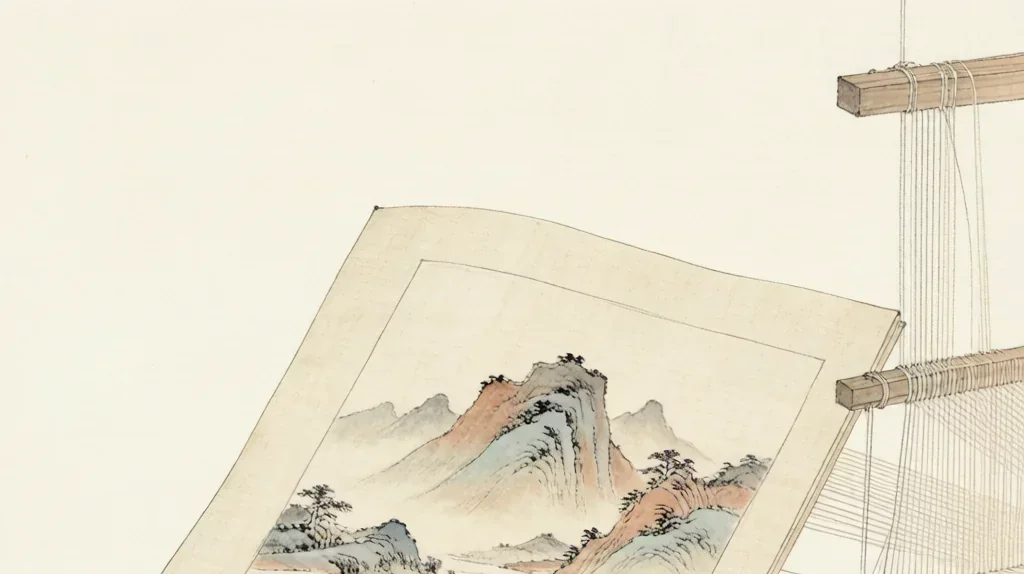
Kesi (缂丝), often translated as "silk tapestry" or "cut silk," is one of the most refined and laborious textiles in the Chinese tradition. Woven on a small loom with a technique that creates a tiny vertical slit wherever colors meet, kesi builds an image thread by thread, with no continuous weft running across the whole width. Historically reserved for the imperial court and the wealthiest patrons, kesi was used for robes, screens, scrolls, and copies of famous paintings. Its name, literally "carved silk," refers to the crisp, almost cut-out edges that the slit-weave produces between color areas. The art is the textile equivalent of a brush painting: where a painter lays wash, the weaver lays a thousand small passages of colored weft, and the result can carry mist, ink tone, and fine line with a precision that printed cloth cannot approach. Because each color stops exactly where the design demands, kesi can mimic a painting so closely that scholars once mounted kesi panels as if they were scrolls, adding colophons and seals, and the line between weaving and painting all but disappeared.
Origins and Early History
Kesi developed from earlier woven silk techniques and came into its own during the Tang dynasty, influenced by patterns and methods arriving along the Silk Road from Central Asia and Persia. Early kesi often reproduced brocade-like medallions and Buddhist iconography, and the foreign input shows in the roundel motifs of the earliest survivals.
By the Song dynasty, kesi had been elevated from decorative cloth to a fine art: imperial workshops wove pictorial images, including close copies of celebrated paintings, that were prized as collectibles in their own right. The shift from pattern to picture is the key moment in kesi history, and the Song made it permanent.
The Silk Road connection is worth stressing. The slit-weave method traveled east with other weaving knowledge, and Chinese weavers refined it into something the original inventors had not imagined, a reminder that Chinese craft often absorbed foreign technique and then surpassed it, returning the gift transformed.
The Song Dynasty Flowering
The Song period is considered a golden age for kesi, when court ateliers in the south specialized in pictorial weaves. Artists used the slit technique to render paintings with astonishing subtlety, capturing misty landscapes and delicate botanicals, and the restraint of Song taste suited the medium's precision.
So valued were these works that scholars mounted kesi panels as if they were paintings, adding colophons and seals. The line between weaving and painting all but disappeared, and a kesi copy of a famous handscroll could be treasured as a painting in its own right, sometimes preferred because it would not fade as ink might.
The pictorial turn changed the loom. Weavers began to work from painted cartoons provided by court artists, so the division of labor between painter and weaver became explicit, and the best kesi is a collaboration across media, the painter's design realized in the weaver's thread with a fidelity that printing could not match.
How Kesi Is Woven
Unlike ordinary weaving, where a single weft shoots back and forth across the warp, kesi uses a separate weft for each local area of color. At the boundary between two colors the wefts turn back, leaving a minute gap — the tōng jīng duàn wěi ("continuous warp, broken weft") structure that defines the craft.
This demands that the weaver follow a cartoon or painted guide, building the picture from countless small colored passages. A complex panel can take months or years, with thousands of weft turns per square inch, and the labor is the true substance of the art, more than the silk itself.
The slit is both the method and the signature. Because the wefts do not cross, each color area is independent, and the tiny gap at the join gives the "carved" edge that names the cloth. Held to the light, a kesi panel shows those gaps as a fine network, the fingerprint of the slit-weave and the proof of the hand.
Visual Character and the "Carved" Edge
The vertical slits give kesi its signature look: hard, clean boundaries between hues, as if each shape were cut from a separate cloth and inlaid. Held to the light, a kesi panel shows tiny openings at every color join, and the eye reads these as crispness rather than flaw.
Because each color stops exactly where it should, kesi can mimic brushwork and ink tones with a precision that printed or embroidered copies cannot easily match, though it lacks the sheen of a continuous weft satin. The matte surface actually helps the pictorial illusion, because paint too is matte, and the cloth reads as a painting held in silk.
The contrast with embroidery is instructive. Embroidery lays thread on a finished ground; kesi builds the ground and the image together, thread by thread, so the whole cloth is the picture, with no base beneath. This makes kesi more integrated and more fragile, but also more truly "woven painting" than any embroidery could claim to be.
Subjects and Uses
Traditional kesi depicted imperial dragons and court robes, Buddhist and Daoist deities, flowers and birds, and landscapes copied from master paintings. Dragon robes woven in kesi were among the most prestigious garments in the imperial wardrobe, and the slit technique let the dragon's scales and flames read with jewel-like clarity.
Beyond clothing, kesi appeared as screen inserts, altar hangings, and album leaves. Its fragility meant such pieces were treated as treasures rather than everyday furnishings, and the cost of the labor alone kept kesi off the bodies of all but the highest ranks and into the cases of the richest collectors.
The court robe deserves emphasis. A kesi dragon robe was a vehicle of state symbolism, its dragons, waves, and mountains arranged by strict rule to signal the wearer's place in the cosmos, so the weave carried both art and law, and the weaver had to be as precise about meaning as about method.
Imperial Workshops and Patronage
Kesi production centered on court manufactories, especially in the Jiangnan region around Suzhou, where climate and silk supply suited the craft. The Ming and Qing empires maintained kesi workshops to supply the palace, and the bureau structure ensured both quality and quantity for the court's enormous appetite for insignia.
Qing emperors such as Qianlong were enthusiastic patrons, commissioning kesi copies of painting masterpieces and garments for ceremony. Imperial taste set standards of density and finish that private workshops emulated, and the palace's demand is the reason kesi survived as a living craft through centuries of cost.
The Jiangnan location is no accident. Suzhou was already the heart of Chinese silk and of scholarly painting, so the weavers worked next to the painters whose work they copied, and the closeness of the two arts in one city is why Suzhou kesi reached a level no other center matched, then or since.
Kesi and Painting
A distinctive feature of kesi is its role as a medium for reproducing paintings. A woven copy of a famous handscroll let the court possess a durable, luminous version of a treasured image, and some kesi are studied today as records of lost originals, preserving compositions whose paintings have vanished.
Weavers sometimes left areas unwoven for later painting or embroidery, blending media. This hybrid practice shows how fluid the boundary was between the textile and pictorial arts, and a single object might be partly woven, partly painted, and partly embroidered, each technique doing what it did best.
The copy tradition also shaped connoisseurship. Because a kesi could outlast the painting it copied, later scholars sometimes judged the original by the weave, reversing the usual hierarchy, and the woven version became a kind of fixed reference for a floating ink original, a curious inversion of value.
Decline and Revival
Kesi nearly vanished in the turbulent early twentieth century as imperial patronage ended and cheap alternatives appeared. Master weavers became scarce, and the knowledge risked being lost, because the years of training required could not be supported without a patron able to wait for the slow return.
From the late twentieth century, renewed interest and heritage funding revived Suzhou kesi, and it was named a national intangible cultural heritage. Today a small number of ateliers keep the demanding craft alive, training apprentices in the slit-weave method and selling both reproductions and new designs.
The revival is fragile. The same slowness that makes kesi precious makes it hard to sustain, and a weaver trained for years may still earn less than a factory worker, so heritage status helps but does not solve the economics, and the craft's future depends on buyers who value the time as much as the silk.
Appreciating Kesi
To appreciate kesi, hold it to the light and look for the slits, then step back and read it as a painting. The carved edges tell you it is woven, not printed; the image tells you it is a picture, not merely a pattern, and the two truths meet in a single cloth that is both.
Notice the density of weft turns in a small area, and imagine the months of work behind a panel the size of a book. The value of kesi lies precisely in that impossibility — that a human being sat and turned thread against thread until a misty mountain stood in silk, and the patience is the artwork as much as the silk.
In the end kesi is a love letter from the loom to the brush. It takes the most fluid of arts, painting, and rebuilds it in the most patient of media, thread, proving that Chinese craft loved nothing so much as a worthy contradiction: the hard made to imitate the soft, the slow made to hold the instant, the woven made to pass as the painted.
❓ Frequently Asked Questions
What is kesi?
Kesi is a Chinese slit-weave silk textile in which each color area has its own weft, producing crisp, "carved" edges; it is used for pictorial panels and fine robes.
How is kesi different from ordinary weaving?
In kesi the weft is broken at every color boundary rather than running across the whole width, creating small slits and allowing precise pictorial detail.
When did kesi reach its height?
It flourished in the Song dynasty, when court workshops wove pictorial images and copies of famous paintings as fine art.
Where was kesi made?
Primarily in the Jiangnan region around Suzhou, under both private and imperial workshops, especially during the Ming and Qing.
Why is kesi so expensive?
Because it is woven thread by thread with countless weft turns, a complex piece can take months or years of highly skilled labor.
Is kesi still made today?
Yes; Suzhou ateliers revived the craft in the late twentieth century, and it is now protected as intangible cultural heritage.