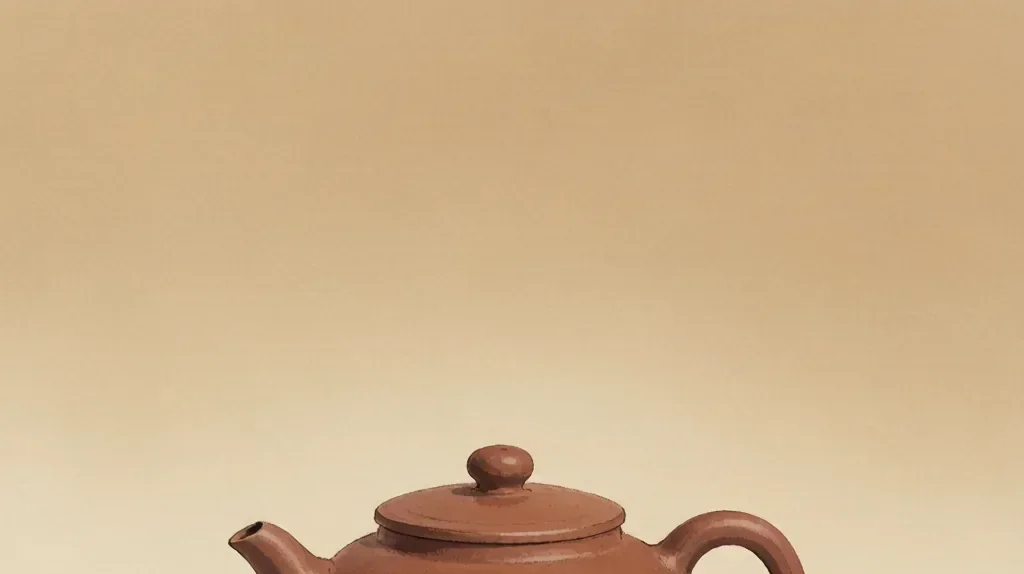
There is a teapot in China that you are never supposed to wash with soap. Over decades of use it darkens, deepens in luster, and begins to pour tea that tastes richer than the leaves alone can explain. This is 紫砂 (), "purple clay," the famous unglazed stoneware of Yixing. More than a vessel, a zisha teapot is a living companion to the tea drinker, prized for the way its porous body breathes, ages, and remembers every brew it has held. To understand zisha is to understand a Chinese philosophy of restraint, patience, and the quiet pleasure of things that improve with time.
Where the Clay Comes From
The story of zisha begins in the hills around 宜兴 (), a city in Jiangsu province southwest of Shanghai, long called the "pottery capital of China." Beneath its low mountains lies a peculiar family of iron-rich clays that fire to a dense, fine-grained stoneware without the need for glaze. The most celebrated deposits are found on Huanglong Mountain and nearby hills, where the ore is dug, weathered for months or years, and purified by hand before it is ever shaped.
What makes zisha clay special is its granular structure. Under a microscope the fired body looks like a sponge of microscopic pores, yet the surface remains smooth. These pores are large enough to let the pot "breathe" but too small to leak water. That breathability is the secret behind the teapot's legendary ability to absorb trace oils and aromas from tea, concentrating flavor over years of faithful use.
The Three Classic Clays
Although the name means "purple clay," zisha ware appears in several natural colors determined by mineral content. 紫泥 (), or purple clay, fires to a muted reddish brown and is the most common. 红泥 (), red clay, is finer and fires to a brighter orange-red, favored for small pots. 段泥 (), also called "celadon clay," is a sandy beige or yellow tone formed where purple and green clays meet in the earth.
Modern potters also blend clays and add mineral oxides to create greys, blacks, and greens, though purists argue that the beauty of true zisha lies in accepting the earth's own palette. No matter the color, authentic zisha is never painted or glazed on the inside; the clay itself is the finish, and its naked surface is exactly what allows the pot to season.
How a Zisha Teapot Is Made
Unlike wheel-thrown pottery, the finest zisha pots are built by hand from slabs and strips of prepared clay, a method known as "slab construction" or 镶身筒 (). The maker rolls the clay into flat sheets, cuts the body, base, shoulder, and lid, then joins them with a dab of clay "slip" and works the seams until they vanish. A second method, "squeezing the body," shapes the clay around a wooden or clay core.
Every spout, handle, and knob is fitted individually and must balance the whole in both weight and line. A good pot pours without dripping, seats its lid with a satisfying suction, and feels alive in the hand. Mastery takes a decade or more, and the great historical names — 供春 (), who is credited with the first artist-signed pot in the Ming era, and 时大彬 (), who refined the craft in the late sixteenth century — are still studied by apprentices today.
Why the Pot Improves with Age
Chinese tea lovers speak of 养壶 (), "raising" or "nourishing" the pot. Each time tea is brewed, tiny aromatic compounds seep into the clay and are slowly released in later sessions, so the pot seems to learn the character of its favorite leaf. Devoted owners wipe the warm pot with the spent tea leaves after each brew, building a patina that turns the surface from matte to a soft, glowing sheen.
The ritual is also a lesson in restraint. You never scrub a zisha pot with detergent, because soap would occupy the pores and kill the flavor the clay has patiently gathered. You dedicate one pot, ideally, to a single type of tea — a pu-erh pot, an oolong pot, a green tea pot — so their spirits do not muddle. In this discipline, caring for an object becomes a form of self-cultivation.
Collecting and Connoisseurship
Fine zisha has been collected for over five hundred years, and the market today ranges from modest everyday pots to museum-grade works selling for fortunes. Collectors judge a pot by the clay's authenticity, the maker's skill, the harmony of its proportions, and the clarity of its "voice" when the lid is tapped. Seals impressed into the base and lid identify the artist, and forged seals are a perennial problem in the trade.
Since the late twentieth century, concerns about depleted natural clay beds have led Yixing to restrict mining, raising the value of old and well-made pots. For the ordinary drinker, however, the point was never investment. A humble zisha pot used daily is as authentic an heirloom as a famous one — perhaps more so, because it carries the warmth of real use across generations.
A Craft That Shaped a Tea Culture
It is no exaggerption to say zisha shaped how China drinks tea. When the Ming court banned compressed tea cakes in favor of loose-leaf brewing in the fifteenth century, the demand for small, efficient, heat-retaining pots surged, and Yixing answered. The teapot form we now consider universal — rounded body, short spout, looping handle — was largely perfected by zisha artists and copied worldwide.
To own and use a zisha teapot is to participate in a very long conversation between earth, fire, water, and human patience. The clay is old, the technique is older, and the reward is slow. In a culture that has always valued the subtle over the loud, few objects express that preference more gracefully than a small purple-clay pot that gets better every year you keep it.
Zisha and the Art of Gongfu Tea
A zisha pot is the natural partner of gongfu tea, the southern Chinese ritual of brewing small, strong infusions. Because the unglazed clay holds heat evenly and breathes, it coaxes dense flavor from oolong, pu-erh, and black leaves without scorching them. The small size suits the many short steeps of gongfu service, and the same pot used again and again builds a patina that seasoned drinkers prize. Hosts often keep separate pots for separate teas so aromas stay pure. In a teahouse or a family sitting room, the squat purple-clay pot anchored on a tray of cups is less a utensil than the centerpiece of a slow, sociable ceremony of attention.
Caring for a Zisha Teapot Over a Lifetime
A zisha pot rewards gentle, consistent care. After each use, rinse it with plain hot water and wipe it with the spent leaves, then leave the lid off so the clay can dry and air out; never use detergent, which would lodge in the pores. Dedicate the pot to one tea type so flavors do not mingle. Over months and years the surface deepens from matte to a soft glow, and the first cup of plain water can carry a ghost of tea. Store the pot uncapped in a well-ventilated place away from strong odors, since the clay will absorb them. Handled this way, a humble pot becomes a personal heirloom that improves as its owner ages.
❓ Frequently Asked Questions
📝 Chinese Vocabulary
紫砂 — : purple clay, the unglazed Yixing stoneware.
宜兴 — : the Jiangsu city where zisha clay is found.
茶壶 — : teapot.
养壶 — : "raising the pot," the practice of seasoning a teapot over time.
供春 — : the Ming-era artisan credited with the first signed zisha pot.
镶身筒 — : Slab construction, the hand-building method that shapes the pot body from flat clay sheets.
时大彬 — : Shi Dabin, the late sixteenth-century master who refined Yixing proportions and technique.
朱泥 — : Zhuni, a fine, dense red Yixing clay favored for small, thin-walled pots.
🎉 Fun Facts
- A well-seasoned zisha pot can pour tea that smells of the leaf even when filled with plain hot water, because the clay has absorbed decades of aroma.
- The Ming court's ban on compressed tea cakes in the 1400s is what created the surge in demand that made the small Yixing teapot iconic.
- Some zisha clays are weathered above ground for years before use, letting impurities break down naturally and the clay mature like a fine wine.
- Genuine Yixing clay is so dense that a finished, empty pot briefly placed over boiling water will "whistle" as air escapes its pores.
- Zisha clay is never glazed on the inside, which is precisely what lets the unglazed body breathe and season.
- The round, short-spouted teapot form perfected by Yixing artists became the worldwide template for the modern teapot.