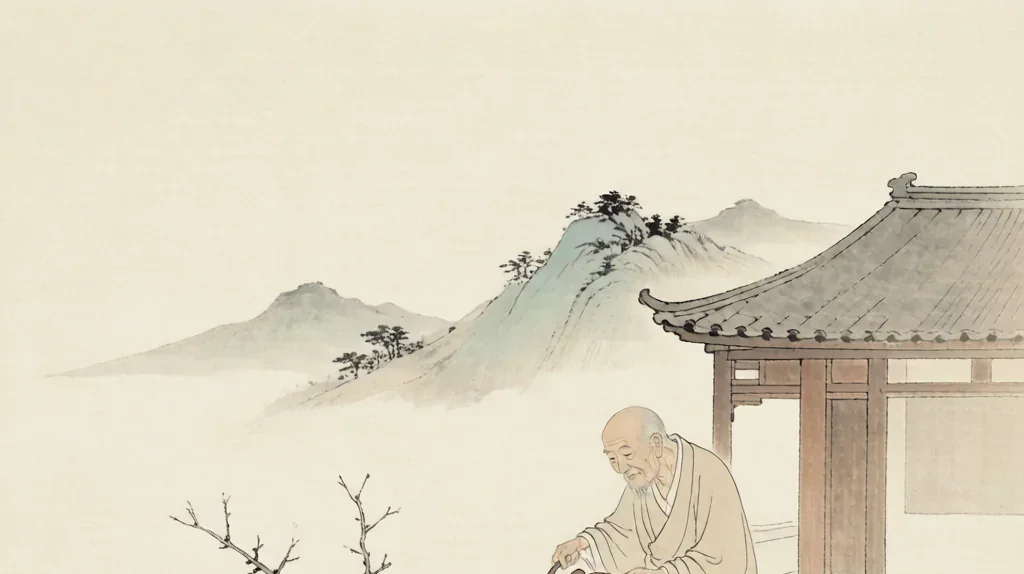
The phrase 'Zen and tea are one taste' (禅茶一味, Chán Chá Yī Wèi) encapsulates one of the most profound spiritual syntheses in Chinese civilization — the thousand-year intertwining of Chan (Zen) Buddhism and the culture of tea. This is not merely a poetic metaphor but a lived reality that has shaped monasteries, inspired art and literature, and transformed the simple act of drinking tea into a path of spiritual cultivation. The connection between tea and Buddhism in China is as old as tea drinking itself. Buddhist monks were among the earliest adopters and promoters of tea, recognizing its practical value in sustaining alertness during long hours of seated meditation. But over time, the relationship deepened far beyond the utilitarian: tea became a sacrament, a medium of teaching, and a vehicle for awakening. The preparation and drinking of tea, when approached with full presence and mindfulness, became indistinguishable from Zen practice itself. As generations of masters taught their disciples, the truth is not found in scriptures or doctrines alone — it is right here, in this cup of tea.
The Origins: Tea in the Buddhist Monastery
The formal integration of tea into Buddhist monastic life began during the Tang Dynasty (618–907 CE), the golden age of both Chinese Buddhism and Chinese tea culture. Monasteries across China established tea gardens on their grounds, and the cultivation, processing, and preparation of tea became an integral part of daily monastic routine. The Baizhang Monastic Regulations (百丈清规, Bǎizhàng Qīngguī), compiled by the great Tang Dynasty Chan master Baizhang Huaihai (百丈怀海, 720–814 CE), codified tea rituals into the formal structure of monastic life. These regulations specified when and how tea should be served — during morning and evening assemblies, before and after meditation sessions, when receiving visiting dignitaries, and at ceremonial occasions throughout the liturgical calendar. The monastic tea ceremony (寺院茶礼, sìyuàn chálǐ) was not a casual affair but a highly structured practice, with designated tea officers, specific utensils, and prescribed movements that transformed the preparation of tea into a form of moving meditation.
Why did tea find such a natural home in Buddhist monasteries? The reasons are both practical and philosophical. Medically, tea's caffeine content helped monks maintain wakefulness during the long hours of zazen (坐禅, seated meditation), combating the drowsiness that was considered one of the 'five hindrances' to meditation practice. The Tang Dynasty poet and tea master Lu Yu (陆羽), who was raised in a Buddhist monastery, wrote in his 'Classic of Tea' (茶经, Chá Jīng) that tea 'quenches thirst, dispels drowsiness, and clears the mind' — precisely the qualities needed for sustained meditation. Beyond the physiological, tea's inherent qualities resonated with Buddhist values: its bitterness echoed the First Noble Truth of suffering; its clarity suggested the purified mind; its simplicity embodied the monastic ideal of renunciation. The act of preparing tea — boiling water, measuring leaves, pouring, serving — required the same quality of mindful attention that characterized meditation itself. As the saying goes, 'In drinking tea, there is no past and no future, only the present moment.' The monastery tea garden thus became a microcosm of the Buddhist path: the soil was prepared with care, the plants nurtured through the seasons, the leaves harvested at just the right moment, and the finished tea offered with reverence — a complete cycle of mindful engagement with the natural world.
'Go Drink Tea': Master Zhaozhou's Timeless Koan
No story better illustrates the fusion of Zen and tea than the famous koan (公案, gōng'àn) of Zhaozhou Congshen (赵州从谂, 778–897 CE), one of the greatest Chan masters of the Tang Dynasty. The story, recorded in the classic Zen text 'The Gateless Gate' (无门关, Wúmén Guān), is deceptively simple. A monk newly arrived at Zhaozhou's monastery approached the master and asked, 'I have just entered this monastery. Please give me instruction, Master.' Zhaozhou replied, 'Have you eaten your rice gruel?' The monk said, 'Yes, I have.' Zhaozhou said, 'Then wash your bowl.' At these words, the monk attained insight.
Later, another monk came to Zhaozhou and asked the same question: 'What is the meaning of Bodhidharma coming from the West?' — a classic Zen question inquiring about the essence of Buddhism. To the first monk who asked this, Zhaozhou replied, 'The cypress tree in the courtyard.' To a second monk who asked, Zhaozhou gave a different answer: 'Go drink tea' (吃茶去, chī chá qù). This response has echoed through the centuries as one of the most celebrated expressions of Zen wisdom. On the surface, it seems almost dismissive — a great spiritual question met with the mundane suggestion to have a cup of tea. But within the Zen tradition, this is precisely the point. Zhaozhou was not deflecting the question; he was answering it in the most direct way possible. Enlightenment is not a special state removed from ordinary life — it is fully present in the ordinary, if only we have the eyes to see. Drinking tea, done with complete attention, is itself the Buddha's way. The taste of tea on the tongue, the warmth of the cup in the hands, the fragrance rising with the steam — these are not obstacles to awakening but its very substance. 'Go drink tea' is not a rejection of the spiritual quest but an invitation to discover that the quest ends exactly where you are, in this moment, with this tea.
The koan of 'Go drink tea' has inspired countless commentaries and remains a touchstone in Zen practice. It is often paired with the phrase 'the ordinary mind is the Way' (平常心是道, píngcháng xīn shì dào), another teaching attributed to the Zen lineage. Together, they point to the central insight that spiritual realization is not about attaining extraordinary states or escaping from the mundane but about fully inhabiting the present moment, whatever it contains. As the modern Zen teacher Thich Nhat Hanh has written, 'Drink your tea slowly and reverently, as if it is the axis on which the world earth revolves — slowly, evenly, without rushing toward the future. Live the actual moment. Only this moment is life.' Zhaozhou's 'Go drink tea' is perhaps the most concise expression of this truth ever uttered.
The Jingshan Tea Ceremony: The Bridge to Japan
The transmission of tea culture from China to Japan — one of the most consequential cultural exchanges in East Asian history — was mediated through Buddhist monasteries, and the key site in this transmission was Jingshan Temple (径山寺) in Zhejiang Province. Founded during the Tang Dynasty and reaching its zenith in the Southern Song (1127–1279), Jingshan was one of the Five Mountains (五山, wǔ shān) — the highest-ranking Chan monasteries in China — and a major center of Buddhist learning that attracted monks from across East Asia. It was here that the Jingshan Tea Ceremony (径山茶宴, Jìngshān Cháyàn) developed, an elaborate ritualized tea gathering that combined Chan Buddhist practice with the aesthetic sensibilities of Song Dynasty literati culture.
The Jingshan Tea Ceremony was a formal event held in the monastery's tea hall, where monks would gather to drink powdered tea (抹茶, mǒchá) — tea leaves ground into a fine powder and whisked with hot water, the precursor to what would become Japanese matcha. The ceremony followed a precise sequence: participants entered the tea hall in order of seniority, seated themselves on meditation cushions arranged around the room, and were served tea by designated attendants while the abbot or a senior monk delivered a Dharma talk. The tea itself was prepared with exacting attention to water temperature, whisking technique, and the quality of the powder. The atmosphere was one of profound stillness and mutual respect — the same qualities cultivated in the meditation hall. The ceremony was understood not as a social occasion but as a form of practice, an opportunity to manifest mindfulness, concentration, and insight through the medium of tea.
Among the Japanese monks who studied at Jingshan were several who would become pivotal figures in the transmission of tea to Japan. The most important was Eisai (荣西, also known as Yōsai, 1141–1215), who visited China twice during the Southern Song and spent time at Jingshan and other Chan monasteries. Eisai returned to Japan not only with Chan (Zen) teachings but also with tea seeds, which he planted on the island of Hirado and in the mountains of Kyushu. He authored 'Kissa Yōjōki' (喫茶養生記, 'Drinking Tea for Health'), Japan's first book on tea, which praised tea as a 'divine remedy' and a 'secret of long life.' Eisai's efforts laid the foundation for tea cultivation in Japan and established the connection between Zen Buddhism and tea that would later culminate in the Japanese tea ceremony. The Jingshan Tea Ceremony, with its powdered tea, whisk, tea bowl, and meditative atmosphere, was the direct ancestor of Japanese chanoyu. While the Chinese tea tradition eventually shifted toward whole-leaf infusion, the powdered tea method — preserved in Japan and lost in China — became the basis for one of the world's most refined cultural practices. The Jingshan temple itself was destroyed and rebuilt multiple times over the centuries, but its legacy lives on in every bowl of matcha whisked in a Japanese tea room.
The Spiritual Landscape of Tea Meditation
The practice of 'tea meditation' (茶禅, chá chán) is not a single prescribed technique but a diverse landscape of approaches united by the recognition that tea can serve as a support for spiritual cultivation. At its simplest, tea meditation involves drinking tea with complete, undivided attention — noticing the temperature of the cup, the color of the liquor, the aroma as it rises, the flavor as it spreads across the tongue, the warmth as it descends into the body. This is mindfulness (念, niàn) applied to the act of drinking, and it transforms what is ordinarily an automatic behavior into a profound meditation. The Zen master's 'Go drink tea' is an invitation to exactly this quality of attention.
Beyond simple mindful drinking, more structured forms of tea meditation have been developed within Chinese Buddhist traditions. Some involve silent group tea ceremonies where participants sit in meditation posture and are served tea in ritual silence, focusing on the sensations of drinking as an object of concentration. Others integrate tea into longer meditation retreats, using specific teas at specific times of day to support different phases of practice — a brisk green tea in the morning to sharpen alertness, a mellow aged pu'er in the evening to settle the mind. Some practitioners use the preparation of tea as a form of 'tea gongfu' (茶功夫), where the entire sequence of boiling water, warming vessels, measuring leaves, and pouring is performed as a slow, deliberate moving meditation, each gesture an expression of presence. The Chinese term '茶道' (chádào, 'the Way of Tea') expresses the understanding that tea is not merely a beverage but a path — a dao — that can lead, through disciplined practice, to the same spiritual insights as seated meditation, sutra study, or koan contemplation. The 'one taste' of Zen and tea is not a metaphor but a direct experience: when the mind is fully present with tea, there is no separation between the drinker, the drinking, and the drunk. Subject and object dissolve into a single, luminous moment of awareness — and that, the masters tell us, is the taste of awakening itself.
The Monastic Tea Rhythm
Inside a Chan monastery, tea was not an occasional treat but the pulse of the day. The Baizhang regulations fixed specific moments for serving it: before dawn sitting, after meals, before and after meditation, and when guests arrived. A designated tea officer boiled the water and moved through the hall with a kettle and bowls, pouring in silence so the clink of ladle and cup became part of the practice. Drinking was done in unison, eyes lowered, mind on the warmth and the taste. This structure turned a simple beverage into a disciplined ritual that anchored the monastic schedule. The rhythm taught monks that awareness need not be confined to the cushion; it could be carried in the hands that hold a bowl.
Lu Yu and the Classic of Tea
Lu Yu, the Tang dynasty figure who wrote the first book devoted to tea, was raised in a Buddhist monastery, and his sensibility was formed by monastic practice. His Classic of Tea described not only how to grow, process, and brew tea but also the vessels, the water, and the frame of mind suited to it. He taught that good tea quenches thirst, disperses drowsiness, and clears the mind, exactly the qualities monks prized for long sessions of sitting. Though he wrote as a connoisseur rather than a preacher, his emphasis on attentiveness and right measure fitted perfectly with the Zen view of ordinary actions as spiritual training. Later generations revered him as the sage of tea, and his writings became the foundation on which the whole Chinese tea culture, monastic and lay, was built.
Tea as Everyday Practice
The lesson of Zen tea is that awakening is not confined to temples. A lay practitioner can brew a cup at a cluttered kitchen counter and, for the length of that cup, set distraction aside. Noticing the steam, the color, the first sip, and the warmth spreading downward is enough to practice. Teachers warn against rushing the cup for the caffeine or the habit, urging instead that each drink be complete in itself. Over time this small daily act trains attention that spills into the rest of life: a calmer reply, a steadier hand, a kinder pause. In this sense the tea bowl is a portable meditation hall, available to anyone, anywhere, with no ordination required. Office workers keep a simple mug and a small tin of leaves at the desk, and a two-minute pause between tasks becomes a miniature retreat.
Chant, Poetry, and the Tea Hall
The monastic tea hall was also a place of letters. Abbots often delivered a short teaching, or Dharma talk, while the assembly drank, so the cup and the word were offered together. Monks composed verses on the fragrance of a fresh brew or the silence of a winter morning, and these poems circulated as tokens of realization. The tea gathering thus joined two esteemed arts, contemplation and poetry, in a single quiet event. Even the implements were praised in verse, as craftsmen and monks alike found beauty in a well-thrown bowl or a clean bamboo scoop. This blending of literary and spiritual culture helped tea remain, through the Song and beyond, not merely a refreshment but a refined language for speaking about mind and emptiness.