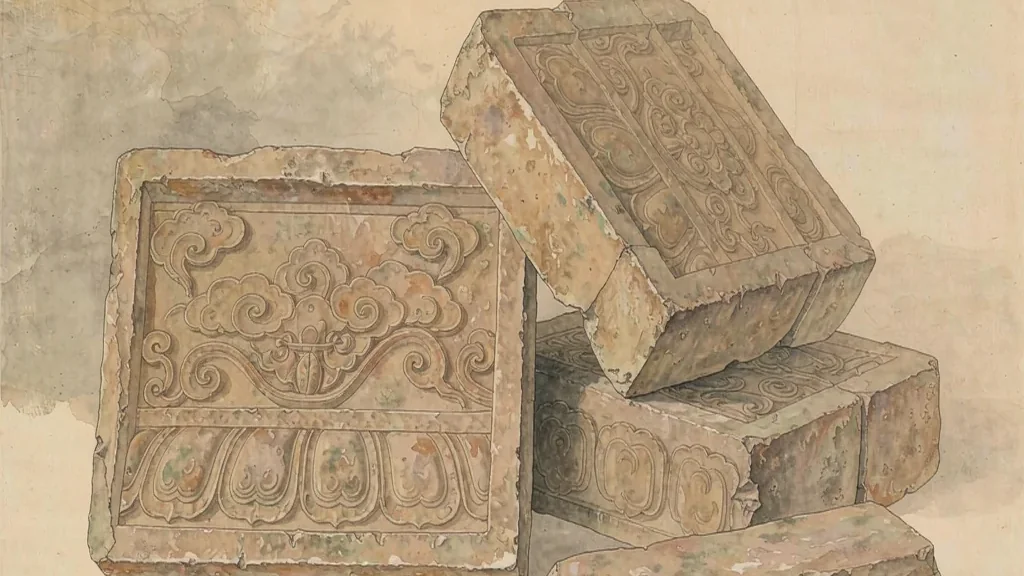
Before the age of photography, and even before the widespread use of paper, the Chinese recorded their beliefs and daily life in fired clay bricks and tiles. Molded brick (画像砖, huàxiàng zhuān) carvings from the Han dynasty provide a remarkable visual record of Chinese civilization — hunting scenes, myths, philosophical parables, and scenes of agriculture, trade, and entertainment, all preserved in baked clay.
The Han Golden Age
The Han dynasty was the golden age of Chinese molded brick. Tombs were constructed with large bricks stamped or carved with images before firing. The bricks assembled into narrative friezes that decorated tomb walls, creating a permanent picture book for the deceased.
Han brick subjects include the Queen Mother of the West, Confucian parables, and scenes of hunting, farming, and chariot processions.
Techniques of Brick Molding
Two techniques were used: stamping and carving. In stamping, a mold with the design in raised relief was pressed into damp clay. In carving, the design was incised directly into leather-hard clay. Stamping allowed mass production while carving was used for unique works.
The Sichuan School
The most famous Han molded bricks come from Sichuan, where a distinctive school of brick carving flourished. Sichuan bricks are larger and more detailed, with complex compositions including multiple figures and detailed backgrounds.
Tile End Decorations
Beyond tomb bricks, Chinese ceramic mold work includes decorated tile ends (瓦当, wǎdāng) on roof eaves. These circular or semi-circular tiles carry auspicious characters for 'longevity' and 'happiness.'
The Subjects of Han Tomb Bricks
Han tomb bricks depict an extraordinary range of subjects that provide a window into Han dynasty life. Agricultural scenes show plowing, sowing, harvesting, and winnowing with remarkable accuracy. Hunting scenes show hunters with bows and arrows chasing deer, rabbits, and birds. Feast scenes show banquets with musicians, dancers, and servants.
Mythological subjects are equally rich: the Queen Mother of the West (西王母, Xīwángmǔ) seated on her throne; the winged immortals who inhabit the eastern paradise; the sun crow and the moon toad; dragons, phoenixes, and other auspicious beasts. The bricks also show Confucian parables — stories of filial piety, loyalty, and scholarship that were meant to instruct the living as well as accompany the dead.
The Technical Mastery of the Brick Carvers
The carvers who made the wooden molds for Han bricks were highly skilled artisans. The design had to be carved in reverse (intaglio) in the wooden mold, so that the impression in the clay would be in raised relief. The carver had to think three-dimensionally, understanding how the positive image would emerge from the negative mold.
The bricks were stamped with the mold while the clay was still damp, then removed and stacked for drying. After drying, the bricks were stacked in a kiln and fired at low temperature (800-900 C). The resulting bricks were porous but hard, and their surface still bears every detail of the original wooden mold.
Tile Ends: A Related Art Form
Chinese ceramic mold work extended beyond tomb bricks to include decorated tile ends (瓦当, wǎdāng) used on roof eaves. These circular or semi-circular tiles carried auspicious characters — 'longevity' (寿, shòu), 'happiness' (喜, xǐ), 'ten thousand years' (万岁, wànsuì) — and designs of animals, clouds, and geometric patterns.
Tile ends were made using the same stamping technique as tomb bricks. They were placed at the end of roof beams, where their decoration was visible from below. The tile ends of the Han dynasty are particularly prized by collectors and are still studied by calligraphers for the quality of their character designs.
Han Bricks as a Window on Daily Life
Han molded bricks are among the most talkative objects the dynasty left behind. Stamped with scenes of farming, winnowing, hunting, music, acrobatics, and mythic beasts, they record how ordinary people lived, worked, and imagined the world beyond death. A single brick can show a roofed granary, a procession of officials, or the Queen Mother of the West enthroned among immortals, turning a tomb wall into a pictographic archive of Han society. Because the images were made for the dead to use in the afterlife, they are frank and detailed in a way official histories rarely are. For modern scholars the bricks are therefore a precious complement to texts: a self-portrait of a vigorous, earthly culture that trusted even its burial goods to tell the story of daily life.
❓ Frequently Asked Questions
📝 Chinese Vocabulary
画像砖 — : pictorial brick.
瓦当 — : tile end.
拓片 — : rubbing.
墓砖 — : tomb brick.
画像砖 — : pictorial brick; brick with carved image
瓦当 — : decorated tile end
拓片 — : rubbing; ink impression of a carved surface
模印 — : Mu yin, mold-imprinting, the method of pressing moist clay into a carved mold to repeat a relief design across many bricks.
🎉 Fun Facts
- Han bricks look as fresh today as 2,000 years ago.
- Sichuan bricks have been stolen from tombs and sold internationally.
- Rubbings of Han bricks have been collected by calligraphers for centuries.
- Han bricks from Sichuan are so prized that they have been stolen from Chinese tombs and sold internationally for decades.
- Some Han bricks show scenes of salt mining, providing the earliest known images of this industry in China.
- Because the designs were stamped with reusable molds, one workshop could produce hundreds of near-identical story-bricks, yet no two fired bricks wear exactly the same after two thousand years of soil and weather.