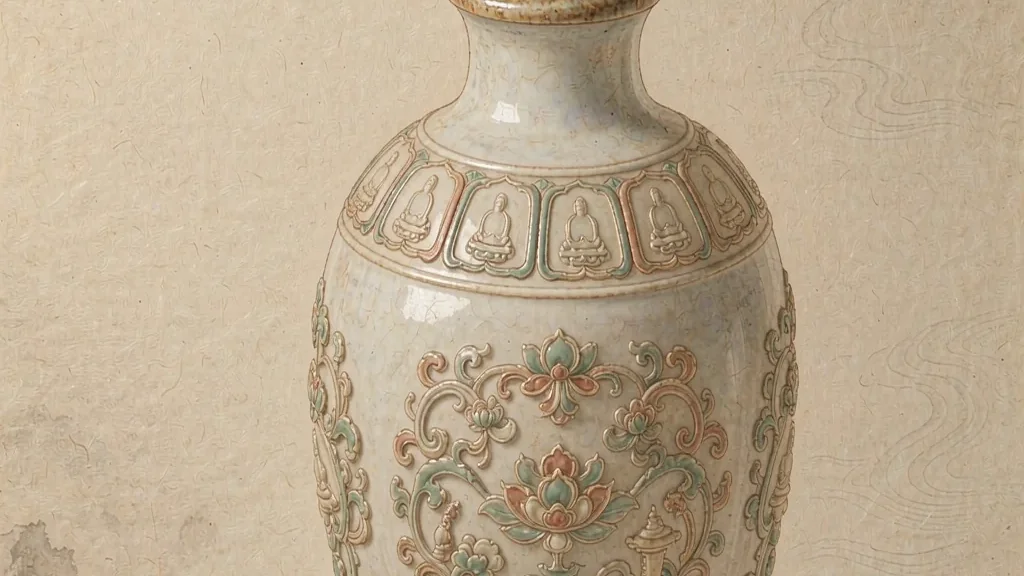
No Chinese art form is more intimate and delightful than the snuff bottle (鼻烟壶, bíyānhú). These tiny bottles, typically 5-8 cm tall, were used to hold powdered tobacco and became, during the Qing dynasty, the most personal and highly refined of Chinese decorative arts. From the emperor to the merchant, every man of means carried a snuff bottle, and the finest bottles were small masterpieces that combined every technique in the Chinese repertoire: carved jade, inside-painted glass, enameled porcelain, and carved lacquer.
The Arrival of Snuff
Snuff, powdered tobacco, was introduced to China by Jesuit missionaries in the 17th century. The Kangxi Emperor adopted the habit, and the court quickly followed. Snuff was believed to have medicinal properties, clearing the sinuses and preventing disease.
The Shape of the Bottle
The classic snuff bottle is a small, flat-sided vessel with a short neck and a spoon attached to the stopper. The spoon is used to extract the snuff. The bottle is typically 5-8 cm tall and designed to be held in one hand.
Inside-Painted Snuff Bottles
The most remarkable snuff bottle technique is inside painting (内画, nèihuà). Using a brush bent at an angle, the artist paints scenes on the interior surface of the glass bottle, working through the narrow neck. The scenes can be extraordinarily detailed: landscapes, figures, birds, and flowers.
Materials and Techniques
Snuff bottles were made from virtually every material used in Chinese decorative arts: jade, glass, porcelain, ivory, lacquer, wood, hornbill ivory, amber, and precious metals.
Inside-Painted Snuff Bottles: Art Through the Bottleneck
Inside painting (内画, nèihuà) is the most remarkable technique in snuff bottle art. The artist uses a brush with a bent tip that is inserted through the bottle's narrow neck — typically only 2-3 mm in diameter. The painting is done on the interior surface of the glass, working in reverse: the artist must paint the foreground elements first, then the background, in the opposite order of normal painting.
The most famous inside-painting artists were active in Beijing and Zibo (Shandong) during the late Qing dynasty. Masters like Yu Zuoren (余作人), Zhou Leyuan (周乐元), and Ma Shaoxuan (马少宣) created works that could be viewed only under magnification. Their subjects ranged from landscapes and portraits to calligraphy and scenes from literature. A single bottle could take weeks or months of painstaking work.
The Materials of Snuff Bottles
Snuff bottles were made from virtually every material in the Chinese decorative arts repertoire. Jade snuff bottles were carved from nephrite or jadeite, often with the natural color of the stone incorporated into the design. Glass snuff bottles were made in various colors, including imitation jade (glass that mimicked the appearance of jade). Porcelain snuff bottles were painted with underglaze blue or overglaze enamels.
Other materials included ivory, carved with landscapes or figures; lacquer, built up in layers and carved; hornbill ivory, a precious material from the helmeted hornbill; amber, which could be transparent, translucent, or filled with fossilized insects; and silver or gold, decorated with filigree or repoussé. The variety of materials was part of the collecting appeal.
The Social World of Snuff Bottles
Snuff bottles were not just containers but social objects. When two gentlemen met, the exchange of snuff bottles was a formal ritual: each would offer his bottle to the other, who would examine it, admire it, and return it. The quality of a man's snuff bottle was a statement of his taste, wealth, and social status.
The Qianlong Emperor's snuff bottle collection, the most famous in Chinese history, contained over 1,000 bottles. The emperor would change his bottle daily, matching it to his robes and the occasion. After his death, his collection was dispersed and some pieces entered European collections, where they helped establish the snuff bottle as a collectible art form in the West.
Snuff Bottles in the Qing Court
The Qing court turned the snuff bottle from a simple container into an instrument of state. Imperial workshops inside the Forbidden City produced bottles in jade, enamel, and inside-painted glass for the emperor and for diplomatic gifts, and the Qianlong Emperor is said to have owned more than a thousand. Because the bottle was carried at the belt and offered in greeting, its material and decoration quietly announced the owner's rank and taste. Court artists competed to fit entire poems, imperial reign marks, and miniature scenes onto a surface smaller than a matchbox. Foreign envoys who received a bottle as a gift carried a piece of Qing craftsmanship back to Europe, where it amazed collectors and helped spark the Western passion for Chinese curiosities that lasts to this day.
❓ Frequently Asked Questions
📝 Chinese Vocabulary
鼻烟壶 — : snuff bottle.
内画 — : inside painting.
鼻烟 — : snuff; powdered tobacco.
玛瑙 — : agate; a common snuff bottle material.
鼻烟壶 — : snuff bottle
内画 — : inside painting; interior surface painting
鼻烟 — : snuff; powdered tobacco
鼻烟 — : Powdered tobacco inhaled through the nose, the substance that snuff bottles were made to contain and that arrived in China via European contact in the 1600s.
🎉 Fun Facts
- Inside-painted snuff bottles require extraordinary skill — the artist cannot see the brush tip while painting.
- The smallest known snuff bottle is just 1.5 cm tall.
- Snuff bottles were often given as diplomatic gifts by Qing emperors.
- The smallest known snuff bottle is only 1.5 cm tall and was carved from a single piece of jade.
- Some inside-painted bottles contain portraits of real people that are so detailed, the subject can be identified from the miniature image.
- The smallest known functional snuff bottles are barely larger than a thumbnail, yet a few still carry fully painted miniature landscapes on their interior walls, visible only when held to the light.