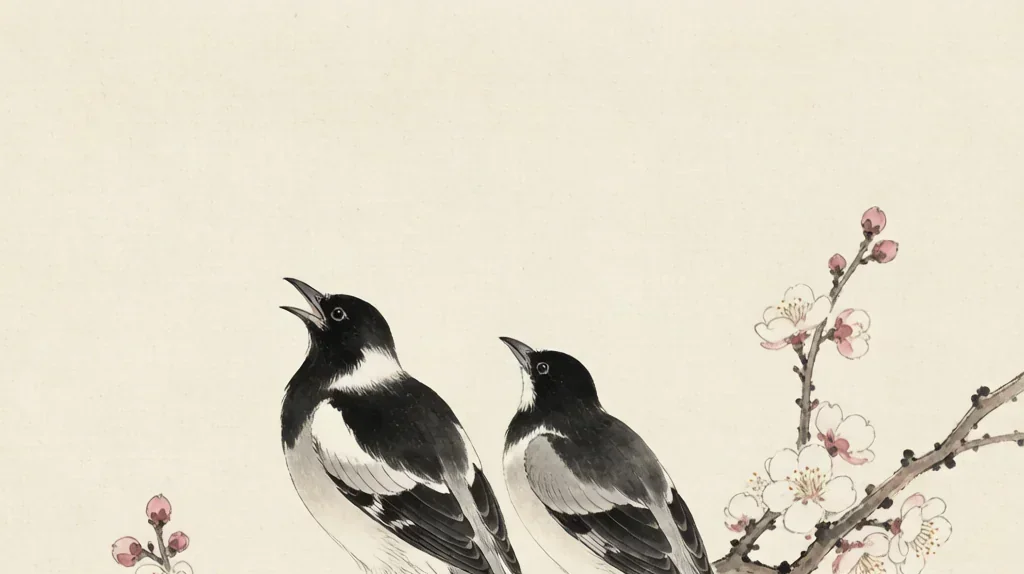
In Chinese visual culture the magpie (喜鹊, xǐ què) is one of the most beloved birds, treasured not for its song but for what it is believed to bring. Unlike the mournful crow, the magpie is regarded as a herald of good news, joy, and the arrival of welcome guests. For well over a thousand years it has appeared in paintings, embroidery, New Year prints, and everyday proverbs as a small black-and-white bird that carries happiness on its wings. To understand the magpie is to understand a larger Chinese habit of reading the natural world as a code of omens, where a bird seen at the right moment could lighten an entire household's mood.
Origins of the Magpie's Lucky Reputation
The magpie's fortunate status rests largely on wordplay. In Mandarin the bird is called xǐ què, and the first syllable xǐ means "joy" or "happiness." Because the crow (乌鸦, wū yā) was long associated with bad omens, people contrasted the two corvids and assigned the brighter, chattier magpie the role of a happy messenger. Over centuries this phonetic association hardened into a genuine folk belief.
Early references to the magpie as a bird of omen appear in classical texts on the natural world and on divination. By the Tang dynasty the idea that "a magpie calling means a guest is coming" was already a common saying. The bird's place in the Chinese imagination was secured not by biology but by a charming coincidence of sound and meaning.
Farmers also noticed that magpies are active and noisy in the morning, precisely when visitors or travelers were most likely to appear. This everyday observation fed the folklore that the bird announces arrivals before they happen.
The Magpie and the Coming of Guests
Among the most enduring Chinese sayings is "喜鹊叫声声,客人就来临" — when the magpie calls, a guest is near. In rural communities, where a visitor was often a rare and happy event, the sight of a magpie hopping on the rooftop was a reason to tidy the house and prepare tea. The bird became a living doorbell of good fortune.
This association made the magpie a favorite motif on door panels, window lattices, and the red couplets pasted during Spring Festival. A magpie perched near a plum branch (喜上眉梢, "joy on the brow") was a visual pun wishing the household constant good news.
In some regions the magpie was also linked to matchmakers and marriage. A pair of magpies could signify a coming engagement, weaving the bird into the language of romance as well as hospitality.
The Magpie Bridge: Qi Xi and the Cowherd
The magpie's most famous myth is its role in the Qī Xī festival, the "Double Seventh" celebration of the Cowherd (牛郎, Niú Láng) and the Weaver Girl (织女, Zhī Nǚ). According to legend, the two lovers were separated by the heavenly river (the Milky Way) and permitted to meet only once a year, on the seventh night of the seventh lunar month.
On that night, so the story goes, flocks of magpies fly up to the sky and form a living bridge (鹊桥, què qiáo) across the Milky Way so the lovers can cross and reunite. The "Magpie Bridge" became a poetic synonym for any reunion of separated lovers and for the tender overcoming of distance.
Because of this tale, the magpie is not merely lucky but romantic, a builder of connections. Poets across the dynasties used the image of the magpie bridge to express longing, fidelity, and the sweetness of brief meetings.
Magpie in Painting and Decorative Arts
Chinese painters developed a whole vocabulary of magpie imagery. A single magpie on a blossoming branch, two magpies facing each other, or a magpie beside a moon gate each carried its own meaning. The bird paired naturally with plum, bamboo, and pine, all symbols of resilience and renewal.
In folk woodblock prints (年画, nián huà), the magpie was a staple of the New Year's domestic scene. Bright, cheerful, and easy to recognize, it advertised the family's hope for a year full of good reports. Such prints were mass-produced in workshops like those at Yangliuqing and Taohuawu.
Embroidery, porcelain, and lattice windows also carried the magpie. On a bride's trousseau, magpie designs wished her a joyful marriage and many happy messages from home.
Phonetic Wordplay and Visual Puns
Chinese decorative art loves puns, and the magpie is a star of the genre. The phrase 喜上眉梢 (xǐ shàng méi shāo) pairs xǐ (joy) with méi, the word for both "plum" (梅) and "eyebrow" (眉). A magpie on a plum branch thus reads as "joy arriving at the brows" — a wish for constant happiness.
Another common composition places a magpie and a hare or magpie and bamboo, each combination triggering a different auspicious reading. Because the bird's name is the very word for happiness, almost any scene containing it is automatically a blessing.
This punning habit meant the magpie rarely appeared "neutrally." Even a simple nature study was understood as a tiny prayer for good fortune, blurring the line between art and wish.
The Magpie Versus the Crow
The magpie's fortune is defined in part by contrast with the crow, its dark cousin. While the crow's caw was heard as a warning and linked to mourning, the magpie's chatter was welcome. Proverbs explicitly pit the two: a crow's cry brings worry, a magpie's brings joy.
This duality reflects a broader Chinese tendency to sort animals into auspicious and inauspicious camps. The magpie sits firmly among the auspicious, alongside cranes, deer, and bats, while the crow shares less pleasant company.
Interestingly, the same corvid family produces both birds, a reminder that folk classification follows feeling and sound more than scientific kinship. The magpie won its place through temperament and tongue.
Regional Folk Beliefs
Beliefs about the magpie vary by region but agree on its kindness. In northern villages the first magpie song of the morning could set the tone for the day. In parts of the south, a magpie landing on one's roof was a sign that relatives would soon visit.
Some local customs held that harming a magpie brought misfortune, so the birds were tolerated even when they raided orchards. Their nests were left undisturbed, protected by superstition as much as by affection.
During the Qī Xī festival, girls in several regions would look to the sky and, according to custom, prick their fingers and let a drop of blood fall — a ritual echo of the weaver girl's tears — while thanking the magpies for building the bridge.
Magpie in Poetry and Literature
From the Tang onward, poets used the magpie to mark time, mood, and home. A magpie startled at dusk might signal a traveler's rest; a magpie at the window might mark a letter's arrival. The bird's presence in verse is rarely merely decorative.
In classical fiction and drama the magpie often appears at turning points — the moment before good news arrives or before lovers reunite. It functions almost like a stage cue for happiness, preparing the reader for relief.
Folk songs, too, invoke the magpie as a cheerful companion. Its familiar call is the soundtrack of a well-ordered, hospitable home.
The Magpie in Modern China
Today the magpie remains a warm, recognizable symbol. It appears on festive cards, in cartoon mascots, and in the names of companies and products that want to promise good tidings. The Qī Xī "Magpie Bridge" is still the most poetic name for the lovers' reunion and is recycled in songs and films.
Although few urban Chinese literally believe a magpie forecasts a guest, the association survives as cultural shorthand. To call someone a "magpie" (喜鹊) is still a gentle compliment about bringing cheer.
The bird thus bridges the ancient and the everyday: a small, chattering creature that has carried China's hopes for news, guests, and love across more than a millennium.
Comparing the Magpie to Other Lucky Birds
The magpie shares the stage with other auspicious birds — the crane (longevity), the peacock (dignity), and the mandarin duck (conjugal love). Each has its specialty; the magpie's is the announcement of joy itself.
Where the crane speaks to the cosmic and the immortal, the magpie speaks to the domestic and the immediate. It is the bird of the doorway rather than the mountain, of the letter rather than the temple.
Together these birds form a kind of symbolic roster from which painters and decorators could assemble exactly the blessing a given room or occasion required.
❓ Frequently Asked Questions
Why is the magpie considered lucky in China?
Its name xǐ què contains xǐ, the word for "joy," and its noisy morning calls seemed to announce arriving guests, so it became a herald of good news and happiness.
What is the Magpie Bridge legend?
On the seventh night of the seventh lunar month, magpies form a bridge across the Milky Way so the separated Cowherd and Weaver Girl can reunite once a year.
How is the magpie different from the crow in folklore?
The crow's caw is read as a warning linked to mourning, while the magpie's chatter is welcomed as a sign of coming joy and visitors.
What does a magpie on a plum branch mean?
It is a pun on xǐ shàng méi shāo, "joy on the brows," wishing the household constant happiness and good news.
Where do magpies appear in Chinese art?
They appear in ink paintings, New Year woodblock prints, embroidery, porcelain, and lattice windows, almost always as a blessing.
Is the magpie still meaningful today?
Yes; it survives as cultural shorthand for good tidings on cards, mascots, and in the enduring name "Magpie Bridge" for lovers' reunions.