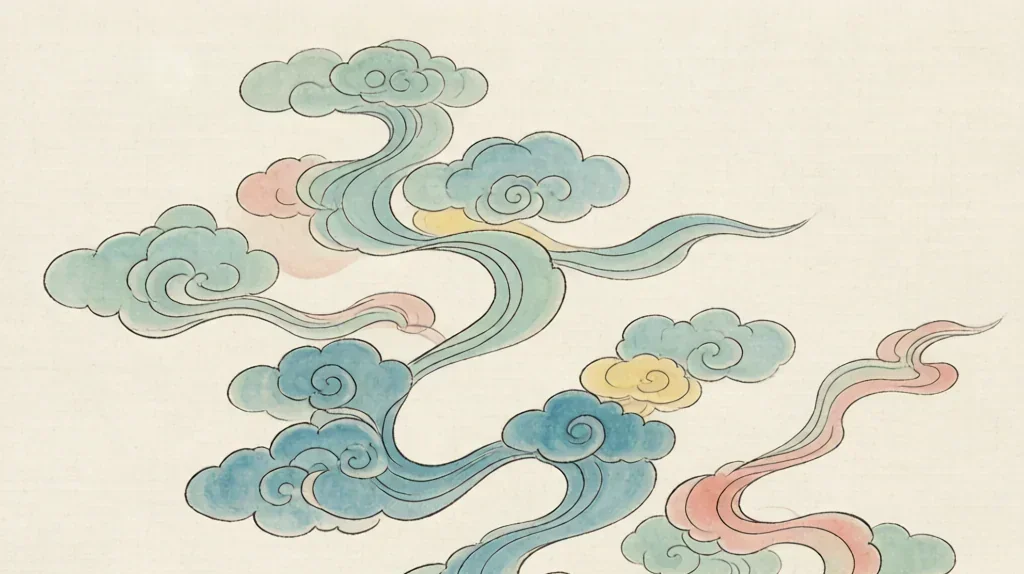
The auspicious cloud, known in Chinese as 祥云 (xiáng yún), is one of the most pervasive decorative motifs in Chinese art and architecture. Unlike ordinary weather, the xiáng yún is a stylized, curling cloud imbued with good fortune — a visual blessing rather than a meteorological event. For two thousand years it has swirled across the robes of emperors, the walls of temples, the borders of scrolls, and the edges of celestial maps, marking whatever it surrounds as touched by heaven's favor. To understand the auspicious cloud is to understand how the Chinese turned the sky itself into a language of hope.
What Is a Xiangyun?
A xiáng yún is not a realistic cloud but a formalized, symmetrical swirl — a spiral capped with a rounded head and trailing ribbons, repeated in rhythmic rows. Its very regularity signals that this is a manufactured omen, an artistic convention rather than a snapshot of the weather.
The character 祥 (xiáng) means "auspicious" or "propitious," so the term literally reads "auspicious cloud." The motif separates the lucky cloud from the plain one, much as the magpie is separated from the crow.
Artists developed many sub-types — the "ruyi cloud," the "rolling wave cloud," the "cloud-and-mountain" pattern — each a variation on the basic curling unit, adaptable to any surface.
Early Origins in Jade and Bronze
The cloud-and-thunder pattern (云雷纹, yún léi wén) appears on Neolithic and Shang–Zhou bronze vessels, where squared spirals filled every empty space. These early "cloud" motifs were abstract, almost graphical, but they established the habit of filling surfaces with auspicious swirls.
By the Han dynasty, clouds became rounder and more explicitly celestial, carrying immortals and floating palaces in tomb paintings. The cloud was the medium of the heavens, the substance on which the blessed rode.
Jade carvers, too, adopted the curling cloud as a border and as a stand-alone ornament, linking the stone's purity with heavenly favor.
Clouds as the Transport of Immortals
In Daoist cosmology, clouds are the vehicle of the immortals (仙人, xiān rén). Deities and perfected beings do not walk; they "ride the clouds" (腾云驾雾, téng yún jià wù). The xiáng yún therefore marks the presence of the sacred and the reachable.
Paintings of the Queen Mother of the West, the Eight Immortals, or the boyi riding through the sky place them on billowing auspicious clouds, visually announcing their holy status and their distance from the mortal dust below.
This made the cloud a kind of divine stage: wherever it appears, the viewer knows the heavenly realm is near.
Xiangyun in Imperial Dress and Architecture
On the dragon robes (龙袍, lóng páo) of emperors, auspicious clouds were woven among the dragons, waves, and mountains of the "full audience" design, marking the sovereign as favored by heaven. The number and placement of clouds followed strict court protocol.
In architecture, cloud brackets (斗拱, dǒu gǒng) and ceiling coffers were carved and painted with cloud scrolls, lifting the eye toward the sky. Temple beams and palace lintels wore rows of xiáng yún as a kind of heavenly wallpaper.
Even humble objects — a teapot, a window frame — could carry a modest cloud border, democratizing the symbol for everyday use.
The Ruyi Cloud and Wordplay
One popular variant is the "ruyi cloud," whose head resembles the ruyi scepter's shape. Because ruyi means "as you wish," this cloud doubles the blessing: it is both auspicious and a pun on granted desires.
The fusion shows how Chinese ornament stacks meanings. A single border might simultaneously invoke heaven's favor, the granting of wishes, and the elegant curve of a court object.
This layering is why the xiáng yún rarely feels empty; every curl can carry a sentence's worth of implied blessing.
Clouds in Painting and Scrolls
Landscape painters used clouds to separate peaks, suggest mist, and create breathing space in a composition. A skillfully left gap of silk or paper became a "cloud," linking the mortal mountain to the immortal haze above.
In Buddhist murals at Dunhuang, clouds carry apsaras (flying celestials) across the cave ceilings, their ribbons merging with cloud scrolls in a single rhythm of motion.
The cloud thus functioned compositionally and symbolically at once — both a design device and a theological statement.
Cloud Patterns as Borders and Frames
Because the xiáng yún is modular, it makes an ideal border. Scroll handlers, mirror backs, and textile edges often repeat the motif in a continuous band, framing the central image with a ribbon of luck.
This framing role is important: the cloud does not always occupy the center. Often it surrounds, supports, and consecrates the main subject — a dragon, a Buddha, a character — by declaring the field around them auspicious.
In this way the motif behaves like a blessing spelled around the edges of a thing.
Modern and Global Afterlife
The auspicious cloud survives in contemporary design — logos, festival banners, and the uniforms of Chinese athletes at international games have all echoed the xiáng yún curve. It reads instantly as "Chinese" and "fortunate."
During the 2008 Beijing Olympics, cloud patterns (the "xiangyun" torch and motifs) were a deliberate revival, presenting the motif to a global audience as a signature of Chinese auspiciousness.
The cloud has thus traveled from bronze vessels to the world stage without losing its basic grammar of curling goodwill.
Xiangyun Compared With Other Sky Motifs
The xiáng yún belongs to a family of heavenly signs that includes the rainbow, the comet (usually inauspicious), and the "qi" vapor. But the auspicious cloud is uniquely positive and endlessly repeatable.
Where a rainbow is a rare event, the xiáng yún is a manufactured constant — you can print it a thousand times. This repeatability is exactly why it became the workhorse of Chinese ornament.
Paired with symbols like the crane or the magpie, the cloud supplies the heavenly setting in which those lucky creatures dwell.
❓ Frequently Asked Questions
What is a xiangyun?
It is a stylized, curling "auspicious cloud" motif whose name literally means "lucky cloud," used as a decorative blessing rather than a realistic weather form.
Where did the auspicious cloud originate?
Its ancestor is the cloud-and-thunder spiral on Shang and Zhou bronzes; by the Han dynasty clouds became rounded, celestial vehicles for immortals.
Why are clouds linked to immortals?
In Daoist belief deities "ride the clouds," so the motif marks the presence of the sacred and the heavenly realm.
How was the cloud used on imperial dress?
Auspicious clouds were woven among the dragons on emperor dragon robes, signaling that the sovereign was favored by heaven.
What is a ruyi cloud?
It is a variant whose head mimics the ruyi scepter, adding the pun "as you wish" to the cloud's basic blessing of good fortune.
Does the motif still appear today?
Yes; it appears in logos, festival décor, sports uniforms, and was featured on the 2008 Beijing Olympic torch.