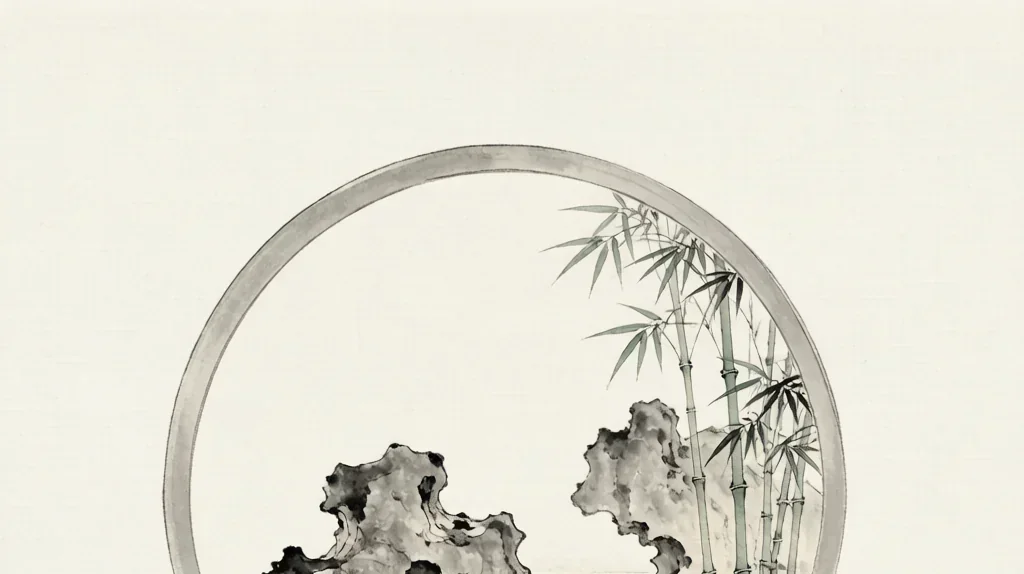
The moon gate (月洞门, yuè dòng mén) is one of the most elegant inventions of Chinese garden design — a circular opening in a garden wall that frames a view as if it were a painting. Neither a door that closes nor a window that opens, it is a pure threshold, an invitation to pause and look. Found in the private gardens of Suzhou and the courtyards of scholar-officials, the moon gate turns movement through a space into a slow, deliberate act of seeing. It is at once architecture, picture frame, and philosophical statement about the gentle passage from one mood to another.
What Exactly Is a Moon Gate?
A moon gate is a circular opening cut into a solid garden wall, usually large enough for a person to walk through. The wall itself remains, dividing two garden spaces, but the round hole lets light, sight, and footsteps pass. The circle is the point: a perfect, calm geometry set against the rectangular grid of buildings.
Strictly, it is a "moon hole" (月洞, yuè dòng) in a wall rather than a hinged gate, though "gate" captures its role as a passage. Some versions sit freestanding as a garden feature; others pierce the wall between a lane and a courtyard.
The opening is often edged with a raised border of stone or brick, sometimes in a contrasting color, which sharpens the sense that you are looking through a framed picture.
Origins and Garden Philosophy
The moon gate belongs to the tradition of the scholar's garden (文人园, wén rén yuán), which matured in the Jiangnan region, especially Suzhou, during the Ming and Qing dynasties. These gardens prized "borrowed scenery" (借景, jiè jǐng) — the art of framing distant or neighboring views to make a small garden feel infinite.
The circle reflects the Chinese esteem for roundness as a symbol of completeness and heaven (as opposed to the square, associated with earth). Passing through it was a small ritual of transition.
Garden theorists such as Ji Cheng, author of the Yuan Ye (园冶, "Craft of Gardens"), codified such devices, teaching builders how openings could shape perception.
Borrowed Scenery and the Framed View
The moon gate's chief magic is that it turns whatever lies beyond into a composed image. A single rock, a spray of bamboo, a branch of blossom — ordinary things — become a living scroll when seen through the ring.
This is "borrowed scenery" made literal: the wall hides the clutter of the rest of the garden, and the circle selects only the essential. The viewer's eye is trained by the architecture to see like a painter.
Because the framed scene changes with the seasons and the time of day, the same gate offers a different "painting" every visit — a built-in renewal.
Moon Gate Versus the Moon Window
A close cousin is the "moon window" (月窗, yuè chuāng), a circular opening in an interior wall or a screen that frames a garden view from inside a room. The difference is mainly whether you walk through it or look through it.
Both share the circular language and the same goal of distillation. The window lets a scholar enjoy the garden from his study; the gate lets him step into it.
Together they show how Chinese garden design treats openings as instruments of attention rather than mere holes for passage or light.
Craftsmanship and Materials
Building a true circle in brick and stone is exacting work. Craftsmen laid tapered wedge bricks in a radiating ring, a technique akin to arch construction, to hold the curve without a supporting lintel.
The surrounding wall was often whitewashed (the famous "powder wall" of Suzhou gardens), making the dark circle pop. A border of gray tile or carved stone gave it definition.
In finer gardens the ring might be echoed by a matching circular pond or a round table nearby, repeating the geometry in furniture and water.
Symbolism of the Circle
In Chinese thought the circle suggests the moon, completeness, reunion, and the heavens. A gate shaped like the full moon thus carries quiet wishes for wholeness and togetherness as one moves from space to space.
The moon itself is a recurrent Chinese symbol of family reunion (think of the Mid-Autumn Festival), so the "moon" gate resonates with themes of coming together and cyclic return.
At the same time, the empty circle is a Buddhist-inflected reminder of openness and emptiness — a form that contains nothing yet reveals everything.
Moon Gates in Famous Gardens
The classical gardens of Suzhou — such as the Humble Administrator's Garden (拙政园, Zhuō Zhèng Yuán) and the Garden of the Master of the Nets (网师园, Wǎng Shī Yuán) — contain celebrated examples. Visitors often photograph the ring with a single tree framed inside.
These gardens, now recognized on the UNESCO World Heritage list, preserve the moon gate as a signature of Jiangnan taste. Each garden places its gates to choreograph a sequence of revealed and hidden views.
The device also appears in courtyard homes and temple compounds, where a round opening separates the secular front from the sacred or private back.
The Moon Gate in Modern Design
The motif has leapt beyond China. The circular garden opening appears in Western landscape design, interior architecture, and even as a social-media backdrop, prized for its photogenic calm.
In contemporary Chinese restaurants, hotels, and parks, a moon gate often stands as a decorative nod to classical taste — sometimes freestanding, purely for framing a view or a plant.
Its global spread shows how a highly specific garden technique became a universal sign of serenity and "the Chinese aesthetic."
Experiencing a Moon Gate
To walk a Chinese garden well is to treat the moon gate as a prompt to slow down. Approaching, you see a tantalizing slice of the other side; passing through, the slice expands into a room; turning back, the view reverses into a new composition.
Gardeners deliberately placed benches or stones near gates so visitors would sit and contemplate the framed scene. The architecture assumes you have time.
In this sense the moon gate is less a door than a lesson in attention — a circular window cut into the hurry of daily life.
❓ Frequently Asked Questions
What is a moon gate?
It is a circular opening cut into a Chinese garden wall that frames a view like a painting and serves as a gentle passage between spaces.
Where did moon gates originate?
They belong to the Jiangnan scholar-garden tradition that matured in Suzhou during the Ming and Qing dynasties.
What is "borrowed scenery"?
It is the garden technique of framing neighboring or distant views through openings so a small garden feels boundless; the moon gate is its clearest tool.
How is a moon gate different from a moon window?
The gate is walked through; the moon window is a circular opening in an interior wall you look through from a room.
What does the circle symbolize?
Roundness suggests the moon, completeness, reunion, and heaven, carrying quiet wishes for wholeness.
Can you see famous moon gates today?
Yes; Suzhou gardens such as the Humble Administrator's Garden preserve celebrated examples and are open to visitors.