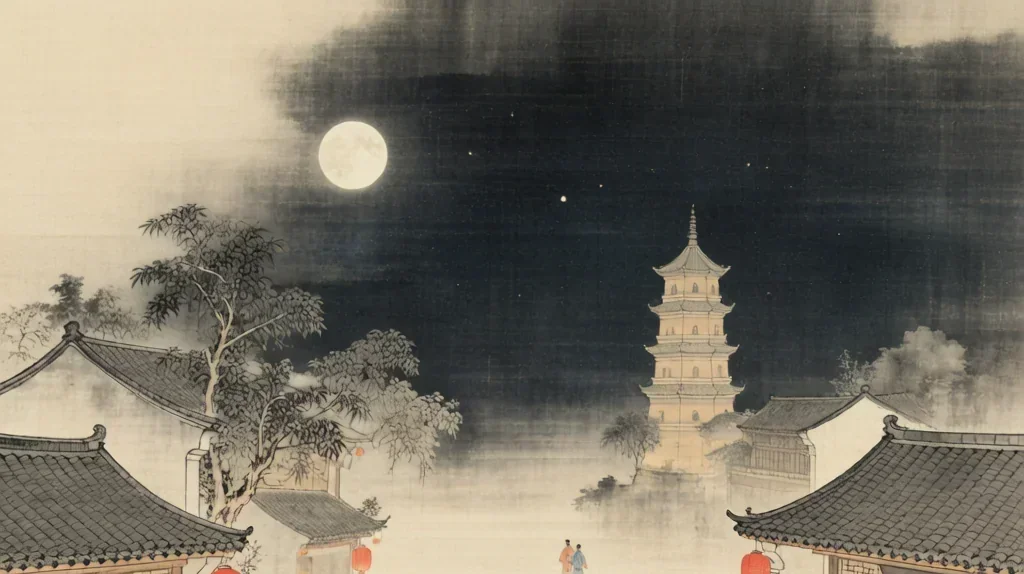
On the 15th night of the first lunar month, the streets of every Chinese town are lit with red lanterns. Some are small enough to hold in a child's hand; some are enormous, spinning figures of horses and dragons taller than a man. And on many of these lanterns, written in calligraphy on small strips of red paper, hang riddles — short, cryptic phrases that hint at a single Chinese character, a famous name, or a line of poetry. Walk the lantern-lit street, find a riddle that catches your eye, puzzle over it, and when you think you have the answer, take it to the lantern-keeper. If you are right, you win a small prize — a fan, a bag of sweet dumplings, a paper flower — and the satisfaction of having unlocked, for a moment, the strange and intricate machinery of the Chinese language.
This is 灯谜 (dēng mí), "lantern riddle" — one of the most beloved customs of the Lantern Festival (元宵节, yuán xiāo jié), which closes the two-week celebration of the Chinese New Year. Lantern riddles are not children's riddles in the Western sense ("What's black and white and read all over?"). They are miniature works of literary art, exploiting the unique features of the Chinese writing system — its characters, its homophones, its thousand-year-old poetry — to conceal meaning in plain sight. To solve one is to perform a small act of decryption; to write one is to compose a tiny poem whose subject is hidden by its own words.
The Lantern Festival: Riddles' Home
The Lantern Festival falls on the 15th day of the first lunar month, the first full moon of the lunar year. It marks the end of the New Year celebrations: families eat sweet rice balls (汤圆 or 元宵), admire lanterns, and — most importantly for our purposes — guess riddles. The festival dates back at least to the Han Dynasty (206 BCE–220 CE), when Emperor Wen designated the 15th of the first month as an official festival. By the Tang Dynasty, lantern-viewing had become a grand public event, with the streets of Chang'an lit for three sleepless nights.
The custom of attaching riddles to lanterns is generally traced to the Song Dynasty (960–1279), when literati began writing riddles on slips of paper and pasting them on the lanterns displayed at the capital's Lantern Festival. The practice spread from the elite salons to the popular festivals, and by the Ming and Qing it was a national pastime. The riddles were often drawn from classical poetry, history, and opera, so solving them required both wit and learning — a kind of public test of education.
The riddle is also known as 打灯虎 (dǎ dēng hǔ), "shooting the lantern tiger," because a good riddle is as fierce and elusive as a tiger. The metaphor stuck: even today, to solve a difficult riddle is to "shoot the tiger."
How a Lantern Riddle Works
Chinese lantern riddles exploit features of the Chinese language that have no real equivalent in English. Three are central.
1. Character dissection (拆字, chāi zì). A Chinese character is built from components — radicals, phonetic parts, simple strokes. A character-dissection riddle describes the components without naming the character, and the solver must mentally reassemble them. For example: "Once there was one, but now there is none" (曾经有一,现在没有). The answer is the character 人 (rén, "person"). Why? Because the character 曾 (céng, "once") contains the component 一 (yī, "one") at its lower left. Remove the "one" from "once," and you have... well, not exactly a character, but the riddle's cleverness is in the misdirection. More typical: "Ten mouths together" (十口合在一起). The components 十 ("ten") and 口 ("mouth") combined yield the character 古 (gǔ, "ancient"). The solver must think visually, in strokes and radicals, not in sounds.
2. Homophonic wordplay (谐音, xié yīn). Chinese is rich in homophones — words that sound identical but mean completely different things. A homophonic riddle exploits this to mislead. For example: "What can you wear that is also a country?" The answer: 中国 (Zhōng guó, "China") — because 中 (zhōng) sounds like 钟 (zhōng, "bell," as in a wristwatch). To wear a "zhong-guo" is to wear a "clock-fruit" — a wristwatch. The solver must hold two meanings of the same sound in mind at once.
3. Poetic allusion (用典, yòng diǎn). Many riddles draw on the vast reservoir of classical Chinese poetry and history. A line of a famous poem may be the riddle's surface; the answer may be the poem's title, the next line, or an object mentioned in it. For example, a riddle whose surface reads "Moonlight before my bed" expects the solver to recognize the opening of Li Bai's famous poem "Quiet Night Thought" (静夜思) and answer with the title or the author. Such riddles reward a classical education and are often considered the most elegant.
Additional techniques include synonym substitution (giving synonyms for the components of the answer), negation (saying what the answer is not), numerical play (using numbers to suggest components), and "meeting at the midpoint" (a phrase whose middle character is the answer). Skilled riddle-setters often combine multiple techniques in a single riddle, so that the solver must work through several layers of misdirection.
Three Classic Riddles, with Answers
Here are three traditional lantern riddles of different types, with explanations.
Riddle 1 (character dissection): "A woman beside a son."
Answer: 好 (hǎo, "good").
Why: The character 好 is composed of the radical 女 (nǚ, "woman") on the left and 子 (zǐ, "son" or "child") on the right. A woman beside a son is, literally, the character for "good" — a small cultural statement about traditional Chinese values.
Riddle 2 (homophonic): "Two people sitting under a tree."
Answer: 来 (lái, "to come").
Why: The character 来 looks like two people (the two horizontal strokes inside) sitting under a tree (the vertical and lower strokes that suggest a plant). This is a visual riddle, but more strictly: the character 休 (xiū, "to rest") is literally a person (人) under a tree (木), and that's the more common answer. Both are accepted in different traditions.
Riddle 3 (poetic): "Looking up, I see the moon; looking down, I think of home."
Answer: The poem 《静夜思》 (Jìng Yè Sī, "Quiet Night Thought") by Li Bai (李白).
Why: The riddle is a paraphrase of the most famous lines of the most famous poem in the Chinese language — every schoolchild knows it. The solver must recognize the allusion and supply either the title or the author.
The Rules of the Game
Traditional lantern riddles follow a set of conventions that distinguish them from other kinds of riddles and that, when understood, make them solvable. The most important rules:
1. The surface must not contain the answer. A riddle whose answer is "spring" cannot use the character 春 in its wording. This seems obvious, but in Chinese — where many characters share components — it requires care.
2. The surface and the answer must be in different categories. If the answer is a character (字谜), the surface should not be a description of that character's meaning. If the answer is a person's name, the surface should not be about that person. This is the principle of "categories must not overlap" (体不相犯), and it forces the riddle-maker to use misdirection rather than direct description.
3. The riddle must be "elegant" (雅). A good riddle avoids vulgarity, obscurity, and cheap puns. The best riddles sound like ordinary phrases or lines of poetry that only reveal their hidden meaning when the solver sees the trick. A riddle that is too obvious or too obscure is considered in poor taste.
4. The answer must be unique. A good riddle has one and only one answer. If multiple answers are equally valid, the riddle is considered defective.
At lantern festivals, the riddles are usually written on long strips of red paper hung from the lanterns, with a number for reference. When you think you have an answer, you take the number to the lantern-keeper and tell them your guess. If you are right, you receive a small prize — and, in some traditions, you must also explain why your answer is correct, to prove you didn't just guess. If you are wrong, the riddle stays up for the next person.
How to Write Your Own Lantern Riddle
Writing a lantern riddle is a small literary art. Here is a step-by-step method for the most accessible type, the character-dissection riddle.
Step 1: Choose a target character. Pick a moderately common character whose components can be described. 明 (míng, "bright") is a good example — it is composed of 日 (rì, "sun") on the left and 月 (yuè, "moon") on the right.
Step 2: Describe the components without naming the character. For 明, you might say "the sun on the left, the moon on the right." But this is too direct. Instead, describe them indirectly: "When the sun goes down on one side, the moon rises on the other." Or, more poetically: "Day and night standing side by side."
Step 3: Make sure your surface doesn't reveal the answer. Don't use the character 明 itself, or any character that contains it as a component. Avoid the words "sun" and "moon" if possible — describe them instead: "the great light of day" and "the lamp of the night."
Step 4: Refine for elegance. A polished riddle should read like a small, self-contained image. "Day's light beside night's lamp" is more elegant than "the sun next to the moon."
For homophonic riddles, the trick is to find a phrase that uses a word whose sound can be reinterpreted as the answer. For poetic riddles, choose a famous line and describe its setting or context — the solver must recognize the allusion and supply the title, author, or next line.
The pleasure of writing riddles is the inverse of the pleasure of solving them: where the solver decrypts, the writer encrypts, packing meaning into a phrase that appears to say one thing while meaning another. Both pleasures are linguistic in the deepest sense — a celebration of the fact that Chinese, with its characters and homophones and thousands of years of poetry, is one of the most riddle-friendly languages ever devised.
Riddles Today
Lantern riddles remain a living tradition. Major Lantern Festivals — in Nanjing, Beijing, Shanghai, and Taipei — feature huge riddle displays, with thousands of puzzles written by members of local riddle societies. Newspapers and magazines publish special riddle columns during the festival. Online communities of riddle enthusiasts exchange new creations year-round. And in schools, teachers use riddles to teach vocabulary, classical poetry, and the structure of characters — a tradition as old as the Song Dynasty, when riddles were first used to make learning delightful.
What makes lantern riddles endure is that they turn the act of reading into a game. Each riddle is a small locked box made of words; the solver's task is to find the key. And because Chinese characters are themselves pictures built from pictures, the game plays out at every level: in the shape of the characters, in the sounds of the words, in the echoes of the classical canon. To solve a lantern riddle is to remember, in a single moment of insight, that the Chinese language is itself the oldest riddle in the world.
Riddles as a Social Game
At a Lantern Festival the riddle is a public sport. Visitors read the strips hung from the lanterns, puzzle in groups, and bring a number to the lantern-keeper when they think they have the answer. A correct solution wins a small prize, and in some traditions the solver must also explain the reasoning, proving real insight rather than a lucky guess. Because the puzzles draw on poetry, history, and wordplay, solving them became a kind of open test of learning that anyone could join regardless of class. The result is a crowd gathered not only for light but for collective wit, where the joy lies as much in the guessing as in the glow.
Riddles in Classical Literature
Lantern riddles appear throughout Chinese fiction and drama as moments of cleverness and fate. In famous novels such as the Dream of the Red Chamber, characters compose and trade riddles that hint at their personalities and destinies, showing how the form was woven into elite leisure. Over the centuries scholars also compiled anthologies of fine riddles, preserving favored puzzles the way they preserved poems. These collections turned a folk pastime into a documented art, with noted setters admired for elegance of misdirection. Reading those old anthologies today reveals the same delight in the Chinese writing system that festival crowds still feel, a continuity of play across a thousand years.
❓ Frequently Asked Questions
📝 Chinese Vocabulary
灯谜 — : "lantern riddle"; the cryptic riddles written on slips of paper and attached to lanterns at the Lantern Festival, exploiting the unique features of the Chinese writing system.
拆字 — : "character dissection"; the riddle technique of describing the components of a Chinese character without naming it, forcing the solver to reassemble it mentally.
元宵节 — : the Lantern Festival, on the 15th day of the first lunar month — the first full moon of the year and the traditional home of lantern riddles.
打灯虎 — : "shooting the lantern tiger"; an old name for solving lantern riddles, comparing the elusive answer to a tiger to be hunted.
谜面 — : The riddle surface, the cryptic phrase written on the lantern that hides the answer.
谜目 — : The hint category, which tells the solver what kind of answer to seek, such as a character, a place, or a creature.
谜底 — : The answer, the single character, name, or object the riddle is designed to conceal.
谐音 — : Homophonic wordplay, a riddle technique that misleads by using words that sound alike but mean different things.
🎉 Fun Facts
- A classic character riddle: "A woman beside a son" — the answer is the character 好 (hǎo, "good"), which is literally composed of the radical for "woman" (女) next to the radical for "child" (子).
- Solving lantern riddles is called "shooting the lantern tiger" (打灯虎), because a good riddle is as fierce and elusive as a tiger — and the solver is its hunter.
- By tradition, a riddle's surface cannot contain the answer (in any character), and the surface and answer must be in different categories — a person, a place, a character — to force the riddle-maker to use misdirection.
- Local riddle societies still hold contests during the Lantern Festival, and newspapers publish special riddle columns for readers to solve at home.
- In the past a clever riddle could make its author famous overnight, and some were credited to unnamed 'lantern masters' whose puzzles were copied across cities.
- Beyond written characters, some riddles use pictures or objects as their answer, making them a playful bridge between visual art and wordplay.