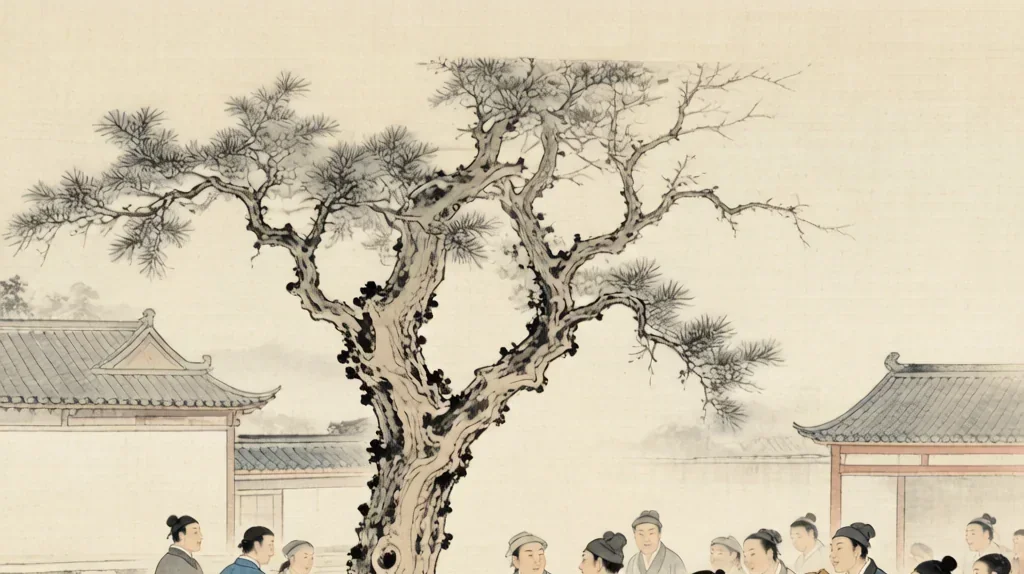
For over six hundred years, every Chinese child who attended a school or heard a story from a grandparent knew the Twenty-Four Filial Exemplars (二十四孝, èr shí sì xiào). Compiled by the Yuan Dynasty scholar Guo Jujing (郭居敬, c. 1300s) — though drawing on much older sources — the collection gathers twenty-four short tales of children, mostly historical but some legendary, who displayed extraordinary devotion to their parents. The stories were illustrated in woodblock prints, recited at family gatherings, painted on temple walls, and used as the standard moral primer for centuries. A child raised on the Twenty-Four Filial Exemplars knew exactly what 孝 (xiào, "filial piety") meant: not a vague respect, but a willingness to suffer, sacrifice, and even die for one's parents.
The Twenty-Four Filial Exemplars present a window into the moral universe of traditional China — a universe in which the family was the fundamental social unit, parents were the source of all obligation, and the virtue of filial piety stood at the very center of ethical life. To modern readers, many of the stories appear shocking: children abandon their own infants, sleep in mosquito-infested rooms, taste their fathers' excrement to gauge their health. To understand the collection, we must read it both as historical document and as living text — a set of stories that still shape Chinese values, even as the culture debates which parts to keep.
Confucius and the Root of Virtue
Filial piety is not a folk custom in China; it is the foundation of the entire ethical system. Confucius (551–479 BCE) made this explicit in the Analects: "Filial piety and fraternal submission — are they not the root of all benevolent action?" His follower Zengzi expanded the idea into a treatise called the Classic of Filial Piety (孝经, xiào jīng), which became one of the most widely studied texts in East Asia. The argument is simple but radical: a person who cannot love and respect the parents who gave him life cannot be trusted to love anyone else. The family is the school of virtue; if you cannot be good to your parents, you cannot be good to a ruler, a friend, or a stranger.
The Twenty-Four Filial Exemplars was created to make this abstract principle vivid and memorable. Each story is short — a few paragraphs — and each illustrates a different dimension of filial behavior: feeding a hungry parent, healing a sick one, avenging a wronged one, providing for an aged one, mourning a dead one. Some are quiet acts of daily care; others are extreme acts of self-sacrifice. Together, they form a kind of moral spectrum, designed to show that filial piety is not one act but an entire way of being in relation to one's parents, from the most ordinary to the most heroic.
Guo Juyu Buries His Son
Of all the Twenty-Four stories, the most shocking to modern readers is that of Guo Juyu (郭巨, also known as Guo Ju), who lived during the Han Dynasty. According to the tale, Guo was a poor man with an aged mother, a wife, and a young son — a three-year-old boy. The family was so poor that they could not feed everyone. The little boy, watching his grandmother eat, would share his own meager portion with her, and his mother — Guo's mother — would instinctively give some of her food to the child. Guo, seeing this, realized that his son was unintentionally depriving his mother of the food she needed to survive.
He made a terrible decision. He told his wife: "Our child can be replaced, but a mother cannot. We must bury the child, so that my mother may live." His wife wept but did not dare resist. Guo took a hoe and began to dig a grave in the yard. But when he had dug three feet into the earth, his hoe struck something hard — a pot of gold, buried there, with an inscription reading: "Heaven's gift to the filial son Guo Ju." Guo had been willing to make the most painful sacrifice a parent can make — and Heaven, the story tells us, had intervened to spare him. He kept the gold, raised his son, and provided for his mother in comfort.
For centuries, this story was told as the supreme example of filial devotion: a man willing to give up his own child for his mother, rewarded by divine intervention. To modern readers, it is one of the most disturbing stories in the Chinese moral tradition. The Lu Xun (鲁迅), the great 20th-century writer, famously attacked the Twenty-Four Filial Exemplars as a child, recalling his horror at the Guo Ju story: "I was afraid," he wrote, "that my father might one day become a filial son." The story has been a flashpoint in modern Chinese debates about traditional morality: is it a parable of ultimate devotion, or an indictment of a culture that valued parents over children?
Wang Xiang Lies on the Ice
A gentler, more poetic story is that of Wang Xiang (王祥, 185–269 CE), a real historical figure who became a high official in the Jin Dynasty. Wang's mother died when he was young, and his father remarried. The stepmother, named Zhu, disliked Wang and treated him cruelly — slandering him to his father, withholding food, making his life miserable. Despite her treatment, Wang remained unfailingly devoted to her.
One bitter winter, the stepmother fell ill and craved fresh carp — a delicacy considered medicinal. The river was frozen solid, the ice thick. Wang went to the river and, having no tool to break the ice, lay down on the frozen surface, hoping his body heat would melt it. As he lay there shivering, the ice suddenly cracked open — some versions say a pair of carp leaped out of the water onto the ice at his feet, as if given by Heaven. Wang took the fish home, cooked them for his stepmother, and she recovered.
The story is striking in several ways. First, Wang's devotion is shown to a stepmother who has been cruel to him — the moral is that filial piety does not depend on the parent's worthiness, but on the child's own virtue. Second, the natural world responds to Wang's devotion: the ice melts, the fish leap, Heaven itself cooperates. (In some versions, this is the moment that inspires the stepmother to repent of her cruelty and finally love Wang as her own son.) Third, the story has an obvious fairy-tale quality — the magical intervention is the point. Extreme virtue provokes extreme grace.
Wang Xiang's story was a favorite subject of Chinese painting, often depicted as a solitary figure lying on a frozen river, a fishing hole cracked open beside him. The image is at once pathetic and heroic — a small figure against the vast cold, sustained only by his devotion.
Other Famous Exemplars
The other twenty-two stories cover a remarkable range of devotion, from the tender to the bizarre. A few of the most memorable:
· Wu Meng: Allowing Mosquitoes to Bite Him (吴猛恣蚊) — An eight-year-old boy whose family was too poor to afford a mosquito net would lie down without covers at night, allowing mosquitoes to feast on his blood. His reasoning: if the mosquitoes bit him, they would be full and would not bother his parents. The story is at once touching and absurd — a child's logic elevated to moral principle.
· Min Sun: Wearing a Reed Coat (闵损芦衣) — A boy whose stepmother favored her own sons dressed Min Sun in a coat of reeds while dressing her own children in cotton. When his father discovered this and vowed to divorce the stepmother, Min Sun pleaded for her: "If Mother stays, only one son is cold; if Mother goes, three sons will be cold." The father relented, and the stepmother, shamed by the boy's kindness, reformed. The story elevates forgiveness over grievance: a filial child protects even the parent who has wronged him.
· Yu Qianlu Tasting Feces (庾黔娄尝粪) — A provincial official who, hearing that his father was ill, resigned his post and rushed home. To diagnose his father's condition, he tasted his father's excrement — a traditional (and revolting) diagnostic method in an age without blood tests. Finding the taste bitter, he knew the prognosis was bad and prayed to the stars to take his own life in exchange for his father's. The story shocks modern readers, but it illustrates the absolute self-abandonment that filial piety could demand.
· Laolaizi Dressing as a Child (老莱子戏彩娱亲) — A man of seventy, whose parents were still alive, would dress in brightly colored clothes, play with toys, and pretend to stumble and fall, all to make his elderly parents laugh. The story is a parable of joyful devotion: true filial piety does not just feed and shelter the parent, it makes them happy.
· Huang Xiang Warming the Bed (黄香温席) — A boy of nine whose mother had died devoted himself to his father. In summer, he fanned his father's pillow and bed mat to cool them before his father slept. In winter, he lay in his father's bed to warm it with his own body, then moved aside when his father came to retire. The story is gentle, practical, and widely loved — a model of everyday filial care.
A Modern Perspective: Lu Xun's Critique
The Twenty-Four Filial Exemplars has been a target of modern Chinese criticism since the early 20th century. The most famous critique came from Lu Xun (1881–1936), the founder of modern Chinese literature, who in a 1926 essay recalled reading the book as a child. Lu Xun confessed that some of the stories — like Huang Xiang warming the bed — he could understand and even admire. But others, particularly Guo Ju burying his son, horrified him. "I was afraid," he wrote, "lest my father, who was ordinarily a filial son, should also dig a hole." The child's-eye view cuts to the heart of the moral problem: a story that asks a child to admire a man who buries his own child is, in some sense, asking the child to consent to his own potential sacrifice.
Lu Xun's critique opened a debate that continues to this day. Since the 1980s, there has been a tentative revival — some stories (especially the gentler ones like Huang Xiang and Laolaizi) are taught to children again, often in bowdlerized versions that soften the harsher edges. The more disturbing stories — Guo Ju, Yu Qianlu tasting feces — are mostly omitted.
What survives, however, is the underlying value: filial piety itself. Modern China, despite its sweeping social changes, remains a society in which adult children feel a deep obligation to care for their aging parents. The legal system enforces this — Chinese law explicitly requires adult children to support their parents, and recent amendments even mandate "spiritual support" in the form of regular visits. When families gather for the Lunar New Year, the central journey is from the child's home back to the parents'. The form has changed, but the value endures. The Twenty-Four Filial Exemplars may be a flawed and dated text, but the question it asks — what do we owe those who gave us life? — remains one of the most important questions in Chinese life, and in human life more broadly.
The most thoughtful modern readers, perhaps, do not reject the Twenty-Four Filial Exemplars but read it as one reads an old scripture: selectively, critically, and with an eye to what is timeless beneath what is dated. The stories of Huang Xiang warming the bed and Laolaizi dressing as a child still move us. The stories of Guo Ju and Yu Qianlu warn us how easily devotion can become pathology. And the underlying claim — that the way we treat our parents reveals who we are — is, if anything, more urgent in an aging society than it was in the Yuan Dynasty when Guo Jujing first collected these tales for the moral instruction of his own time.
The Art and Illustration of the Tales
The Twenty-Four Filial Exemplars lived as much in images as in words. From the Ming Dynasty onward the stories were carved as woodblock prints, painted on lanterns, and copied onto the walls of village schools and temples, so a child who could not yet read still grew up seeing Wang Xiang on the ice or Huang Xiang warming the bed. These pictures fixed the examples in popular memory and turned moral teaching into a visual routine of daily life. The illustrated editions also let the collection travel across social classes, making it one of the most reproduced story cycles in Chinese history. In this sense the work was less a book than a picture world of virtue.
Filial Piety Across East Asia
The collection was never confined to China. Through Confucian schooling it spread to Korea, Vietnam, and Japan, where local editions appeared with familiar or adapted tales. In each place the stories reinforced the same ideal: that respect and care for parents is the first duty of a person and the foundation of a orderly society. Painters and printmakers across the region copied the scenes, and moralists cited the exemplars in their own languages. Today the imagery survives in museums and folk art throughout East Asia, a shared inheritance that shows how one Chinese text helped shape family values far beyond its borders.
Teaching Filial Piety to Children Today
Modern China has a complicated relationship with the collection. Schools and families still value the core lesson of respecting and caring for parents, and the law requires adult children to support their elders. But the harshest stories are no longer told to young children; instead teachers choose the gentle ones, such as Huang Xiang warming the bed or Laolaizi making his parents laugh. The goal is to pass on gratitude and duty without the shock of the extreme examples. In this careful editing, the old text becomes a conversation between generations about which lessons endure and which belong to a different age.
❓ Frequently Asked Questions
📝 Chinese Vocabulary
孝 — : filial piety; the virtue of love, respect, obedience, and care for one's parents and ancestors, considered the root of all virtue in Confucian ethics.
二十四孝 — : the Twenty-Four Filial Exemplars; a collection of twenty-four tales of extraordinary filial devotion, compiled by Guo Jujing in the Yuan Dynasty.
孝经 — : the Classic of Filial Piety; a short Confucian treatise attributed to Zengzi that articulates the foundational role of filial piety in Chinese ethics.
卧冰求鲤 — : "lying on the ice to seek carp"; the story of Wang Xiang, who lay on a frozen river to catch fish for his cruel stepmother — one of the most beloved of the Twenty-Four Exemplars.
郭居敬 — : The Yuan Dynasty scholar who compiled the Twenty-Four Filial Exemplars, drawing on older sources for the moral instruction of his time.
论语 — : The Analects of Confucius, the text where filial piety is named as the root of all benevolent action.
曾子 — : Zengzi, the disciple credited with expanding filial piety into the Classic of Filial Piety.
黄香 — : Huang Xiang, the exemplar who fanned his father's bed in summer and warmed it with his body in winter.
🎉 Fun Facts
- The most shocking of the Twenty-Four stories — Guo Ju burying his son to feed his mother — was famously attacked by the modern writer Lu Xun, who wrote as a child: "I was afraid lest my father should also dig a hole."
- The Twenty-Four tales include a boy who let mosquitoes bite him so they would not bother his parents (Wu Meng), and an official who tasted his father's feces to diagnose his illness (Yu Qianlu) — extremes of devotion that even traditional readers found challenging.
- Modern Chinese law explicitly requires adult children to financially and emotionally support their parents — a legal codification of the filial piety first articulated in the Classic of Filial Piety 2,500 years ago.
- The tales were frequently illustrated as woodblock prints, turning the collection into one of the most widely circulated moral picture books of premodern China.
- Several stories were painted on temple walls and household screens, so even those who could not read learned the examples by looking.
- In modern children's editions the gentler tales are kept while the harshest, such as burying a son, are often left out or softened.