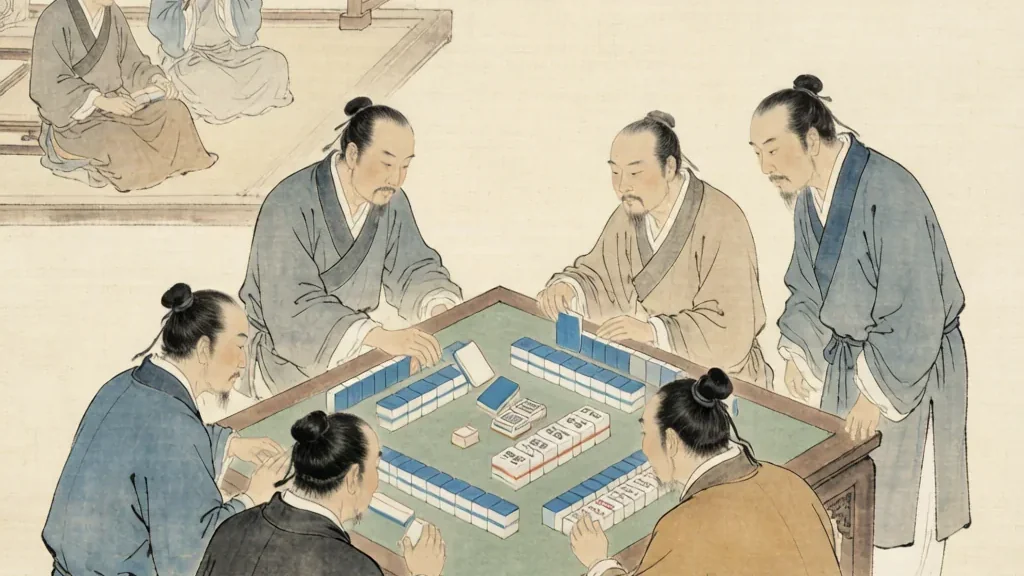
The click of tiles being shuffled, the calls of "Pong!" and "Chow!" ringing through the air, the satisfying snap of a winning hand being revealed — these are the sounds of mahjong, a game that has been the soundtrack of Chinese social life for generations. From the tea houses of Chengdu to the community centers of San Francisco's Chinatown, from family gatherings during Lunar New Year to casual afternoons in retirement homes, mahjong is more than a game. It is a cultural institution, a social ritual, and a living link to centuries of Chinese tradition.
Despite its deep roots in Chinese culture, mahjong's origins are surprisingly mysterious. Unlike chess or Go, which can be traced back thousands of years with reasonable historical confidence, mahjong seems to have emerged relatively recently — and its true origin story remains a subject of scholarly debate and colorful legend. What is certain is that in the century and a half since it first appeared, mahjong has conquered the world, becoming one of the most popular table games on the planet.
The Mystery of Origins
Where did mahjong come from? The question has generated numerous theories, each with passionate advocates and intriguing evidence. One popular legend attributes the game's invention to none other than Confucius himself, who supposedly created the tiles as a teaching tool for his disciples. According to this story, the three suits — characters, bamboos, and circles — represent Confucian values of literacy, nature, and cosmic harmony. However, most historians dismiss this as romantic fiction, noting that no mention of mahjong appears in any text before the nineteenth century.
A more historically plausible theory connects mahjong to the Ming Dynasty admiral Zheng He. During his great voyages across the Indian Ocean in the early fifteenth century, Zheng He's sailors supposedly invented a card game to pass the long months at sea. Over time, the cards evolved into tiles, which were more practical on a rolling ship. The winds and dragons that are central to mahjong might reflect the sailors' preoccupation with favorable breezes and mythical beasts. Yet this theory also lacks solid documentary evidence.
Most modern scholars believe mahjong evolved from earlier Chinese card games, particularly a game called madiao, which was popular during the Ming Dynasty. Madiao used cards rather than tiles and featured suits similar to those in modern mahjong. Over the course of the Qing Dynasty, the game gradually transformed: cards became tiles, the rules became more complex, and the distinctive four-player format emerged. By the mid-nineteenth century, something very close to modern mahjong was being played in the tea houses and private clubs of Shanghai and Ningbo.
The Symbolism of the Tiles
Part of mahjong's enduring appeal lies in the rich symbolism of its tiles. A standard set contains 144 tiles divided into several categories, each carrying layers of cultural meaning. The three suits — Characters (万), Bamboos (条), and Circles (筒) — each contain tiles numbered one through nine, and each suit represents a different aspect of traditional Chinese life.
The Character suit, marked with Chinese numerals and the character for "ten thousand," represents wealth and prosperity. The Bamboo suit, with its depictions of bamboo stalks, connects to nature, scholarship, and the literati tradition — bamboo being a symbol of resilience and moral integrity. The Circle suit, showing coins or circular designs, represents money and commerce. Together, the three suits encompass the fundamental concerns of traditional Chinese society: wealth, virtue, and trade.
Beyond the suits lie the honor tiles, which add another dimension of meaning. The four winds — East, South, West, and North — represent the cardinal directions and are associated with different seating positions at the table. The three dragons — Red, Green, and White — are rich with philosophical significance. The Red Dragon (中) represents the center and the virtue of benevolence. The Green Dragon (發) represents prosperity and is associated with the character for "fortune." The White Dragon (白) represents purity and is often depicted as a blank tile or with a simple frame.
The flower and season tiles add yet another layer. These eight tiles depict flowers (plum, orchid, chrysanthemum, bamboo) and seasons (spring, summer, autumn, winter), connecting the game to the natural world and the Chinese artistic tradition. Though often treated as bonus tiles in modern play, they reflect mahjong's origins as a game deeply embedded in Chinese aesthetic sensibilities.
How the Game Works
At its core, mahjong is a game of building a complete hand from a combination of drawn and discarded tiles. Four players sit around a square table, each representing one of the cardinal directions. Play begins with each player drawing thirteen tiles, and the dealer drawing a fourteenth. Players then take turns drawing a tile from the wall and discarding one from their hand, with the goal of forming four sets of three tiles (called melds) plus a pair.
The basic melds are the pong (three identical tiles), the chow (three consecutive numbers in the same suit), and the kong (four identical tiles). When another player discards a tile that completes your pong or kong, you can claim it by calling out "Pong!" or "Kong!" — a rule that creates dynamic interaction among players and prevents anyone from playing in isolation. A chow can only be claimed from the player to your left, adding a strategic layer to the seating arrangement.
Winning requires a complete hand of fourteen tiles — four melds and a pair — though special hands with unique patterns also exist. The moment of victory is celebrated with the cry "Hu le!" — "I've won!" — a sound that is instantly recognizable to anyone who has spent time in a Chinese community. The scoring system, which varies widely by region, rewards difficult combinations and penalizes risky play, adding a gambling element that has been both part of mahjong's appeal and a source of controversy.
Regional Variations: A Game of Many Faces
One of the most fascinating aspects of mahjong is its extraordinary regional diversity. Walk into a mahjong parlor in Shanghai, Hong Kong, Taiwan, or Singapore, and you may encounter rules that differ significantly from what you know. Chinese mahjong alone has dozens of regional variants, each with its own scoring system, special hands, and house rules.
Hong Kong mahjong, also known as Cantonese mahjong, is the most widely played variant internationally and uses a relatively simple scoring system based on faan, or points, with a minimum requirement to win. Taiwanese mahjong uses a sixteen-tile hand instead of the standard thirteen, adding an extra meld and making for more complex combinations. Japanese riichi mahjong, which has become popular worldwide through anime and online platforms, introduces additional strategic elements like the riichi declaration — a bet that your hand is one tile away from completion.
Sichuan mahjong deserves special mention for its unique character. In the tea houses of Chengdu, mahjong is played with a distinctive "bloody" rule set that eliminates some suits and emphasizes speed and aggression. The Sichuan variant has become so culturally significant that the city is sometimes called the "mahjong capital of China." On any given afternoon, you can hear the clatter of tiles echoing from countless tea houses and see players of all ages absorbed in the game.
Mahjong Goes Global
Mahjong's journey from Chinese parlors to the global stage began in the early twentieth century. The game was introduced to the West around 1920, and it quickly became a sensation. In the United States, mahjong swept through high society with remarkable speed. Department stores sold mahjong sets alongside the latest fashions. Mahjong clubs formed in cities across the country. By 1923, the Mah Jongg League had been founded, and the game was a fixture of American social life.
The American version of mahjong evolved in its own direction, developing a distinctive set of rules and a special card of winning hands that changes annually. American mahjong is played with a larger set that includes joker tiles, and the strategy differs significantly from Chinese variants. Despite — or perhaps because of — these differences, American mahjong has maintained a devoted following for a century, particularly among Jewish American women, for whom mahjong nights became an important social tradition.
In recent years, mahjong has experienced a global renaissance. Online platforms and mobile apps have introduced the game to a new generation of players. International tournaments draw competitors from dozens of countries. The game has appeared in films, television shows, and video games, including a memorable scene in the 2018 hit Crazy Rich Asians that showcased mahjong's strategic depth and cultural significance. What was once a Chinese parlor game is now a truly global pastime.
Mahjong and Social Life
To understand mahjong fully, you must understand that it is never just a game. It is a social event, a bonding ritual, and sometimes a test of character. In Chinese culture, the way a person plays mahjong is thought to reveal their personality. The patient player who waits for the perfect tile shows wisdom. The aggressive player who calls every pong shows boldness — or recklessness. The player who blames bad luck for every loss shows a lack of self-awareness.
Mahjong plays a particularly important role during holidays and family gatherings. At Chinese New Year, families often gather around the mahjong table after the reunion dinner, playing late into the night as firecrackers pop outside. The game bridges generations: grandparents teach grandchildren, and the clatter of tiles provides a soundtrack for conversations and laughter. In a culture that values family unity, mahjong serves as a social lubricant that brings people together.
But mahjong is not without its controversies. The gambling element has led to periodic crackdowns by authorities concerned about addiction and financial ruin. In some periods of Chinese history, mahjong was officially discouraged or even banned. Yet the game has always survived, adapting to changing circumstances. Today, many Chinese play mahjong without money, treating it purely as a social game. The pleasure of the game, it turns out, does not depend on the stakes.
The Living Tradition
In an age of smartphones and video games, mahjong's continued popularity is remarkable. The game has adapted to the digital world — online mahjong platforms have millions of users — but it has also retained its essential physicality. There is something irreplaceable about the weight of the tiles in your hand, the sound they make when shuffled, the face-to-face interaction with other players. These sensory and social dimensions resist digitization.
Mahjong has also proven remarkably adaptable to cultural exchange. In Japan, it has become a competitive sport with professional leagues. In the United States, it has become a cherished tradition in communities that have no other connection to Chinese culture. In Europe, mahjong clubs and tournaments are growing steadily. Each culture that adopts mahjong makes it its own, adding new rules and traditions while preserving the essential character of the game.
Perhaps the secret to mahjong's longevity is that it occupies a perfect sweet spot between luck and skill, strategy and chance. A complete beginner can enjoy the game and occasionally win. An expert can spend a lifetime mastering its subtleties. The randomness of the draw means that anyone can have a good day, but skill determines who wins over the long run. This balance makes mahjong accessible to all while rewarding dedication — a formula for enduring popularity that few games have achieved.
The Rituals and Etiquette of the Table
Before the first tile is drawn, a mahjong table follows a quiet ritual. Players build the wall by stacking tiles in pairs, then the dealer casts the dice to decide where the deal breaks, and the opening hands are drawn with a practiced shuffle that sounds like rolling rain. During play, certain calls carry etiquette of their own: a clear 'pong' or 'chow' claims a discard and reshapes the table, while declaring a concealed or revealed kong must be announced so no one is caught off guard. Good players also observe unspoken courtesy, not gloating over a win, not sulking over bad luck, and keeping the pace lively. These small conventions turn four strangers into a temporary society, and they are why the game feels less like a contest than like a shared performance with rules everyone agrees to honor.
❓ Frequently Asked Questions
📝 Chinese Vocabulary
- 麻将 (májiàng) — Mahjong; the game's name in Chinese
- 碰 (pèng) — "Pong"; claiming a tile to complete a set of three identical tiles
- 吃 (chī) — "Chow"; claiming a tile to complete a sequence of three in the same suit
- 杠 (gàng) — "Kong"; declaring a set of four identical tiles
- 胡了 (hú le) — "I've won!"; the victorious declaration when completing a winning hand
🎉 Fun Facts
- There are over 40 recognized regional variants of mahjong, from the 13-tile Cantonese style to the 16-tile Taiwanese style and the "bloody" rules of Sichuan.
- Mahjong became a sensation in the United States in the 1920s, with Abercrombie & Fitch selling over 12,000 sets and the game becoming a fixture of high-society parties.
- In 2018, mahjong was recognized by the International Mind Sports Association, joining chess, bridge, and Go as an official mind sport.
- A full mahjong set weighs several kilograms and was traditionally made of bone and bamboo, so the satisfying 'click' comes as much from the material and carving as from the snap of play.
- The Sichuan 'bloody' style strips out whole suits and rewards fast, aggressive play, a reason Chengdu is nicknamed the mahjong capital of China.
- American mahjong adds joker tiles and a fresh published card of winning hands each year, making it a distinct game from its Chinese cousins while keeping the tile-click charm.