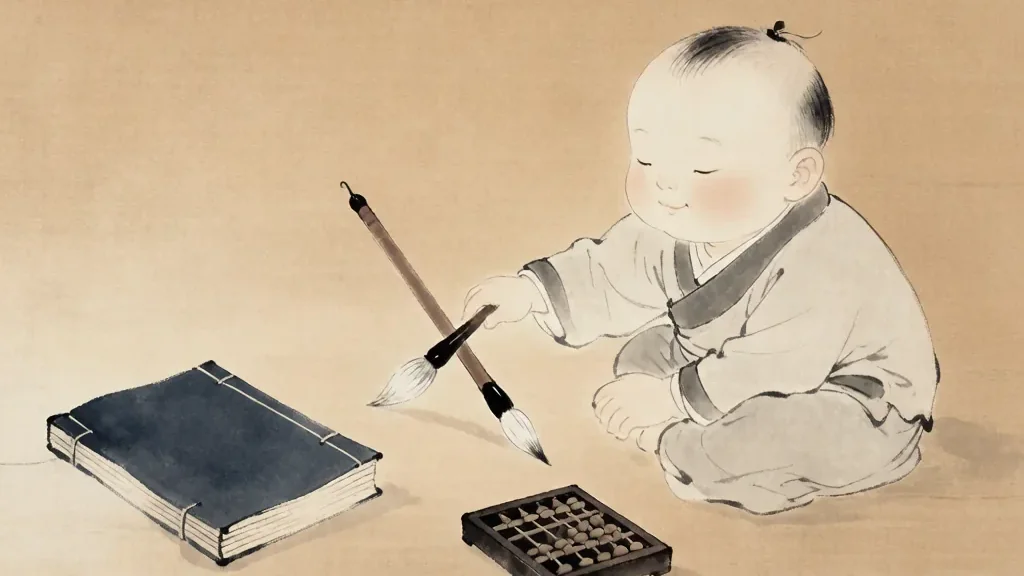
Among the most charming and quietly suspenseful rituals in Chinese family life is 抓周 (Zhuā Zhōu), "the one-year grab," held when a baby reaches its first birthday. On this day the child is placed before a spread of symbolic objects, books, brushes, coins, food, and tools, and the item it reaches for is read as a playful prophecy of its future character, talents, and calling. Lighthearted though it may seem, Zhuā Zhōu is a tender snapshot of parental hope, an occasion that turns a simple grasp of tiny fingers into a family story retold for years. It reveals how Chinese culture has long linked early childhood to learning, destiny, and the dreams parents pour into the next generation.
The Ceremony at One Year
The grab takes place at the baby's first-month-or, more commonly, first-year celebration, with the full rite reserved for the first birthday. Family gathers, the child is dressed in new clothes, and an array of objects is laid out on a clean mat or low table within easy reach. The adults then set the baby down and watch with delight to see which object first captures its hand. Whatever is chosen becomes the talk of the day and, often, a fond family legend.
Crucially, the ritual is understood as entertainment and blessing rather than a binding verdict. No parent disowns a child for grabbing a cake instead of a book, and modern families treat the outcome with good humor. Yet the choice is lovingly recorded, sometimes in a baby book or a photograph, and mentioned at later milestones such as school entry, as a gentle thread connecting the infant to the adult they become.
Historical Origins
Zhuā Zhōu is documented as far back as the Southern Dynasties, more than fifteen hundred years ago, in texts that describe the "grab test" for one-year-olds among the literate elite. By the Tang and Song dynasties it had spread through society and appears in novels and miscellaneous notes as a familiar custom. The rite grew alongside a culture that prized education and civil service, where a child's early inclination toward the brush or the book was a matter of genuine family interest.
One famous legendary example concerns the poet and statesman Su Shi's family, and similar anecdotes populate classical fiction, where a hero's future is foreshadowed by what he clutched as an infant. Whether or not such tales are literal, they show that the grab was already, in the literary imagination, a recognized moment of fateful play. Over centuries the objects were refined to reflect the occupations most valued or most feared by society.
Traditional Objects and Their Meanings
The tray is a miniature map of a good life. A writing brush or book points to scholarship and a literary career; an abacus or coin suggests business acumen and wealth; a seal hints at office and official rank; a sword or bow suggests a martial path; a whisk or scroll may hint at a religious or Daoist life; and a stalk of rice or a ladle suggests farming or homemaking. Food items, such as a sweet or a piece of fruit, are read as a life of comfort, while a needle and thread point to skill with the hand.
Families choose objects that reflect their own values and hopes, so the exact set varies. The trick is to offer a genuine spread rather than stacking the deck, because the charm lies in the surprise. The child's unfiltered preference, untainted by instruction, is precisely what makes the omen feel authentic and fun for everyone watching.
What the Choice Was Thought to Foretell
Interpretation follows a simple logic of association. Grasping the brush was the most celebrated outcome in scholar-official households, taken as a sign the child would excel in study and perhaps pass the imperial examinations. Coin or abacus promised commercial success; the seal promised authority; the ruler or inkstone promised craft. A girl reaching for needle and thread was traditionally read as destined for domestic skill, though today families interpret such grabs far more loosely and aspirationally.
It is worth stressing that the forecast was never treated as destiny's lock. Chinese thought balances fate with effort, and the grab was a spark for encouragement, not a sentence. Parents of a "scholar" baby might simply tell more stories; those of a "merchant" baby might praise cleverness. The ritual gave the family a narrative, not a contract.
Zhuā Zhōu in Modern Families
Today the one-year grab thrives as a photogenic, joyful party centerpiece. Parents assemble colorful arrays of miniature props, sometimes themed to modern professions: a stethoscope for medicine, a microphone for performance, a tiny laptop for technology. The event is documented on social media, and grandparents delight in debating the meaning of a grab that lands on a basketball or a paintbrush.
Even as the objects change, the feeling endures. The ritual remains a way to honor the milestone of one year of life, to gather family, and to voice hopes for the child's path. In cities where relatives may live far apart, the grab offers a focused, meaningful reason to come together and celebrate a small person's first steps into a wider world of possibility.
Scholarship, Fate, and Play
Seen broadly, Zhuā Zhōu sits at the intersection of three Chinese ideas: that education shapes destiny, that the cosmos hints at a person's path from the start, and that childhood should be met with warmth and play. The rite asks no child to perform, only to choose, and in that choice the family projects its loves and ambitions. It is divination made domestic, a fortune told not by a master but by a toddler's curious hand.
Perhaps the truest meaning of the one-year grab is not the prediction but the attention it bestows. To lay out the world's possibilities before a one-year-old and watch with held breath is to say, wordlessly, that this child's choices will matter. That message, repeated at birthdays and milestones, may be the most lasting fortune the ritual bestows.
Regional Variations in the Grab
While the one-year grab is known across China, its details shift from place to place. In some regions the objects are laid on a round winnowing tray, in others on a low table or a red cloth, and the exact set is tailored to local values and the family's hopes. Northern households may emphasize scholarly items such as brushes and books, while southern ones might add scales or abacuses reflecting a mercantile heritage. A few locales stage a smaller version at the full-month celebration rather than waiting for the first birthday, though the first-year rite remains the main event. Whatever the variation, the spirit is constant: a spread of the world's possibilities is offered to a tiny child, and the family reads its own dreams into the first curious handful.
A Rite of Attention: Why Families Still Do It
The deepest meaning of the one-year grab may be the attention it bestows rather than any prophecy it makes. To lay out books, coins, tools, and toys before a one-year-old and watch with held breath is to say, wordlessly, that this child's choices will matter. The rite gathers scattered relatives around a single small person at a real milestone, turning an ordinary birthday into a focused act of love and hope. In a culture that balances fate with effort, the grab affirms that a life is shaped as much by the family's steady care as by any omen. Long after the objects are put away, what remains is the memory of being seen, celebrated, and wished well at the very start of the journey.
❓ Frequently Asked Questions
📝 Chinese Vocabulary
抓周 — : the one-year grab, a first-birthday prediction ritual.
周岁 — : the completion of one year of age.
抓 — : to grab or clutch.
毛笔 — : writing brush, symbol of scholarship.
算盘 — : abacus, symbol of commerce.
印章 — : A seal, placed on the tray to hint at official rank and authority.
如意 — : A ruyi scepter, set out as a sign that the child's wishes will be granted.
书 — : A book, the classic object whose grasp foretells a life of learning.
🎉 Fun Facts
- The one-year grab is attested in Chinese records for more than fifteen hundred years.
- Classical novels sometimes use a child's grab to foreshadow a hero's future career.
- Modern parents theme the object tray to new professions like medicine, tech, and music.
- The rite is meant as affectionate fun, never a binding life sentence.
- If the baby reaches for food first, families traditionally read it as a sign of a comfortable, well-fed life.
- The object a child chooses is often kept as a keepsake or photographed, then brought out again at later milestones such as starting school.