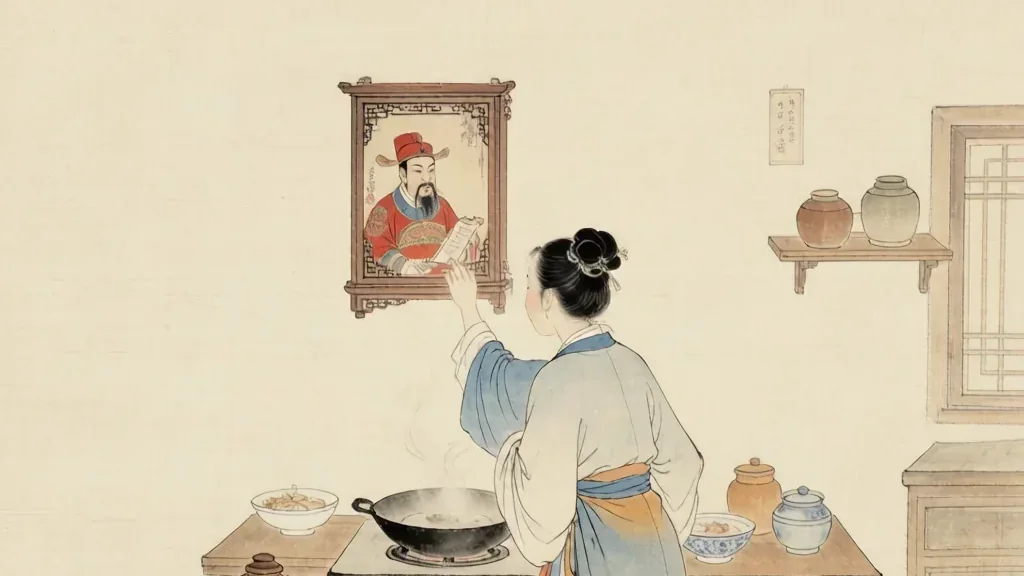
In a traditional Chinese kitchen, you might find a small shrine above the stove. In a fishing village, a temple faces the sea. At a crossroads, a modest stone altar bears offerings of fruit and incense. These are the sacred spaces of Chinese folk religion (民间信仰, mínjiān xìnyǎng) — the vibrant, unorganized spiritual life that has sustained ordinary Chinese people for millennia, outside the formal structures of Buddhism, Taoism, or Confucianism.
Chinese folk religion is not a single faith with a founder, scripture, or creed. It is a living tapestry of local gods, ancestor worship, seasonal festivals, and practical spirituality. Its gods are not distant cosmic principles but familiar figures who share human concerns: health, wealth, family harmony, and protection from misfortune.
The Kitchen God: Heaven's Household Spy
Perhaps no deity is more intimately woven into Chinese domestic life than the Kitchen God (灶神, Zàoshén), also known as the Stove God. Every household kitchen was his domain, and his portrait — often a simple woodblock print — hung above the stove, watching over the family's daily life.
But the Kitchen God was more than a benign presence. According to tradition, on the twenty-third day of the twelfth lunar month, he ascended to heaven to deliver an annual report on the family's conduct to the Jade Emperor. Based on this report, the family's fortune for the coming year would be determined — good behavior rewarded, misdeeds punished.
This created an annual ritual of delightful pragmatism. On the day of the Kitchen God's departure, families would offer him sweet, sticky foods — particularly malt candy (糖瓜, tángguā) — to ensure his report would be favorable. The logic was simple: either the sweetness would put him in a good mood, or the stickiness would seal his lips and prevent him from speaking ill of the family. Some families even smeared honey directly on the mouth of his portrait.
The old portrait was then burned, symbolizing his ascent to heaven, and a new one was pasted up for the new year. This ritual, still observed in many Chinese households, captures the spirit of Chinese folk religion: a blend of reverence, practicality, and a touch of good-humored cunning in dealing with the divine.
The Earth God: Guardian of Place
If the Kitchen God watches over the household, the Earth God (土地公, Tǔdì Gōng) watches over the local community. These humble deities are the lowest-ranking officials in the celestial bureaucracy, each responsible for a specific territory — a village, a neighborhood, or even a single street.
Earth God shrines are among the most common sacred sites in the Chinese world. You will find them at village entrances, under old trees, at crossroads, and in the corners of temple courtyards. They are typically small — sometimes no more than a stone slab with an incense holder — and the deity is often depicted as a kindly old man with a white beard, accompanied by his wife, the Earth Goddess (土地婆, Tǔdì Pó).
Despite their low rank, Earth Gods are deeply beloved. They are approachable, familiar figures who understand the concerns of ordinary people. Farmers pray to them for good harvests. Travelers seek their protection on journeys. Families report births and deaths to them, as the Earth God is believed to keep the local register of souls.
In a sense, the Earth God system creates a sacred geography in which every place has its guardian. No matter how humble the village, the divine is present — watching, protecting, and connecting the community to the larger cosmic order.
The City God: Divine Magistrate
At the urban level, the City God (城隍, Chénghuáng) functions as a divine magistrate, mirroring the imperial official who governed the earthly city. The City God's temple served as a spiritual counterpart to the government office (衙门, yámen), and the deity was believed to judge the souls of the dead within his jurisdiction before they proceeded to the afterlife.
Historically, City Gods were often deified historical figures — virtuous officials or military heroes who had served the city in life and continued to protect it in death. Their temples were imposing structures, complete with courts, judgment halls, and terrifying statues of underworld officials who carried out the City God's sentences.
The City God cult reached its peak during the Ming Dynasty (1368–1644), when the Hongwu Emperor formalized the system, assigning each city a specific City God with a defined rank. The emperor understood that religion could reinforce political authority — the City God answered to the Jade Emperor, just as the earthly magistrate answered to the emperor.
Mazu: Goddess of the Sea
Among the most beloved deities in Chinese folk religion is Mazu (妈祖), the goddess of the sea and protector of fishermen and sailors. Unlike many Chinese gods who are mythological figures or deified historical officials, Mazu began as a real person — a young woman named Lin Moniang (林默娘) who lived on Meizhou Island off the coast of Fujian Province during the tenth century.
According to legend, Lin Moniang was a remarkable child who never cried as a baby (her name means "Silent Girl") and displayed supernatural abilities from a young age. She could predict storms, heal the sick, and project her spirit across the sea to rescue sailors in distress. After her death at the age of twenty-seven, fishermen began reporting that she appeared to them during storms, guiding them to safety.
The cult of Mazu grew rapidly along the southeastern coast, and she was eventually recognized by imperial decree, receiving increasingly exalted titles from successive dynasties. Today, Mazu is worshipped by millions across China, Taiwan, and Southeast Asian Chinese communities. Her birthday, on the twenty-third day of the third lunar month, draws massive pilgrimages to her home temple on Meizhou Island.
Mazu embodies a distinctly Chinese form of divinity: a human being who, through virtue and selflessness, transcended mortality to become a protector of the living. Her temples are not somber places but vibrant community centers filled with the smoke of incense and the murmur of prayers for safe voyages and family well-being.
Ancestor Worship: The Family as Sacred Community
Underlying all these deities is the most fundamental practice of Chinese folk religion: ancestor worship (祭祖, jìzǔ). The ancestors are not gods in the usual sense, but they are treated with religious reverence. They are believed to continue existing in a spiritual realm, maintaining an active interest in their descendants' welfare and possessing the power to influence fortune.
Ancestor veneration takes many forms: daily offerings of incense at the family altar, elaborate rituals during the Qingming Festival and the Hungry Ghost Festival, and the maintenance of ancestral tablets and graves. The living and the dead are understood to exist in a relationship of mutual obligation — the living provide offerings and maintain the family line, while the ancestors provide protection and blessing.
This practice reflects the deep Confucian value of filial piety (孝, xiào), which extends beyond death. To honor one's parents does not end at the grave; it continues as long as the family line endures. Ancestor worship thus transforms the family into a sacred community that spans generations, binding the living, the dead, and those yet to be born into a single spiritual body.
The Great Synthesis: Three Teachings as One
What makes Chinese folk religion truly distinctive is its syncretism. Most Chinese do not identify exclusively as Buddhist, Taoist, or Confucian. Instead, they draw on all three traditions as circumstances require — a phenomenon captured in the saying "the three teachings are one" (三教合一, sān jiào hé yī).
A single family might consult a Taoist priest for an exorcism, engage Buddhist monks for a funeral, and follow Confucian principles in daily ethics — all while maintaining the household shrine to the Kitchen God and making offerings to ancestors. This is not inconsistency but a practical wisdom that recognizes different spiritual resources for different needs.
This syncretic spirit has allowed Chinese folk religion to survive centuries of dynastic change, foreign invasion, and political upheaval. It is flexible, adaptable, and deeply rooted in the rhythms of daily life. As long as there are kitchens to bless, ancestors to honor, and seas to cross, the gods of Chinese folk religion will continue to receive their offerings of incense and prayer.
Temple Fairs and the Calendar of the Gods
Chinese folk religion gives the year a sacred rhythm through the birthdays and festivals of its gods. Nearly every deity has a designated day, and on that date his or her temple hosts a fair: processions carry the god's image through the streets, opera troupes perform plays in his honor, and stalls sell food, toys, and amulets. The Kitchen God's departure at Little New Year, the Jade Emperor's birthday on the ninth of the first month, and Mazu's festival on the twenty-third of the third are only the most prominent of a crowded liturgical calendar. These events are not solemn affairs but communal celebrations where worship, trade, and entertainment merge. By marking time with the gods, folk religion keeps the divine present in ordinary village and city life throughout the year.
Local Shrines and the Sacred Geography
Folk religion maps the landscape as a hierarchy of guardian spirits. At the smallest scale sits the Earth God in a roadside shrine or under an old tree; above him the City God governs the town from his temple; and across the region, mountain and river deities watch over larger territories. This layering means that almost every place, however humble, has a divine official responsible for its peace and harvest. Pilgrims travel between famous sacred sites, but daily piety stays local, addressed to the gods one can literally walk to. The system effectively extends the imperial bureaucracy into the spirit world, so that heaven, like the state, is organized by jurisdiction. To live in a place is therefore to live under its gods, who know the names of the families and the boundaries of the fields.
关公 — : Guan Yu, the deified warrior and god of loyalty and protection, patron of merchants.
财神 — : The God of Wealth, worshipped for prosperity, especially at New Year.
门神 — : The Door Gods, martial figures pasted on gates to block evil from entering the home.
妈祖 — : Mazu, the sea goddess and protector of fishermen and travelers.
玉皇大帝 — : The Jade Emperor, supreme head of the celestial bureaucracy of gods.
龙王 — : The Dragon King, ruler of rain, rivers, and the seas.
城隍 — : The City God, divine magistrate who judges the dead of his jurisdiction.
土地婆 — : The Earth Goddess, consort of the Earth God and sharer of local shrines.
❓ Frequently Asked Questions
🎉 Fun Facts
- The Kitchen God's annual report to heaven is so important that the ritual of sending him off is known as "Little New Year" (小年, Xiǎonián), celebrated about a week before the Lunar New Year.
- Mazu is one of the few Chinese deities recognized by both the Chinese government and the Vatican — there are even Catholic churches in Taiwan that include Mazu imagery.
- There are estimated to be over 200 million practitioners of Chinese folk religion worldwide, making it one of the largest religious traditions on Earth, though it is rarely counted in global religious statistics.
- Temple fairs held on a deity's birthday turn streets into open-air markets of opera, food stalls, and fortune-telling, blending commerce and worship.
- Many Chinese homes keep a heaven and earth shrine or a simple red plaque by the door, showing that folk religion follows people from the village into city apartments.
- The Jade Emperor's birthday, the ninth day of the first lunar month, is marked by households offering sugarcane and lamps, among the most widely observed folk rites.
- Temple fairs held on a deity's birthday turn streets into open-air markets of opera, food stalls, and fortune-telling, blending commerce and worship.
- Many Chinese homes keep a heaven and earth shrine or a simple red plaque by the door, showing that folk religion follows people from the village into city apartments.
- The Jade Emperor's birthday, the ninth day of the first lunar month, is marked by households offering sugarcane and lamps, among the most widely observed folk rites.