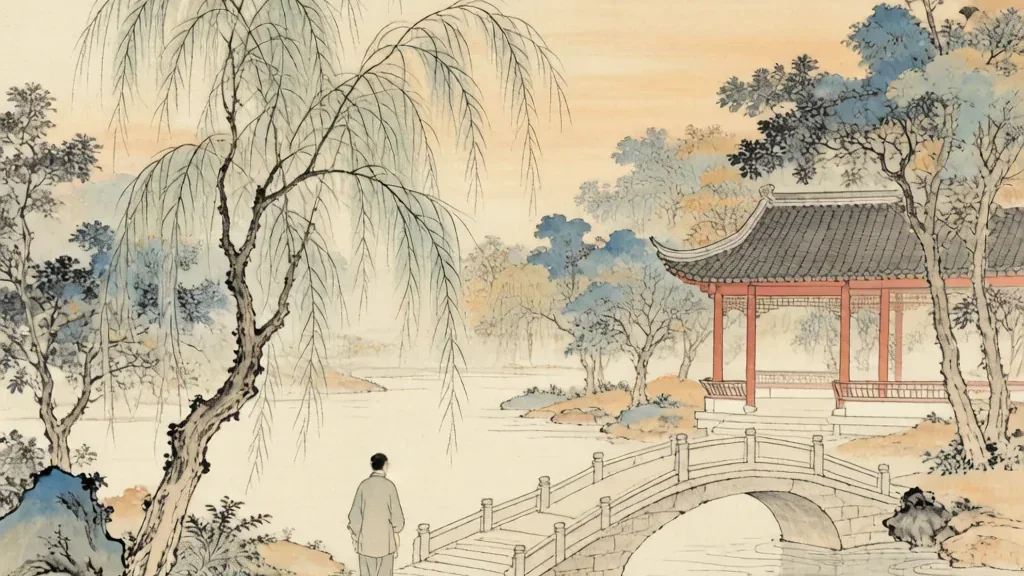
Every morning, before the city is fully awake, the parks of China fill with a quiet sight. Groups of mostly older people, dressed in loose cotton trousers and soft cotton shoes, stand in long rows on the stone paths. They move together, slowly, each gesture flowing into the next like water following water — a step forward, a hand rising, a turn of the waist, the arms parting like a bird opening its wings. There is no music, or only a faint one; there is no rush. A single "form" — a set sequence of movements — may take twenty minutes to complete. The practitioners breathe. They attend. They move as if through honey. This is 太极拳 (tài jí quán), Tai Chi Chuan — perhaps the most widely practiced martial art on earth, and certainly one of the most misunderstood.
To a casual observer, Tai Chi looks like gentle exercise for the elderly. It is in fact a sophisticated martial art, a system of self-defense, a form of moving meditation, and a practical philosophy all at once. Its full name — 太极 (tài jí), "supreme ultimate," a term from Chinese cosmology for the state of undivided unity from which yin and yang arise — signals the depth of its ambitions. Tai Chi does not just train the body; it asks what it means to move in harmony with the way things are.
The Legend of Zhang Sanfeng and the Snake and the Crane
Every tradition needs an origin story, and Tai Chi's is one of the most charming in Chinese folklore. According to legend, the art was founded by Zhang Sanfeng (张三丰), a Daoist monk who lived on Wudang Mountain in the 13th or 14th century — though some accounts place him centuries earlier, and historians debate whether he existed at all. Zhang is said to have been a large, powerful man who had mastered the "external" martial arts (hard, fast, forceful styles) but who longed for a deeper, softer way.
One day, the story goes, Zhang witnessed a fight between a snake and a crane (in some versions, a magpie). The crane attacked with sharp, direct strikes of its beak, expecting to make quick work of the snake. But the snake did not resist. It yielded, twisted, flowed around each strike, and waited. The crane grew tired. The snake, still fresh, found an opening and struck. Zhang, watching, realized that softness could overcome hardness, that yielding could defeat force, that the principle of yin and yang could be applied to combat itself. He retired to his hermitage and over years developed a new martial art based not on strength and speed but on relaxation, balance, internal energy, and the redirection of an opponent's force. He called it Tai Chi.
Historians are skeptical. The earliest verifiable records of Tai Chi date to the 17th century and the Chen family of Chenjiagou village in Henan Province. Whatever the truth of Zhang Sanfeng, his legend captures something essential about the art: Tai Chi is founded on a paradox — that the soft can master the hard, that slowness can train speed, and that the greatest power comes not from muscular force but from a calm, attentive, balanced body.
Yin and Yang in Motion
The taiji tu (太极图), the famous circle divided into black and white swirls each containing a dot of the opposite color, is the visual emblem of the art — and of Chinese cosmology more broadly. It represents the dynamic interplay of yin (dark, soft, receptive, yielding, feminine) and yang (light, hard, active, forceful, masculine). Neither can exist without the other; each already contains the seed of its opposite; and the constant transformation of one into the other is the engine of all change.
Tai Chi embodies this philosophy in physical form. Every movement has an empty and a full side, a yin hand and a yang hand, a step that sinks and a step that rises. When you push forward, you also pull back; when you rise, you also sink; when you attack, you also defend. The practitioner learns to feel the balance point between opposites and to move from there. A famous Tai Chi saying puts it: "用意不用力" (yòng yì bù yòng lì) — "use intention, not force." The movements are not weak; they are relaxed, and relaxation allows the body's full weight and structure to be expressed without the interference of muscular tension.
This is also why Tai Chi is practiced slowly. Slowness is not the goal; it is the training method. By moving slowly, the practitioner can pay attention to every joint, every transition, every weight shift. Over time, the same movements can be performed fast — and Tai Chi as a martial art is, in application, anything but slow. But the slow form is the laboratory in which the body learns to move as a unified whole.
The Four Major Styles
Over the centuries, several distinct schools or "styles" of Tai Chi developed, each named after the family that originated it. The four most widely practiced today are:
1. Chen style (陈式) — the oldest, from Chenjiagou village in Henan. Chen style alternates slow, flowing movements with sudden bursts of explosive power (发劲, fā jìn) — fast, stomping, low stances. It is the most physically demanding of the four and the closest in spirit to its martial-arts roots.
2. Yang style (杨式) — by far the most popular worldwide. In the mid-19th century, a Chen student named Yang Luchan (杨露禅) adapted the art for a wider audience, removing the most strenuous elements and emphasizing large, open, slow movements. Yang style is what most people picture when they think of Tai Chi: even, graceful, accessible to all ages. The Yang 24-form, a shortened sequence created in 1956 by the Chinese government to standardize practice, is the form most commonly taught today.
3. Sun style (孙式) — developed in the early 20th century by Sun Lutang (孙禄堂), a master who also trained in Xingyiquan and Baguazhang. Sun style is characterized by higher stances, lively footwork with frequent follow-steps, and a more compact overall shape. It is the gentlest of the four and especially suitable for older practitioners.
4. Wu style (吴式) — created by Wu Quanyou (吴全佑) and his son in the late 19th century. Wu style uses a distinctive forward-leaning posture and emphasizes small, refined movements, particularly in the hands and wrists. It is the second most popular style after Yang.
(There is also a second "Wu" style — 吴 vs 武 in Chinese — sometimes called the "Hao" or "Wu/Hao" style, less commonly practiced but historically important. The four main styles above are the ones a beginner is most likely to encounter.)
Health Benefits: What the Studies Show
In recent decades, Tai Chi has attracted serious scientific attention as a health intervention. A growing body of research — including large-scale randomized trials — suggests that regular practice offers significant benefits, particularly for older adults. Studies have shown that Tai Chi can improve balance and reduce falls (a major cause of injury in the elderly), lower blood pressure, improve symptoms of arthritis and fibromyalgia, reduce stress and anxiety, and modestly improve cognitive function. It has also been incorporated into cardiac rehabilitation programs and Parkinson's disease therapy.
What makes Tai Chi unusual among exercise modalities is its combination of physical, cognitive, and meditative elements. The movements require sustained attention, memory (forms can include over a hundred distinct postures), and proprioceptive awareness — the sense of where the body is in space. This integration may explain why its benefits extend beyond simple fitness into the realms of mood, sleep, and mental clarity. The fact that it can be practiced at any age, requires no equipment, and produces almost no injuries makes it nearly unique among physical disciplines.
The traditional Chinese explanation for these benefits is, of course, different. Tai Chi is understood as a form of qigong (气功) — "energy work" — that cultivates and circulates qi (气), the life energy that flows through the body's meridians. The slow movements, deep breathing, and relaxed attention are said to open blockages, balance yin and yang within the body, and strengthen the three treasures of jing (essence), qi (energy), and shen (spirit). Modern science may describe the mechanisms differently, but practitioners often report a sense of calm, warmth, and aliveness that maps closely onto the traditional account.
How to Begin: The First Form
Starting Tai Chi is remarkably straightforward. You need loose clothing, flat-soled shoes (or bare feet), and a few square meters of floor space. No equipment, no partner, no gym. The traditional way to learn is in person, from a teacher — and this is still ideal, because so much of Tai Chi is in the transmission of feeling that cannot be captured in a video. Most cities have at least one Tai Chi class, often free in public parks in the early morning.
If a class is unavailable, online videos can introduce the basic shape of a form. The standard beginner sequence is the Yang 24-form, which takes about six minutes to perform and is taught in countless videos. Be prepared for frustration at first: the movements feel unnatural, the slow pace is harder than it looks, and the balance requirements will humble even fit people. This is normal. Tai Chi rewards patience. A month of daily practice — even fifteen minutes a day — will begin to change how you stand, how you walk, and how you feel.
Three pieces of advice from the classical Tai Chi classics are worth carrying into the practice: "sink the chest, raise the back" (posture); "distinguish full and empty" (weight distribution, always knowing which leg carries the weight); and "the mind leads the qi, and the qi leads the body" (intention first, movement second). With these as guides, even a beginner can begin to taste what Tai Chi promises: not strength over others, but harmony within oneself — the supreme ultimate, made flesh, one slow step at a time.
Tai Chi in the Park: A Social Practice
In China and in Chinese communities abroad, Tai Chi is above all a communal morning ritual. Before work, groups gather in parks, on riverbanks, and in plazas, moving in loose formation to the same slow count. The practice is free, open to all, and gently social: newcomers learn by following the row ahead, and friendships form across generations. This public dimension separates Tai Chi from studio-bound arts; the square itself becomes the classroom and the city's quiet hour its schedule. For many elderly practitioners the gathering is also their main daily exercise and their main social contact, so the art weaves health, community, and habit into a single early-morning fabric that outlasts fashion.
Push Hands and Martial Application
Behind the calm solo form lies partner training. Push hands, or tui shou, is a two-person exercise in which players keep forearms in contact and try to unbalance each other without force-on-force collision. It teaches listening, the ability to feel an opponent's intent through the arms, and yields the abstract principle of softness overcoming hardness into something trainable. From this base a student learns throws, uprooting, and the explosive release called fa jin. Push hands is the bridge between the meditative form and Tai Chi's origin as a martial art, proving that the slow dance is also a method of self-defense grounded in timing, structure, and relaxation rather than strength.
Tai Chi and Qigong Compared
Tai Chi is often grouped with qigong, but they are distinct. Qigong is a broader family of energy exercises, standing or moving, focused on breathing and circulating qi, while Tai Chi is a martial system whose forms happen to cultivate qi as a by-product of coordinated movement. Many Tai Chi warm-ups borrow qigong stretches and the same emphasis on the dantian and natural breath, which is why the two are taught side by side. A person seeking pure relaxation may prefer simple qigong, whereas someone wanting structure, challenge, and martial depth chooses Tai Chi. Both share the core Chinese idea that gentle, mindful motion sustains health better than strain, and clinics often recommend either according to a patient's needs.
❓ Frequently Asked Questions
📝 Chinese Vocabulary
太极拳 — : Tai Chi Chuan; literally "supreme ultimate fist," a soft internal martial art and moving meditation practiced by millions worldwide.
太极 — : the "supreme ultimate" — the state of undivided unity from which yin and yang arise, central to Chinese cosmology and Daoist philosophy.
气 — : qi, life energy; in Tai Chi, the subtle vital force that the practitioner learns to cultivate, circulate, and direct through breath, posture, and intention.
用意不用力 — : "use intention, not force" — the core Tai Chi principle that relaxation and mental focus generate more power than muscular tension.
推手 — : Push hands, the two-person training drill that develops sensitivity and martial application.
缠丝劲 — : Silk-reeling energy, the spiraling force cultivated especially in Chen style Tai Chi.
丹田 — : The cinnabar field, the lower-abdomen center where internal energy is gathered.
站桩 — : Standing pole, a still standing meditation that builds root and internal structure.
🎉 Fun Facts
- The legendary founder of Tai Chi, the Daoist monk Zhang Sanfeng, is said to have invented the art after watching a snake defeat a crane by yielding to its attacks rather than resisting — a parable of softness overcoming hardness.
- The Yang 24-form, the most widely practiced Tai Chi sequence in the world, was created in 1956 by a Chinese government committee to standardize and simplify the art for mass practice.
- Clinical trials have shown that Tai Chi can reduce fall risk in older adults by about 50% — one of the most effective interventions ever measured for a problem that causes millions of injuries a year.
- Tai Chi is often practiced in groups at dawn in public parks, and in many Chinese cities the morning gathering is such a fixture that locals set their routines by it.
- The martial lineage is preserved in weapon forms using the straight sword and the broadsword, taught alongside the empty-hand sets.
- Some hospitals and rehabilitation clinics in China prescribe Tai Chi as a complement to conventional treatment for balance and chronic conditions.