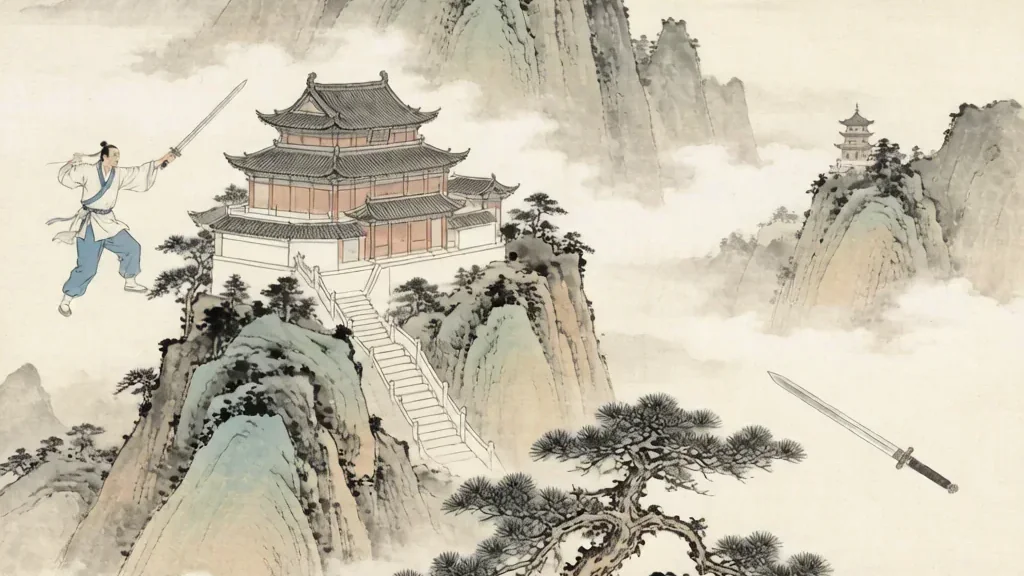
Rising from the landscape of Hubei Province like a scene from an ancient scroll painting, the Wudang Mountains have been a sanctuary of Taoist practice for over two thousand years. Shrouded in mist and dotted with temples that seem to float among the peaks, Wudang is the spiritual home of China's internal martial arts — a tradition that emphasizes the cultivation of qi (vital energy), the harmony of yin and yang, and the principle that softness can overcome hardness. Alongside Shaolin, Wudang stands as one of the two great pillars of Chinese martial culture.
The Legend of Zhang Sanfeng
No figure looms larger in Wudang lore than Zhang Sanfeng (张三丰), the semi-mythical Taoist immortal credited with founding the internal martial arts tradition. Born during the late Song or early Yuan Dynasty (12th-14th centuries), Zhang was said to have been a man of extraordinary intelligence who studied both Confucian classics and Taoist alchemy before retreating to the Wudang Mountains to seek deeper truths.
The most famous origin story of Wudang martial arts describes Zhang Sanfeng observing a fight between a snake and a crane. He noticed how the snake used soft, coiling movements to evade the crane's sharp beak and powerful strikes, never meeting force with force but instead yielding and redirecting. In that moment of insight, Zhang realized that the Taoist principle of wu wei — effortless action in harmony with nature — could be applied to combat. He developed a martial system based on circular, flowing movements that neutralize aggression rather than confront it directly.
While historians debate whether Zhang Sanfeng was a single historical person or a composite figure, his influence on Chinese martial arts is undeniable. He is revered as the founder of Tai Chi (Taijiquan, 太极拳), and his teachings form the philosophical core of all Wudang martial arts. Temples throughout the Wudang range house statues and shrines dedicated to him, and practitioners still bow to his image before training.
The Internal Arts: Neijia vs. Waijia
Chinese martial arts are traditionally divided into two broad categories: external (waijia, 外家) and internal (neijia, 内家). External arts, exemplified by Shaolin Kung Fu, prioritize muscular strength, speed, and physical conditioning. Internal arts, epitomized by Wudang styles, focus on developing and directing internal energy through relaxed, mindful movement.
This distinction is not absolute — accomplished Shaolin practitioners cultivate internal energy, and skilled Wudang martial artists develop formidable physical strength. But the training methodologies differ profoundly. A Wudang practitioner begins by learning to stand still in zhan zhuang (站桩) postures, developing root and sensitivity before learning a single technique. The emphasis is on song (松) — relaxation — which allows qi to flow freely and enables the body to respond instantly to an opponent's intention.
The core internal arts of Wudang include Tai Chi, Baguazhang (八卦掌, Eight Trigrams Palm), and Xingyiquan (形意拳, Form-Intention Boxing). Each of these arts expresses Taoist philosophy through different movement patterns: Tai Chi flows like water in continuous spirals, Baguazhang walks the circle in constant change, and Xingyiquan strikes with direct, explosive power born from internal cultivation.
The Wudang Sword Tradition
While Wudang is known for many weapons, none is more closely associated with the tradition than the straight sword (jian, 剑). In Taoist culture, the sword carries deep symbolic meaning — it represents the power to cut through illusion and attachment, to sever the bonds of ignorance. Taoist priests and martial masters alike carry swords not merely as weapons but as spiritual tools.
Wudang sword forms are renowned for their elegance and precision. Unlike the powerful, sweeping cuts of the battlefield broadsword, the Wudang jian is wielded with delicate wrist movements, threading thrusts, and circular deflections. The sword becomes an extension of the practitioner's intention, moving with a fluidity that makes it appear almost weightless. Practitioners train for years to achieve the ideal of "the sword and the body becoming one."
Famous Wudang sword forms include the Taiyi Sword (太乙剑), named after the primordial Taoist deity, and the Liangyi Sword (两仪剑), which expresses the interplay of yin and yang energies. These forms are passed down through strict master-disciple lineages, with each generation adding its own understanding while preserving the essential principles.
Wudang in the Modern World
Like Shaolin, Wudang has attracted a global following. The ancient temple complexes — including the Golden Hall, the Purple Cloud Temple, and the Nanyan Palace — were designated a UNESCO World Heritage Site in 1994. Students from around the world travel to Wudang to study with Taoist masters, learning not only martial arts but also Taoist philosophy, traditional Chinese medicine, and internal alchemy.
Wudang martial arts have also found their way into popular culture. The graceful, flowing movements of Wudang swordplay have been featured in countless films, from Ang Lee's "Crouching Tiger, Hidden Dragon" to Zhang Yimou's "Hero." Video games and martial arts novels frequently draw on Wudang imagery, cementing its place in the global imagination.
Yet the true heart of Wudang remains unchanged. It is a place where the morning mist still rises over ancient stone steps, where the sound of sword practice echoes across courtyards, and where the Taoist principle of living in harmony with the natural world is not just a philosophy but a daily practice. To study Wudang martial arts is to walk a path that leads not toward violence but toward balance, not toward conquest but toward wisdom.
The Discipline of the Wudang Practitioner
Training in the Wudang tradition follows a path distinctly different from the external martial arts. A new student does not begin by learning punches and kicks. Instead, the first lessons focus on standing meditation — holding specific postures for extended periods while relaxing the body and calming the mind. This practice, known as zhan zhuang (站桩), is the foundation upon which all Wudang skills are built. Through standing, the student learns to feel the connection between the feet and the earth, to release unnecessary tension, and to allow qi to sink to the dantian — the body's energetic center located below the navel.
Only after months of standing practice does the student begin to learn movement. The first forms are taught slowly and meticulously, with an emphasis on correct body alignment and continuous, unbroken flow. A single movement might be repeated hundreds of times before the teacher considers it acceptable. This patience-centered approach reflects the Taoist understanding that true skill cannot be rushed — it grows naturally, like a tree extending its roots before reaching toward the sky.
The relationship between teacher and student in Wudang is deeply personal. Knowledge is transmitted not through written manuals but through direct experience and oral instruction. A teacher might adjust a student's posture with a light touch, demonstrating the correct alignment wordlessly. This transmission method preserves the subtle, internal qualities of the art that cannot be captured in books or videos. It also creates a lineage — a living chain of knowledge stretching back through generations of masters to the legendary Zhang Sanfeng himself.
The Internal Family Of Arts
Wudang is the banner under which Chinese martial arts group themselves as the 'internal family,' or neijia, in contrast to the 'external family' associated with Shaolin. Internal arts prioritize relaxation, whole-body coordination, and the cultivation of internal energy over muscular tension and hard conditioning. Tai Chi is the most famous offspring, but Wudang also embraces sword, staff, and various qigong and boxing sets that share the same soft-yet-rooted logic. The distinction is not that internal arts avoid power, but that they generate it through connected structure and timing rather than isolated strength. Historically this framing helped schools define their identity and lineage, and it still shapes how styles are taught and compared. For learners, recognizing the internal label is the first clue to what a Wudang art will feel like: slow, relaxed, and surprisingly demanding once the principles are tested.
Zhang Sanfeng And The Founding Myth
Wudang's origin story credits the Daoist sage Zhang Sanfeng with founding its martial arts, often through a tale in which he watched a snake and a bird fight and realized the power of softness meeting hardness. Like many founding legends, the historical Zhang Sanfeng is wrapped in myth, and scholars doubt a single inventor of such a broad tradition. What the story does is articulate Wudang's core value: observation of nature, yielding strategy, and a Daoist frame for combat. The Zhang Sanfeng figure also links the arts firmly to the Wudang mountains and to Daoism rather than Buddhism. Whether literal or not, the myth unified later practices under one revered name and gave students a symbolic ancestor to emulate. Understanding this helps the learner see Wudang not as a fixed inventor's invention but as a tradition that grew around a powerful idea of softness.
Wudang Today As Heritage And Practice
Modern Wudang is a living blend of temple, tourist site, and martial academy. On the mountain, Daoist priests and lay teachers still practice sword, Tai Chi, and qigong, while nearby schools train both Chinese and foreign students who come for health, meditation, or martial study. The site's cultural and natural status has brought preservation support, yet also tension between commercial demonstration and authentic transmission. Internationally, Wudang arts are taught in cities worldwide, often through Tai Chi and sword classes that emphasize wellness. This global spread means many people practice a piece of Wudang without ever visiting the mountain. The tradition's survival thus depends on a balance: keeping the internal principles exact while welcoming newcomers who may care more about calm and fitness than combat. That balance is Wudang's contemporary challenge and its continuing strength.
❓ Frequently Asked Questions
📝 Chinese Vocabulary
- 武当 (Wǔdāng) — The Wudang Mountains, the sacred Taoist site and birthplace of internal martial arts
- 张三丰 (Zhāng Sānfēng) — The legendary Taoist immortal credited with founding Tai Chi and Wudang martial arts
- 内家 (Nèijiā) — "Internal family," referring to martial arts that prioritize internal energy cultivation
- 剑 (Jiàn) — The straight double-edged sword, the signature weapon of Wudang martial arts
- 松 (Sōng) — Relaxation or looseness, a fundamental principle of internal martial arts training
🎉 Fun Facts
- The Wudang Mountains contain 72 peaks, 36 cliffs, and 24 streams — numbers that carry deep significance in Taoist numerology. The main peak, Tianzhu (Heavenly Pillar), rises 1,612 meters above sea level.
- Wudang Taoist priests traditionally practice "cloud walking" — a method of traversing mountain paths with a light, gliding gait that conserves energy. This walking technique is considered a form of moving meditation.
- The Ming Dynasty Yongle Emperor (reigned 1402-1424) ordered the construction of over 300,000 workers to build Wudang's temple complex, believing the mountain's deity had helped him win his throne.
- Wudang mountain is a UNESCO-listed site and remains an active center of Daoist worship and martial training.
- The Wudang arts are often called the 'internal family' to contrast with the 'external family' of Shaolin.
- Wudang's connection to Tai Chi makes it the source most Westerners unknowingly trace their slow-motion exercise to.