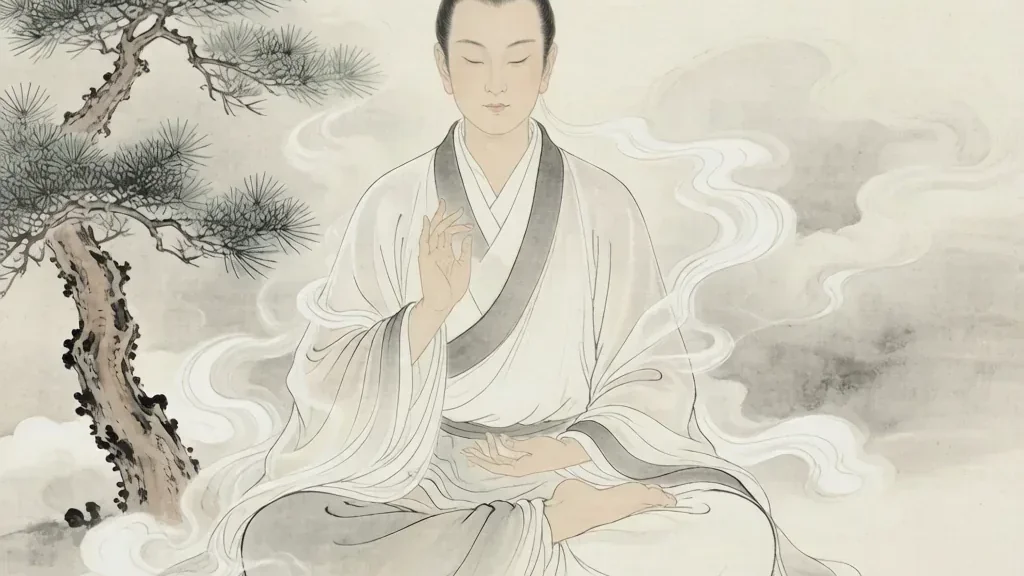
At the heart of Chinese culture lies a concept that has no exact equivalent in Western thought: qi (气). Often translated as "vital energy," "life force," or "breath," qi is understood as the fundamental animating principle of the universe — the energy that flows through all living things, that moves the stars and nourishes the grass. Qigong (气功) — literally "qi work" or "energy cultivation" — is the ancient Chinese practice of working with this energy to promote health, longevity, and spiritual development. It is one of humanity's oldest continuous systems of mind-body practice, with roots stretching back over 5,000 years.
Ancient Origins: From Shamanism to System
Qigong's earliest origins lie in the shamanic traditions of prehistoric China. Archaeological evidence, including a painted pottery jar dating to approximately 3000 BCE, depicts figures in meditative postures remarkably similar to those still practiced today. Ancient shamans used breathing techniques, movement, and sound to enter altered states of consciousness, believing they could communicate with the spirit world and channel healing energy.
As Chinese civilization developed, these practices were absorbed and systematized by two great traditions: Taoism and traditional Chinese medicine. Taoist philosophers of the Warring States period (475-221 BCE) wrote of "nourishing the life principle" (yangsheng, 养生) through breath control and meditation. The "Dao De Jing," attributed to Laozi, contains passages that can be read as instructions for internal energy cultivation — "Can you concentrate your qi and become as supple as a newborn?"
The medical tradition, codified in texts like the "Yellow Emperor's Inner Canon" (Huangdi Neijing, 黄帝内经) around the 2nd century BCE, mapped the pathways of qi through the body. These pathways, known as meridians (jingluo, 经络), form a network along which qi flows to nourish the organs and tissues. When qi is abundant and flowing freely, the body is healthy. When it is blocked or depleted, illness follows. Qigong, in the medical view, is the practice of keeping the qi moving.
The Three Treasures: Medical, Martial, and Spiritual Qigong
Over the millennia, qigong branched into three broad categories, each emphasizing different aspects of the practice.
Medical qigong (yixue qigong, 医学气功) is the healing branch, practiced by both patients seeking recovery and physicians treating others. It includes gentle movements, self-massage, and guided breathing exercises tailored to specific health conditions. In Chinese hospitals today, qigong is prescribed alongside acupuncture and herbal medicine as part of an integrated treatment approach. Research has documented its benefits for conditions ranging from hypertension to chronic pain, anxiety, and immune function.
Martial qigong (wushu qigong, 武术气功) is practiced by martial artists to develop extraordinary physical capabilities. Shaolin monks use qigong to harden their bodies against strikes, while Tai Chi practitioners cultivate internal energy to deliver explosive power. Iron Shirt qigong, one of the most demanding forms, trains practitioners to withstand powerful blows without injury — a feat that requires years of progressive conditioning of the body's tissues and energy systems.
Spiritual qigong (zongjiao qigong, 宗教气功) is practiced within Taoist and Buddhist traditions as a path to enlightenment. Here, qigong becomes a form of internal alchemy (neidan, 内丹), in which the practitioner refines their qi through meditation, visualization, and specialized breathing techniques. The goal transcends physical health — it is the transformation of consciousness itself, the union of the individual spirit with the Dao.
The Eight Brocades: Qigong for Everyone
Among the hundreds of qigong forms, none is more widely practiced than the Baduanjin (八段锦), or "Eight Brocades." This set of eight simple exercises, believed to date from the Song Dynasty (960-1279 CE), is often called the "people's qigong" because it is accessible to practitioners of all ages and fitness levels.
Each of the eight movements targets specific meridians and organ systems. "Two Hands Hold Up the Heavens" stretches the triple burner meridian and regulates the internal organs. "Drawing the Bow to Shoot the Hawk" opens the chest and strengthens the lungs. "Separating Heaven and Earth" harmonizes the spleen and stomach. The movements are performed slowly, with attention to breath and posture, and the entire set can be completed in about 15 minutes.
What makes Baduanjin so enduring is its combination of simplicity and depth. A beginner can learn the basic movements in a single afternoon, yet a dedicated practitioner can spend a lifetime refining the internal aspects — the precise coordination of breath, movement, and intention (yi, 意) that transforms physical exercise into energy cultivation. In parks across China, millions practice Baduanjin each morning, a living link to centuries of embodied wisdom.
Qigong Meets Modern Science
For much of the 20th century, Western science dismissed qigong as pseudoscience. The concept of qi, with no measurable physical correlate, seemed incompatible with the biomedical model. But as research into mind-body medicine has advanced, the scientific picture has grown more nuanced.
Numerous studies have now documented measurable physiological effects of qigong practice. Regular practice has been shown to lower cortisol levels, reduce inflammation markers, improve heart rate variability, and enhance immune function. Brain imaging studies reveal that experienced qigong practitioners show changes in brainwave patterns, increased gray matter density in regions associated with attention and emotional regulation, and altered activity in the autonomic nervous system.
Researchers increasingly view qigong through the lens of stress physiology and neuroplasticity. The slow, mindful movements combined with deep breathing activate the parasympathetic nervous system — the body's "rest and digest" mode — counteracting the chronic stress response that underlies many modern diseases. Whether or not qi exists as a distinct energy, the practice of qigong demonstrably changes the body and brain in beneficial ways.
A Daily Practice for Modern Life
Perhaps qigong's greatest gift is its accessibility. Unlike demanding martial arts or strenuous gym workouts, qigong meets practitioners where they are. It requires no equipment, no special clothing, and very little space. A few minutes of standing meditation or gentle movement can reset a stressed nervous system and restore a sense of centered calm.
For those beginning a qigong practice, the advice passed down through generations is simple: start small, be consistent, and focus on the feeling rather than the form. Ten minutes of daily practice is worth more than an occasional two-hour session. Pay attention to the sensations in your body — the warmth in your palms, the gentle stretch along your spine, the deepening of your breath. Over time, these subtle experiences deepen, and the practitioner discovers what millions before them have found: that the path of qi cultivation leads not just to better health, but to a more harmonious relationship with life itself.
The Three Regulations
Classical Qigong teaching organizes practice around three adjustments known as tiao shen, tiao xi, and tiao xin: regulating the body, the breath, and the mind. Regulating the body means adopting relaxed, aligned postures so energy can move without obstruction, whether standing, sitting, or moving through gentle forms. Regulating the breath means slowing and deepening respiration until it becomes smooth and unforced, which in turn settles the heart rate. Regulating the mind means letting attention rest lightly on the breath, a point in the body, or the motion itself, releasing restless thinking. The three are taught together because none works fully without the others; a calm mind supports smooth breath, and smooth breath supports relaxed posture. This simple framework is why Qigong can be practiced by almost anyone, from athletes to hospital patients, using the same underlying principle of unified body and attention.
Medical And Martial Qigong
Qigong divides broadly into several purposes, and two of the most important are the medical and the martial streams. Medical Qigong, sometimes called health Qigong, uses slow forms, breathing, and intention to support recovery, reduce stress, and maintain wellness; it is the version most commonly taught in parks and clinics. Martial Qigong, by contrast, trains the body to store and release power for combat, hardening the limbs and cultivating the explosive 'jin' seen in internal styles like Tai Chi and Bagua. The same basic mechanics appear in both, but the goal shifts from nurturing to generating force. Understanding this split helps explain why Qigong can seem both gentle and formidable. A single art that calms a patient in the morning can, with different intent and training, condition a fighter's strike in the afternoon.
Qigong In Daily Chinese Life
Far from being a fringe practice, Qigong is woven into ordinary life across China. At dawn in city parks and village squares, groups gather to move through forms like Eight Brocades or Wild Goose, often to recorded music and with little ceremony. Hospitals and community centers offer Qigong as supportive therapy for chronic conditions, and schools may include simple breathing exercises for students. This everyday presence means Qigong functions less as a special discipline and more as a shared hygiene of body and mind, like stretching or walking. Its low cost and adaptability make it accessible across ages and incomes. For cultural learners, observing public Qigong is one of the easiest windows into how traditional Chinese health ideas survive in modern routines, quietly linking contemporary life to concepts of energy and balance that are centuries old.
❓ Frequently Asked Questions
📝 Chinese Vocabulary
- 气 (Qì) — Vital energy, life force, or breath — the fundamental animating principle in Chinese philosophy and medicine
- 气功 (Qìgōng) — "Energy work," the practice of cultivating and circulating qi for health, martial, or spiritual purposes
- 八段锦 (Bāduànjǐn) — "Eight Brocades," the most widely practiced set of qigong exercises, accessible to all ages and fitness levels
- 养生 (Yǎngshēng) — "Nourishing life," the Taoist principle of cultivating health and longevity through lifestyle practices
- 经络 (Jīngluò) — Meridians, the network of energy pathways through which qi flows in the body according to Chinese medicine
🎉 Fun Facts
- Qigong is one of the most practiced health activities in the world. An estimated 80 million Chinese citizens practice some form of qigong regularly, and it has been adopted in hospitals, schools, and community centers nationwide.
- The "Horse Stance" (mabu), a fundamental posture in many qigong and martial arts practices, was used as a form of punishment in some traditional schools — students would be made to hold the position for hours to build discipline and leg strength.
- In 2010, a study published in the Journal of Alternative and Complementary Medicine found that qigong practice significantly increased telomerase activity — an enzyme associated with cellular longevity — suggesting a possible mechanism for qigong's anti-aging effects.
- Qigong is often grouped into two broad families: dynamic forms that move the body and static forms done standing or seated.
- Millions of Chinese citizens practice Qigong in public parks at dawn as a daily routine.
- Some Qigong sets are explicitly medical, prescribed by clinics as part of rehabilitation.