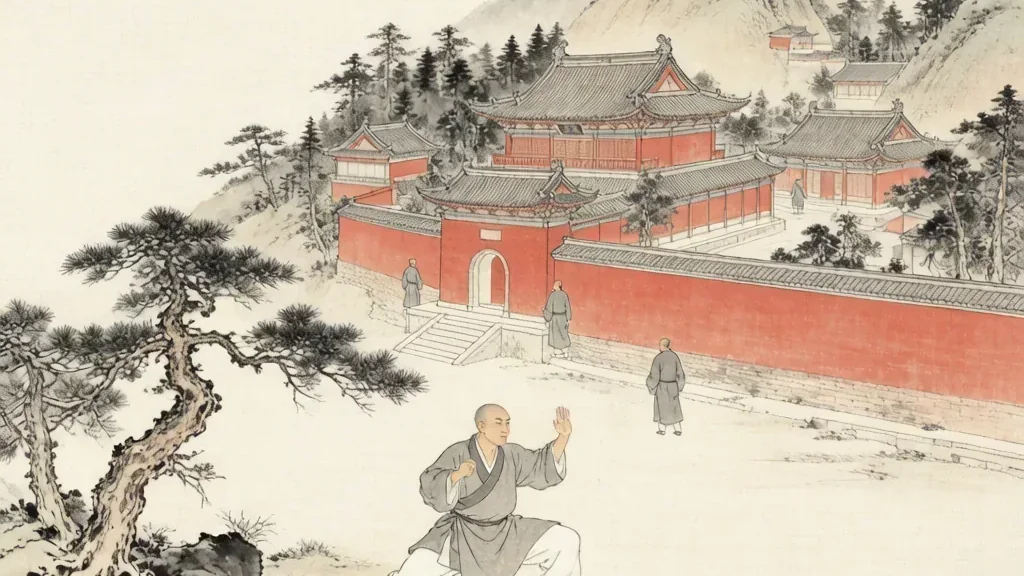
Perched on the forested slopes of Mount Song in Henan Province, the Shaolin Temple stands as the cradle of one of the world's most iconic martial traditions. For over 1,500 years, this Buddhist monastery has been synonymous with disciplined warriors, breathtaking physical feats, and a spiritual philosophy that blends Chan (Zen) meditation with combat training. Shaolin Kung Fu is far more than a fighting system — it is a living cultural heritage that has shaped martial arts across China, Japan, Korea, and beyond.
The Arrival of Bodhidharma
The story of Shaolin Kung Fu begins not with a warrior, but with a monk. In the 5th or 6th century CE, an Indian Buddhist master named Bodhidharma — known in Chinese as Damo (达摩) — traveled eastward to spread the teachings of Chan Buddhism. Legend holds that Bodhidharma arrived at the Shaolin Temple and found the resident monks physically weak, unable to endure the long hours of seated meditation required by Chan practice.
Recognizing that a weak body could not support a strong mind, Bodhidharma is said to have retreated to a cave near the temple, where he meditated in silence for nine years. During this time, he developed a series of physical exercises designed to strengthen the monks' bodies, improve their circulation, and sharpen their mental focus. These exercises — known as the "Sinew Metamorphosis Classic" (Yijin Jing, 易筋经) and the "Marrow Washing Classic" (Xisui Jing, 洗髓经) — are considered the foundational texts of Shaolin physical training.
Whether Bodhidharma personally created these systems is debated by historians. What is certain, however, is that his synthesis of physical discipline with meditative practice established the core principle of Shaolin: the unity of body and mind. The monks came to believe that martial training was not a contradiction to Buddhist non-violence but rather a path to self-mastery and, when necessary, a means of protecting the innocent.
The 72 Arts of Shaolin
Over the centuries, Shaolin monks developed and codified an astonishing range of combat techniques. The Shaolin system eventually grew to encompass 72 distinct arts, covering strikes, kicks, joint locks, grappling, weaponry, and internal energy cultivation. Each art was designed to push the human body beyond its perceived limits.
Among the most famous are the "Iron Palm" technique, in which practitioners gradually condition their hands to deliver devastating strikes, and the "Golden Bell Cover," a form of body hardening that allows a monk to withstand powerful blows without injury. Other arts focus on lightness skills, enabling practitioners to leap great heights and move with ghostlike silence.
Weapons training holds an equally important place in the Shaolin curriculum. The staff (gun, 棍) is considered the fundamental Shaolin weapon — so central to the tradition that the temple is often associated with the saying, "The Shaolin staff is the king of all weapons." Monks also train extensively with the straight sword (jian, 剑), the broadsword (dao, 刀), the spear (qiang, 枪), and a variety of exotic weapons including the three-section staff, the rope dart, and the monk's spade.
The Warrior Monk Tradition
Shaolin monks did not train purely for self-cultivation. Throughout Chinese history, the temple's warrior-monks (wuseng, 武僧) repeatedly entered the political and military stage. During the early Tang Dynasty (7th century), thirteen Shaolin monks famously rescued the future Emperor Taizong from enemy forces, earning the temple imperial patronage and the right to maintain a standing fighting force.
In the Ming Dynasty (14th-17th centuries), Shaolin warrior-monks were deployed to defend China's southeastern coast against Japanese pirate raids. Historical records describe them fighting with such ferocity and skill that they turned the tide of several key battles. This period cemented the temple's reputation as a center of martial excellence recognized far beyond its religious role.
Yet the temple's history has also been marked by destruction and renewal. The Shaolin Monastery was burned and rebuilt multiple times, most devastatingly during the 1928 warlord era, when a fire destroyed much of the temple's ancient archives. Despite these tragedies, the martial knowledge survived — carried in the bodies and memories of monks who passed techniques from master to disciple across generations.
Shaolin Kung Fu Today
In the modern era, Shaolin Kung Fu has achieved global recognition unlike any other Chinese martial art. Following the 1982 film "Shaolin Temple," which launched the career of Jet Li, international interest in Shaolin culture exploded. Today, tens of thousands of students from around the world travel to Dengfeng County each year to train at the numerous martial arts academies that surround the temple.
The temple itself has adapted to the modern world while preserving its core traditions. Under the leadership of the current abbot, the Shaolin Temple has established cultural centers in dozens of countries, organized international martial arts festivals, and even embraced digital platforms to share its teachings. In 2010, the historic monuments of Dengfeng, including the Shaolin Temple, were designated a UNESCO World Heritage Site.
What makes Shaolin Kung Fu endure is not merely its effectiveness as a fighting art but the philosophy it embodies. The training demands patience, humility, and relentless self-discipline. A true Shaolin practitioner seeks not to dominate others but to conquer their own limitations. As the temple's ancient motto reminds us: "The fist is not for fighting; the fist is for peace." In a restless world, that lesson may be the most powerful technique of all.
The Daily Life of a Shaolin Monk
Life inside the Shaolin Temple follows a rhythm that has remained largely unchanged for centuries. The day begins before dawn, typically around 5:00 AM, with the ringing of the temple bell. Monks rise for morning chanting and meditation in the main hall, where the resonant sound of sutras fills the ancient wooden chambers. After a simple vegetarian breakfast — often consisting of congee, steamed buns, and pickled vegetables — the physical training commences.
A typical training session might begin with running up and down the stone steps of the mountain, sometimes carrying water buckets to build endurance and leg strength. This is followed by stance training — holding deep horse stances and other foundational postures for extended periods, sometimes for an hour or more. Only after the body is thoroughly warmed and the mind is settled do monks proceed to forms practice, weapons drills, and sparring.
The connection between Buddhist practice and martial training runs deep in daily life. Before and after each training session, monks bow to the Buddha and to their teachers. Combat techniques are framed not as violence but as moving meditation — a way to understand the nature of mind, body, and impermanence. Many senior monks describe their martial practice as inseparable from their spiritual path: the discipline of the body sharpens the mind, and the clarity of meditation informs every movement.
The Legend Of Bodhidharma
Shaolin's origin story centers on Bodhidharma, the Indian monk known in Chinese as Damo, who is said to have arrived at the temple in the early centuries of the common era and spent years in meditation facing a wall. Legend credits him with teaching breathing and stretching exercises to monks whose bodies had grown weak from long sitting, exercises later elaborated into the temple's health and martial arts. Whether or not the stories are literal history, they fixed Shaolin's self-image as a place where meditation and physical training belong together. The famous tale of Damo's shadow burned into a cave wall became a symbol of unwavering concentration. For cultural learners this legend is the key to understanding why Shaolin never separates the cushion from the courtyard: the fighting art is framed as an outgrowth of contemplative discipline rather than a separate pursuit.
Forms, Weapons, And The 72 Arts
Shaolin's curriculum is famously vast, traditionally described through the '72 arts' that include striking, conditioning, weapons, and unusual skills like iron palm and finger strength. Students typically begin with basic stances and short empty-hand forms before progressing to longer sequences and then to weapons such as the staff, saber, and spear. Each form is a stored catalogue of technique, preserved and repeated so knowledge survives across generations of monks and lay students. The emphasis on repetition builds the raw attributes, power, flexibility, and endurance, that the more advanced arts require. While the exact list of 72 arts varies by source, the idea of a comprehensive, graduated system is consistent. This structured depth is what allowed Shaolin boxing to spread into countless regional styles, all tracing authority back to the Song Mountain temple.
Shaolin In The Modern World
Today Shaolin is both a working Buddhist temple and a global martial brand. The monastery trains monk practitioners, hosts tourists, and sends demonstration teams abroad, while lay academies around the world teach Shaolin-inspired wushu to children and adults. This visibility has revived interest but also raised debates about commercialization and the balance between performance and authentic practice. The Chinese state has recognized Shaolin culture as intangible heritage, supporting its preservation even as the temple navigates tourism and media. For many learners Shaolin now means a first introduction to Chinese martial arts through films, festivals, or local classes. Beneath the spectacle, the core claims remain: disciplined training, moral conduct, and the union of movement and mind. That enduring message is why Shaolin still commands respect centuries after its founding.