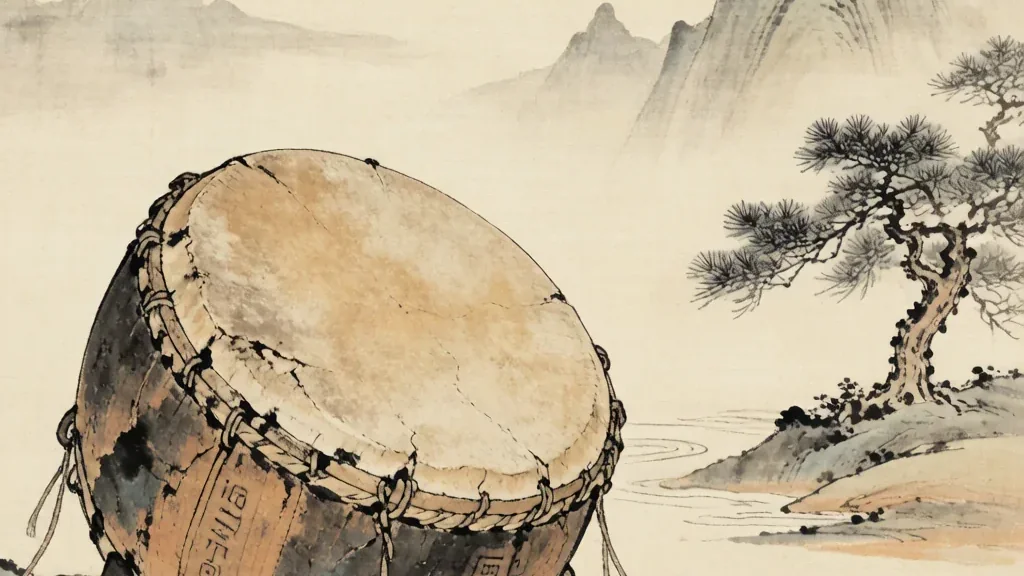
Long before written language, before bronze bells and silk strings, there was the drum. The deep, resonant voice of the drum has been the heartbeat of Chinese civilization for over seven thousand years — calling warriors to battle, summoning communities to ceremony, marking the rhythms of seasons and celebrations, and connecting the human world to the realm of spirits. In China, the drum is not merely a musical instrument. It is a cultural force, a symbol of power and vitality, and one of the oldest continuous traditions in human history.
From the Neolithic clay drums unearthed by archaeologists to the thunderous performances of the 24 Festive Drums that thrill modern audiences, the Chinese drum has evolved through millennia while retaining its essential power. Its voice has been heard on battlefields and in temples, at imperial courts and village festivals, in opera houses and concert halls. To understand the Chinese drum is to understand something fundamental about Chinese culture itself — its rhythm, its energy, and its deep connection to the past.
Neolithic Origins: The First Drumbeats
The oldest known drums in China date back to the Neolithic period, around 5500 BCE. Archaeologists have discovered clay drums in the Yangshao culture sites of the Yellow River valley, their surfaces decorated with painted patterns. These early drums were simple vessels with skins stretched across their openings — the same basic design that would persist for thousands of years. Even at this early date, drums seem to have held ritual significance, used in ceremonies that connected communities to their ancestors and to the natural world.
The Shang Dynasty saw the development of more sophisticated drums. Oracle bone inscriptions from this period include characters for drums, indicating their importance in ritual and court life. Bronze drums from the Shang and Zhou dynasties, often elaborately decorated with animal motifs and geometric patterns, have been found in tombs of the elite, suggesting that drums were valued possessions that accompanied their owners into the afterlife. These bronze drums, some weighing hundreds of kilograms, produced a sound that could be heard for miles.
Perhaps the most remarkable ancient Chinese drums are the tonggu, or bronze drums, of southern China and Southeast Asia. These massive instruments, cast in bronze with intricate decorations depicting scenes of daily life, warfare, and ritual, represent the pinnacle of ancient percussion technology. The largest surviving examples weigh over 300 kilograms and produce a deep, resonant tone that seems to vibrate in the bones of anyone standing nearby. The bronze drum tradition, which flourished from the first millennium BCE, continues among some ethnic minority groups in southern China today.
War Drums: The Voice of Battle
Throughout Chinese history, the drum has been inseparable from warfare. In ancient Chinese armies, drums served as the primary means of battlefield communication — coordinating troop movements, signaling attacks and retreats, and maintaining morale in the chaos of combat. The thunder of war drums was so important that military drummers held a special status, and the loss of a drum was considered a grave dishonor.
The military use of drums is described in some of China's earliest texts. The Art of War by Sun Tzu discusses the use of drums and gongs to direct troops: "In night fighting, use many torches and drums; in day fighting, use many banners and flags." The Rites of Zhou, an ancient text on government and ritual, describes the organization of military drummers and the specific signals used for different commands. A rapid beat meant advance; a slow beat meant hold position; a long roll meant retreat.
The most famous Chinese war drum is the jiangu, or "establishing drum," a large drum mounted on a stand that was beaten to announce the beginning of battle. According to historical accounts, the drumming at the Battle of Fei River in 383 CE was so thunderous that it caused panic among the opposing forces. The psychological power of drums — their ability to inspire courage in one's own troops and terror in the enemy — was well understood by Chinese military commanders, who employed drums as weapons of psychological warfare.
Ceremonial Drums: Heaven, Earth, and Humanity
Beyond warfare, drums played a central role in Chinese ceremonial life. At the imperial court, drums announced the emperor's presence, marked the hours of the day, and accompanied the elaborate rituals that maintained cosmic harmony. The Temple of Heaven in Beijing, where emperors performed the most important state sacrifices, featured a special drum tower whose instrument was beaten to signal the beginning of ceremonies.
In Buddhist and Daoist temples, drums served both practical and spiritual functions. The morning drum called monks to prayer; the evening drum signaled the end of the day. The deep resonance of temple drums was believed to reach the spirit world, carrying prayers and offerings to the ears of gods and ancestors. The rhythmic beating of drums during rituals helped induce meditative states and focused the attention of worshippers on the sacred moment.
In folk religion and village ceremonies, drums connected communities to their local gods and to the rhythms of the agricultural year. The drumming at temple fairs, harvest festivals, and rain-making ceremonies was not just entertainment — it was a form of communication with the divine, a way of aligning human activity with the cosmic order. The drum was the voice of the community, speaking to heaven on behalf of the people.
The Lion Dance Drum: Heart of the Celebration
For many people around the world, the most familiar Chinese drum is the one that accompanies the lion dance. This drum — typically a large barrel drum played with two wooden sticks — provides the driving rhythm that animates the lion's movements. The lion dance drummer is more than a musician; they are a performer who interacts with the lion, responding to its movements and directing the flow of the dance.
The lion dance drumming follows specific rhythmic patterns that have been passed down through generations. The most basic pattern, known as the "three-star" beat, is simple but powerful: a sequence of three strong beats followed by rests that create a compelling forward momentum. More complex patterns incorporate cymbals and gongs, building to climactic crescendos that match the lion's most dramatic movements — leaping onto platforms, snatching the lucky lettuce, or spitting out auspicious scrolls.
The lion dance drum is particularly prominent during Chinese New Year celebrations, when lion dance troupes visit homes and businesses to bring good luck and drive away evil spirits. The thunderous drumming is believed to have apotropaic power — the loud noise frightens away malevolent forces and clears the way for good fortune. In this context, the drum is not just providing a beat for the dance; it is actively participating in the ritual work of the celebration.
The 24 Festive Drums: A Modern Tradition
One of the most exciting developments in Chinese drum culture is the 24 Festive Drums, a contemporary art form that has become a global phenomenon. Created in 1988 by Malaysian Chinese artists Tan Chai Puan and Tan Hooi Song, the 24 Festive Drums combine traditional Chinese drumming with modern choreography, creating spectacular performances that have captivated audiences around the world.
The name "24 Festive Drums" refers to the twenty-four solar terms of the Chinese agricultural calendar, and each drum represents one of these terms. The performances typically feature twenty-four drummers arranged in formation, executing precisely choreographed movements while playing complex rhythmic patterns. The visual spectacle — the synchronized movements of the drummers, the flying drumsticks, the powerful physicality of the performance — is as important as the music.
The 24 Festive Drums represent a creative fusion of tradition and innovation. The drumming techniques draw on Chinese classical and folk traditions, but the choreography incorporates elements of modern dance and martial arts. The performances are set to original compositions that blend Chinese and Western musical influences. Since its creation, the 24 Festive Drums have been adopted by schools, community groups, and professional companies across Malaysia, China, and the global Chinese diaspora, becoming one of the most visible expressions of contemporary Chinese percussion.
Drums in Chinese Opera
In Chinese opera, the drum occupies a position of unique authority. The lead drummer — playing the bangu, a small drum that produces a sharp, penetrating sound — serves as the conductor of the entire orchestra. Every entrance, every movement, every dramatic climax is cued by the drummer's precise strokes. The drummer must know the opera as thoroughly as the singers and actors, anticipating every beat and responding to every nuance of the performance.
The drum's role in opera reflects a broader Chinese cultural principle: the idea that percussion provides the framework within which melody and drama unfold. In Western music, the conductor's baton sets the tempo; in Chinese opera, the drummer's stick performs the same function. The drum is not merely one instrument among many — it is the foundation upon which the entire musical structure rests.
The Living Tradition
Today, the Chinese drum thrives in multiple forms. Traditional drumming remains central to festivals, ceremonies, and community celebrations. Contemporary drum ensembles like the 24 Festive Drums have brought Chinese percussion to international audiences. Drumming has been incorporated into music education programs, fitness classes, and team-building exercises. The ancient instrument continues to find new expressions while maintaining its connection to tradition.
The enduring power of the drum lies in its primal simplicity. Unlike a string or wind instrument, which requires training to produce a pleasant sound, a drum speaks directly to the body. Its vibrations are felt as much as heard. Its rhythms bypass the analytical mind and connect directly to something deeper — the pulse that has been the heartbeat of human culture since the first person struck a hollow log and discovered that rhythm could bring people together.
When you hear a Chinese drum — whether it is the thunderous roar of a temple drum, the driving beat of a lion dance, or the precise articulation of an opera drummer — you are hearing a sound that has echoed through Chinese civilization for seven thousand years. It is the sound of community, of celebration, of connection to ancestors and gods. It is the heartbeat of a civilization, still beating strong.
The Drum as a Symbol of Vitality
More than an instrument, the Chinese drum has long stood for vitality, unity, and the shared pulse of a community. Its sound is felt in the chest before it is heard, which is why it has always been used to gather people, whether for war, worship, harvest, or celebration. The drum turns private feeling into public energy: one player's beat becomes a crowd's momentum, and a village's anxiety becomes courage. In folk belief the loud report also had an apotropaic role, driving away malevolent forces at New Year and at rites of purification. Scholars note that the drum's centrality reflects a wider Chinese idea, that order and harmony are maintained not only by texts and rites but by rhythm itself. To beat the drum was, and still is, to affirm that the community is alive, awake, and together.
❓ Frequently Asked Questions
📝 Chinese Vocabulary
- 鼓 (gǔ) — Drum; one of the oldest and most fundamental Chinese instruments
- 战鼓 (zhàngǔ) — War drum; used for battlefield communication and morale
- 铜鼓 (tónggǔ) — Bronze drum; the massive ceremonial drums of southern China
- 板鼓 (bǎngǔ) — The small, high-pitched drum used as the conductor's instrument in Chinese opera
- 二十四节令鼓 (Èrshísì Jiélìng Gǔ) — 24 Festive Drums; the modern drum ensemble tradition
🎉 Fun Facts
- The oldest Chinese drums discovered by archaeologists date back to 5500 BCE — over 7,000 years ago — making the drum one of the oldest instruments in continuous use anywhere in the world.
- Some ancient Chinese bronze drums weigh over 300 kilograms and produce a sound so deep and resonant that it can be felt physically as well as heard.
- The 24 Festive Drums, created in 1988, have grown from a local Malaysian Chinese art form into a global phenomenon performed in over 20 countries and recognized as a Malaysian National Intangible Cultural Heritage.
- In imperial cities, the drum tower beat an evening drum to close the day and sound the curfew, while a morning bell opened it.
- In Chinese opera, the small bangu drum acts as the conductor, cueing every entrance, movement, and climax of the performance.
- At a traditional yamen, or government office, a grievance drum stood outside so ordinary people could beat it to request a magistrate's hearing.