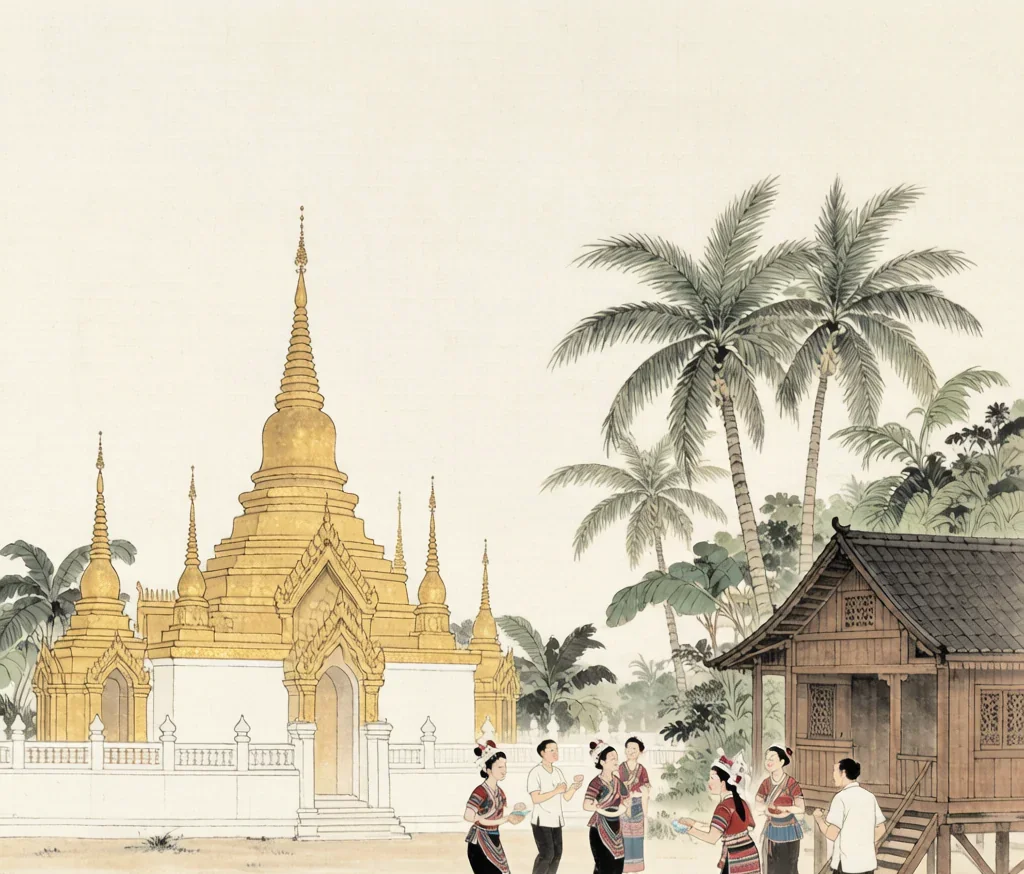
In the lush tropical valleys of Xishuangbanna, where the Mekong River flows south toward Southeast Asia and the air is heavy with the scent of frangipani, the Dai people have created a civilization that feels more like Thailand or Laos than the China of popular imagination. Known in Chinese as 傣族 (Dǎi zú), the Dai are masters of water — their most famous festival involves drenching everyone in sight, their architecture rises from rivers and ponds, and their entire culture seems to flow with the liquid grace of the tropical monsoon.
A Tropical Civilization
The Dai homeland in southern Yunnan province is a world apart from the China of rice paddies and wheat fields. Here, the climate is subtropical, the vegetation is lush and evergreen, and the cultural influences flow from Southeast Asia as much as from the Chinese heartland. The Dai are ethnically and linguistically related to the Thai, Lao, and Shan peoples, and their culture shares deep roots with the Theravada Buddhist civilizations of mainland Southeast Asia.
The Mekong River — known in China as the Lancang (澜沧江, Lán cāng jiāng) — is the lifeline of Dai civilization. Its waters irrigate the rice paddies that produce the staple food. Its fish provide protein. Its banks are lined with the bamboo groves that provide building material for Dai houses and temples. The river is not merely a geographical feature but a spiritual presence, celebrated in Dai poetry, song, and ritual.
Dai agriculture centers on wet-rice cultivation, a system that requires sophisticated water management. The terraced paddies, flooded during the growing season and drained for harvest, represent a collaboration between human engineering and natural hydrology that has been refined over centuries. The agricultural calendar structures Dai social life, with festivals marking the key moments of the rice cycle — planting, transplanting, and harvest. The intimate connection between water, rice, and life is the foundation of Dai culture.
The Water-Splashing Festival
If there is one event that defines Dai culture in the popular imagination, it is the Water-Splashing Festival (泼水节, pō shuǐ jié). Celebrated in mid-April to mark the Dai New Year, this three-day festival transforms Dai communities into scenes of joyful aquatic chaos. Everyone — young and old, male and female, resident and visitor — is a target. Water is thrown from buckets, sprayed from hoses, and launched from water guns. To be drenched is to be blessed, and the wetter you get, the better your luck for the coming year.
The festival's origins lie in both Buddhist tradition and pre-Buddhist folk belief. In Buddhist practice, the water-splashing represents purification — washing away the misfortunes and misdeeds of the old year to begin the new year clean. The first day of the festival involves respectfully pouring water over Buddhist statues and the hands of elders, a gentle and reverent act. The second and third days, however, explode into the free-for-all water fight that has made the festival famous worldwide.
Beyond the water battles, the festival features dragon boat races on the Mekong, the launching of Kongming lanterns (孔明灯, kǒng míng dēng) that float into the night sky carrying wishes and prayers, and traditional dance performances. Young people use the festival as an opportunity for courtship, with the custom of "losing one's pouch" (丢包, diū bāo) — young women throw embroidered pouches to young men they favor, and if the man catches it, a courtship may begin. The entire festival is a celebration of life, community, and the life-giving power of water.
The Peacock Dance
Among the Dai, the peacock is not merely a beautiful bird but a sacred creature, a symbol of beauty, dignity, and good fortune. The Peacock Dance (孔雀舞, kǒng què wǔ) is the most celebrated Dai performance art, a solo dance in which the performer — traditionally male, though women also perform it today — imitates the movements of a peacock with extraordinary precision and grace.
The dance depicts a peacock's daily life: emerging from its nest at dawn, preening its feathers, drinking from a stream, spreading its magnificent tail, and strutting through the forest. The costume is elaborate, featuring a long, flowing skirt that represents the peacock's tail, decorated with peacock-feather patterns. The dancer's movements are precise and controlled — the rapid vibration of the hands, the proud arch of the neck, the sudden spread of the "tail" — creating a performance that is at once naturalistic and highly stylized.
The Peacock Dance has its origins in ancient Dai folk religion, where it may have been a form of bird worship. With the arrival of Buddhism, the peacock became associated with the Buddha's virtues — the bird's beauty representing the beauty of the dharma, its dignity representing the composure of the enlightened mind. Today, the dance is performed at festivals, for tourists, and in professional dance companies, but it retains its power to transport audiences into the lush, tropical world of the Dai imagination.
Bamboo Architecture and the Dai House
Traditional Dai architecture is a masterclass in adapting to the tropical environment. The classic Dai house is built on stilts, with the living quarters elevated above the ground to protect against flooding, snakes, and insects. The walls are made of woven bamboo, allowing air to circulate freely through the house. The roof is steeply pitched and covered with thatch or tiles, shedding the heavy monsoon rains. The space beneath the house serves as a shaded work area and shelter for livestock.
The Dai house is more than shelter — it is a social space structured by cultural rules. The interior is divided into distinct areas: a public area for receiving guests, a family area for daily life, and a sleeping area. The division between these spaces is marked by changes in floor level rather than walls, creating a flowing, open interior. The hearth is the heart of the home, and the space around it is governed by rules about who may sit where, reflecting the hierarchical structure of Dai family life.
Dai Buddhist temples represent the most elaborate expression of Dai architecture. Unlike the multi-story pagodas of Chinese Buddhism, Dai temples follow the Southeast Asian model — single-story structures with multiple, sweeping roof tiers that curve upward at the eaves. The temple compounds are surrounded by walls and entered through ornate gates. Inside, the walls are covered with murals depicting the life of the Buddha and scenes from Buddhist scripture, painted in the bright, narrative style characteristic of Southeast Asian Buddhist art.
Theravada Buddhism and Dai Spirituality
The Dai practice Theravada Buddhism, the oldest surviving school of Buddhism and the dominant religion of Sri Lanka, Myanmar, Thailand, Laos, and Cambodia. This distinguishes them from the majority of Chinese Buddhists, who follow Mahayana traditions. Theravada Buddhism emphasizes monastic discipline, meditation, and the individual's path to enlightenment, and its influence permeates every aspect of Dai culture.
The temple (wat) is the center of Dai village life, serving as school, community center, and spiritual refuge as well as place of worship. Traditionally, all Dai boys spent time as novice monks, living in the temple, studying Buddhist scriptures, and learning to read and write the Dai script. This period of monastic education, which could last from a few months to several years, was the primary means of cultural transmission. Even today, though state education has largely replaced temple schooling, the tradition of temporary ordination continues in many Dai communities.
Beneath the Buddhist surface, older layers of Dai spirituality persist. Spirit worship, predating the arrival of Buddhism, continues in the form of offerings to village guardian spirits and nature spirits. The Dai believe in a complex spirit world that coexists with the human world, and maintaining proper relations with spirits is essential for health, prosperity, and harmony. This syncretic spirituality — Buddhism and animism intertwined — is characteristic of Theravada cultures throughout Southeast Asia.
The Dai Script and Literary Tradition
The Dai possess their own writing system, derived from the ancient Mon script of Southeast Asia and related to the writing systems of Thai, Lao, and Burmese. The Dai script exists in several regional variants, reflecting the historical division of the Dai into different petty kingdoms. The script is alphabetic, with letters representing consonants and diacritics indicating vowels — a system fundamentally different from Chinese characters.
Dai literature encompasses a wide range of genres, from Buddhist scriptures translated from Pali to indigenous epic poetry, folk tales, and historical chronicles. The most famous work of Dai literature is the epic "Zhao Shutun" (召树屯), a love story about a prince and a peacock princess that has been compared to the Western tale of Cinderella. The story has been adapted into films, dance dramas, and operas, and it remains a beloved part of Dai cultural heritage.
The Dai people, with their water festivals and peacock dances, their bamboo houses and Buddhist temples, represent a cultural bridge between China and Southeast Asia. Their civilization, adapted to the rhythms of the monsoon and the flow of the Mekong, offers a vision of life lived in harmony with water — the element that gives life, cleanses impurity, and, on one glorious day each April, drenches everyone in joyful celebration.
Dai Cuisine and Tropical Flavors
Dai food reflects the warm, wet climate of southern Yunnan, built on glutinous rice, fresh herbs, lemongrass, and sour-savory dips. Dishes such as sour bamboo-shoot soup and grilled fish are common, and rice steamed in bamboo tubes (竹筒饭, zhú tǒng fàn) is a distinctive local preparation enjoyed at festivals and family meals.
Dai Textiles and Silverwork
Dai women are skilled weavers, producing handwoven cotton and silk in bright, intricate patterns used for skirts, shoulder cloths, and ceremonial dress. Silver ornaments — belts, combs, and bracelets — are treasured markers of festive attire, and Dai temples are often adorned with gilded and lacquered woodwork showing Southeast Asian influence.
❓ Frequently Asked Questions
The Dai people (傣族, Dǎi zú) mainly live in the Xishuangbanna Dai Autonomous Prefecture and Dehong Dai and Jingpo Autonomous Prefecture in Yunnan Province.
The Water Splashing Festival (泼水节, Pōshuǐ Jié) is the Dai New Year celebration, held in mid-April. People splash water on each other to wash away bad luck and welcome the new year.
Most Dai people practice Theravada Buddhism, which arrived from Southeast Asia. Every Dai village has a Buddhist temple, and young boys traditionally become novice monks.
Dai culture is known for its elegant peacock dance (孔雀舞, kǒngquè wǔ), stilted bamboo houses, and beautiful traditional clothing made from handwoven fabrics.
The Peacock Dance (孔雀舞, kǒng què wǔ) is the Dai's signature performance, mimicking a peacock's grooming and strutting to express beauty and good fortune, and it is performed at festivals and on stage.
The Dai speak a Tai-Kadai language written in an alphabetic script derived from the Mon script of Southeast Asia, with several regional variants used across Yunnan.
📝 Chinese Vocabulary
- 傣族 (Dǎi zú) — The Dai ethnic group
- 泼水节 (pō shuǐ jié) — The Water-Splashing Festival; the Dai New Year celebration
- 孔雀舞 (kǒng què wǔ) — The Peacock Dance; the most famous Dai performance art
- 澜沧江 (Lán cāng jiāng) — The Lancang (Mekong) River; the lifeline of Dai civilization
- 召树屯 (Zhào Shù Tún) — "Zhao Shutun"; the classic Dai epic poem
🎉 Fun Facts
- During the Water-Splashing Festival, it is considered good luck to be drenched — the wetter you get, the more blessings you receive. Even police officers and government officials are fair game for water attacks.
- Dai villages traditionally had no locks on doors — theft was virtually unknown, and the community's social fabric was strong enough that security measures were unnecessary.
- The Dai have a unique method of cooking rice in bamboo tubes — glutinous rice is packed into green bamboo sections with water, then roasted over an open fire until the bamboo chars and the rice inside is perfectly steamed.
- Dai temple architecture follows the sweeping, multi-tiered roof style of mainland Southeast Asia rather than the pagoda form common elsewhere in China.
- The Dai writing system is alphabetic and related to Thai and Lao scripts, making it fundamentally different from Chinese characters.
- The peacock dance was historically performed by men, though today both men and women take the stage in its flowing, bird-like movements.