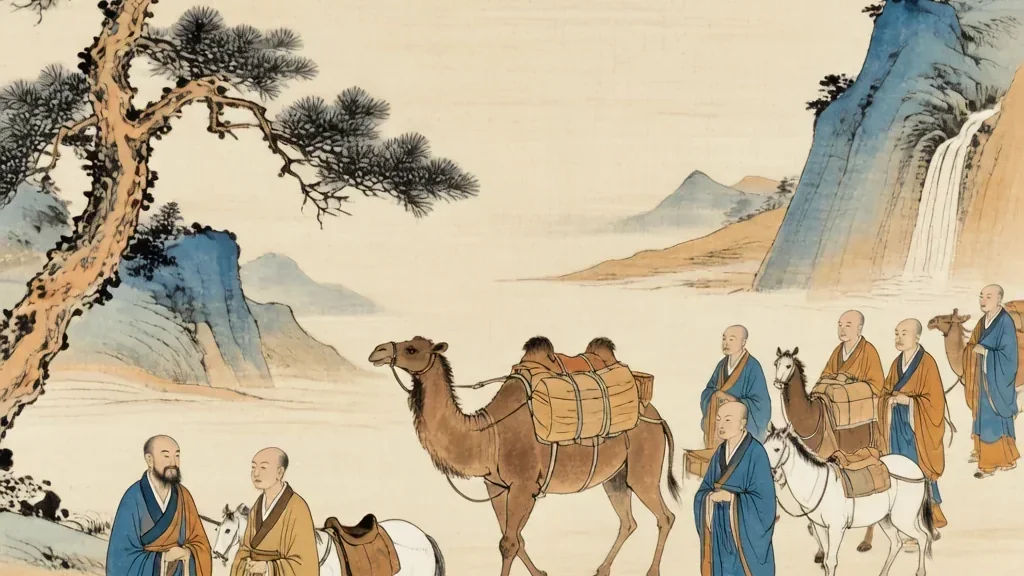
In the first century CE, a strange and wondrous teaching began drifting eastward along the Silk Road. It carried with it the image of a serene figure seated in meditation, the promise of liberation from suffering, and a radical new understanding of the mind. This was Buddhism — and its arrival in China would transform one of the world's oldest civilizations forever.
The Emperor's Dream
According to tradition, Buddhism entered China through a dream. In 67 CE, Emperor Ming of the Eastern Han Dynasty saw a golden figure flying through his palace, radiating light. His ministers interpreted the vision as a sign of the Buddha, a sage from the West whose teachings had begun circulating among Silk Road merchants. The emperor dispatched envoys to India to learn more.
The envoys returned with two Indian monks, Kasyapa Matanga and Dharmaratna, who carried Buddhist scriptures on white horses. To house these sacred texts, the emperor ordered the construction of the White Horse Temple (Baima Si) in Luoyang — the first Buddhist temple on Chinese soil. Today, nearly two thousand years later, the White Horse Temple still stands, a living monument to that fateful meeting of civilizations.
But Buddhism did not spread overnight. For the first two centuries, it remained a curiosity, practiced mainly by foreign merchants and a handful of curious scholars. The real transformation began in the chaotic centuries that followed the Han Dynasty's collapse.
Translation and Transformation
The fall of the Han in 220 CE plunged China into centuries of division and warfare. In this atmosphere of uncertainty, Buddhism's message of transcending suffering found a deeply receptive audience. But there was a problem: the sutras were in Sanskrit and Pali, languages few Chinese could read. The task of translation fell to a remarkable succession of scholar-monks.
The greatest of these was Kumarajiva (344–413 CE), a Central Asian monk of prodigious talent. Captured by Chinese forces and brought to Chang'an, he produced translations of such clarity and beauty that they remain standard texts to this day. His rendition of the Lotus Sutra, the Diamond Sutra, and the Heart Sutra shaped the development of Chinese Buddhism more than any other single figure.
Kumarajiva understood that translation was not merely linguistic — it was cultural. He rendered abstract Indian concepts into elegant classical Chinese, drawing on native Taoist vocabulary to make Buddhist ideas feel familiar. The Sanskrit term dharma became dao (道, "the Way"), and nirvana became wuwei (无为, "non-action"). This cultural bridge-building allowed Buddhism to take root in Chinese soil.
Two centuries later, the Chinese monk Xuanzang (602–664 CE) reversed the journey. Dissatisfied with the conflicting translations available in China, he set out on a seventeen-year pilgrimage to India, crossing deserts and mountain passes, visiting Buddhist universities, and collecting hundreds of Sanskrit manuscripts. His epic journey — immortalized in the classic novel Journey to the West — brought back the most authoritative corpus of Buddhist texts ever assembled in China. Xuanzang spent the rest of his life translating them at the Great Wild Goose Pagoda in Chang'an, producing translations of unprecedented accuracy.
The Flowering of Chinese Schools
As the translated sutras spread, Chinese Buddhists began developing their own distinctive interpretations. Unlike the relatively unified traditions of South and Southeast Asia, Chinese Buddhism splintered into a rich ecosystem of schools, each emphasizing different aspects of the Buddha's teaching.
Tiantai (天台宗), founded by the brilliant systematizer Zhiyi in the sixth century, arranged the entire Buddhist canon into a hierarchical scheme, arguing that all teachings were ultimately reconciled in the Lotus Sutra. Tiantai's comprehensive philosophy influenced every subsequent Chinese school.
Huayan (华严宗), or the Flower Garland school, developed a breathtaking vision of cosmic interpenetration, in which every particle of reality contains and reflects every other — a philosophy that resonated deeply with Chinese holistic thinking.
Pure Land (净土宗) offered a simpler path: faith in Amitabha Buddha and recitation of his name would ensure rebirth in the Western Paradise, a realm free from suffering where enlightenment was guaranteed. This devotional approach became the most popular form of Buddhism among ordinary Chinese people, and it remains so today.
But perhaps the most distinctively Chinese creation was Chan (禅宗), known in the West by its Japanese name, Zen. Rejecting scriptural study in favor of direct experience, Chan emphasized seated meditation and the possibility of sudden enlightenment. Its iconoclastic masters used paradoxes, shouts, and even blows to jolt students out of conceptual thinking and into direct realization. Chan would go on to profoundly influence Chinese art, poetry, tea culture, and martial arts.
Persecution and Resilience
Buddhism's rise was not without resistance. Confucian officials resented the economic power of monasteries, which owned vast tax-exempt lands. Taoist rivals accused Buddhism of being a foreign creed incompatible with Chinese values. These tensions erupted in the Great Anti-Buddhist Persecution of 845 CE, when Emperor Wuzong ordered the destruction of thousands of temples and forced hundreds of thousands of monks and nuns to return to lay life.
The blow was devastating. Many schools, including Huayan and Tiantai, never fully recovered. But Chan and Pure Land, which relied less on monastic infrastructure and scriptural libraries, survived and even thrived. By the Song Dynasty, they had become the dominant forms of Chinese Buddhism — a position they hold to this day.
A Living Tradition
Today, Buddhism is woven into the fabric of Chinese life. Temples dot every city and mountain. The chanting of sutras mingles with the smoke of incense. Millions of Chinese, whether or not they identify as Buddhist, participate in Buddhist practices: burning incense at temples during festivals, consulting monks for auspicious dates, and honoring deceased ancestors through Buddhist rites.
From the emperor's dream to the bustling temples of modern China, Buddhism's journey from India to the East is a story of cultural encounter, creative adaptation, and enduring spiritual power. It reminds us that the greatest ideas do not remain confined to their birthplace — they travel, transform, and take root in new soil, enriching all who encounter them.
Buddhist Art and the Cave Temples
One of Buddhism's most visible gifts to China is its art, above all the great cave temples carved into cliff faces along the Silk Road and beyond. At Yungang, Longmen, and Dunhuang, generations of artisans cut colossal Buddha images, carved relief sermons, and painted vivid scenes of paradise and pilgrimage, turning stone and sand into scripture the illiterate could read with their eyes. These sites were also workshops where Indian, Central Asian, and Chinese styles met and fused, producing the serene, elongated figures now seen as classical Chinese Buddhist art. The Mogao caves at Dunhuang alone hold thousands of murals and hundreds of sculpted niches, a library of image and color. Through such monuments Buddhism gave China a visual language of the sacred that still draws pilgrims and scholars to these cliffs.
The Rise of the Monastic Economy
As Buddhism grew, its monasteries became major economic institutions, owning land, employing laborers, and running workshops, mills, and hostels for travelers. Wealthy donors and emperors endowed temples with estates whose harvests supported monks and funded massive building projects, while the clergy's exemption from some taxes made the church both useful and resented. Monasteries also became places of learning and healing, copying scriptures and later operating the earliest large-scale printing in China. This economic power is precisely what drew the suspicion of Confucian officials, who warned that idle, tax-exempt estates drained the state. The tension between the monastery as a spiritual refuge and as a landed corporation runs through Chinese Buddhist history, surfacing in periodic calls for reform and in the great persecutions that sought to reclaim its wealth.
Buddhism in Chinese Daily Life
Beyond ordination and study, Buddhism shaped the ordinary routines of Chinese households. Families burned incense at temple courtyards during festivals, consulted monks for auspicious wedding or burial dates, and observed rites for departed ancestors rooted in Buddhist views of rebirth. The simple act of offering a stick of incense before a Bodhisattva became a quiet, regular gesture of hope and respect, whether or not the person identified as a Buddhist. Vegetarian feasts on certain holy days, the chanting of a few well-known phrases, and the habit of merit transfer all entered common custom. In this lived, everyday form Buddhism rarely demanded exclusive belief; it offered practical comfort and ritual structure that sat easily alongside Daoist and Confucian practice in the mixed religious life of most Chinese communities.
白马寺 — : The White Horse Temple in Luoyang, traditionally the first Buddhist monastery established on Chinese soil.
鸠摩罗什 — : Kumarajiva, the Central Asian monk whose elegant translations shaped early Chinese Buddhism.
玄奘 — : Xuanzang, the Chinese pilgrim monk whose journey to India gathered the texts later translated at Chang'an.
大藏经 — : The Chinese Buddhist canon, the vast collected body of sutras, commentaries, and treatises.
涅槃 — : Nirvana, the liberation from the cycle of suffering, rendered in Chinese with native philosophical terms.
罗汉 — : An arhat, a perfected follower who has attained liberation and is often depicted in temple statuary.
菩萨 — : A bodhisattva, a being who delays full enlightenment to help all others reach liberation.
释迦牟尼 — : Sakyamuni, the historical Buddha whose teachings founded the tradition that reached China.
❓ Frequently Asked Questions
🎉 Fun Facts
- The White Horse Temple in Luoyang is considered the "cradle of Chinese Buddhism" and has been operating continuously for over 1,900 years.
- Xuanzang's journey covered approximately 16,000 kilometers (10,000 miles) through some of the world's most dangerous terrain — all on foot or horseback.
- The Chinese Buddhist canon (大藏经, Dàzàngjīng) contains over 5,000 individual texts, making it one of the largest collections of religious literature in the world.
- Buddhism gave Chinese a large stock of everyday words, from world and moment to karma and compassion, many coined by early translators to express Indian concepts.
- The cave temples at Yungang, Longmen, and Dunhuang preserve huge carved Buddhas and painted sutras, making cliff faces into vast open-air scripture.
- Monastic vegetarian cooking, developed to fit the Buddhist precept against taking life, grew into a refined regional cuisine now enjoyed far beyond the temple.
- Buddhism gave Chinese a large stock of everyday words, from world and moment to karma and compassion, many coined by early translators to express Indian concepts.
- The cave temples at Yungang, Longmen, and Dunhuang preserve huge carved Buddhas and painted sutras, making cliff faces into vast open-air scripture.
- Monastic vegetarian cooking, developed to fit the Buddhist precept against taking life, grew into a refined regional cuisine now enjoyed far beyond the temple.