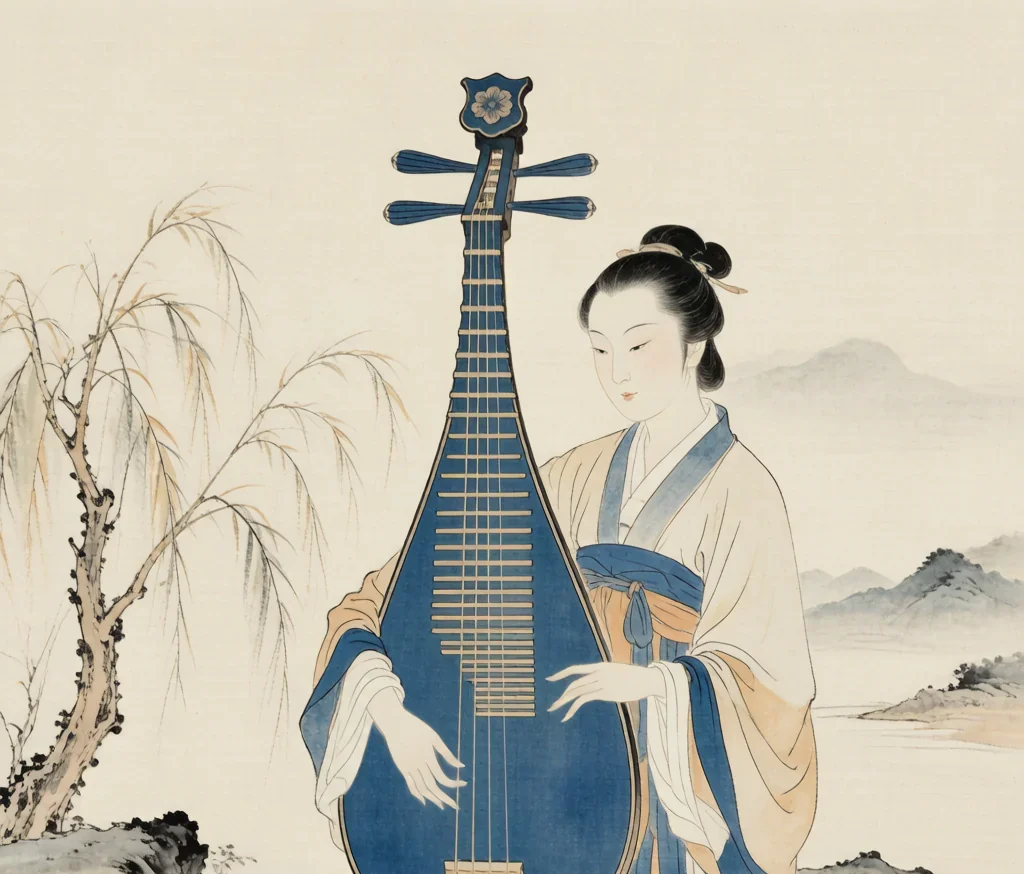
Hold a pipa in your hands, and you hold a piece of the Silk Road. This pear-shaped lute, with its four strings and fretted neck, is the product of centuries of cultural exchange between China, Central Asia, and Persia. It is an instrument of dazzling virtuosity and deep emotion — capable of whispering a lullaby one moment and conjuring the chaos of a battlefield the next. The pipa is China's great musical storyteller.
Along the Silk Road
The pipa did not originate in China — at least, not entirely. Its ancestors include the Persian barbat and the Central Asian oud, short-necked lutes that traveled eastward along the Silk Road with merchants, monks, and musicians. By the time of the Han Dynasty (206 BCE–220 CE), these foreign instruments had begun to take root in Chinese soil. The Chinese word pipa itself describes the two fundamental playing techniques: pi (琵), the forward pluck of the right hand, and pa (琶), the backward pluck.
Over the following centuries, Chinese musicians transformed this imported instrument into something entirely their own. They lengthened the neck, added frets, and developed a playing technique of extraordinary sophistication. By the Tang Dynasty (618–907 CE), the pipa had become the dominant instrument of the imperial court, the star of orchestras and the darling of poets. The Tang capital of Chang'an was a cosmopolitan metropolis where musicians from India, Persia, Korea, and Japan mingled and exchanged ideas. The pipa, with its exotic origins and breathtaking capabilities, perfectly embodied the spirit of this golden age.
The Tang Dynasty Golden Age
The Tang Dynasty was the pipa's finest hour. Musicians played the instrument horizontally, like a Spanish guitar, using a large plectrum to strike the strings with percussive force. Court records describe pipa masters who could imitate the sounds of nature — wind, rain, birdsong — and who held audiences spellbound with their technical wizardry. The poet Bai Juyi immortalized one such performance in his famous poem "Song of the Pipa Player," in which he describes meeting a former court musician reduced to playing on a riverboat. The poem captures both the instrument's power and the poignant fragility of art:
"The bold strings pattered like a sudden shower of rain,
The delicate strings whispered like lovers' secrets.
Chattering and pattering, pattering and chattering,
Like pearls, large and small, dropping on a plate of jade."
The Vertical Revolution
After the Tang Dynasty fell, the pipa underwent a dramatic transformation. Musicians began holding the instrument vertically, resting it on the thigh, and plucking the strings with their fingernails instead of a plectrum. This new position freed the left hand to move more freely across the fingerboard, enabling expressive techniques like bending notes, sliding between pitches, and producing a wider range of tonal colors. The modern pipa, with its 24 to 30 frets and sophisticated playing technique, is the product of this centuries-long evolution.
Today's pipa players wear artificial fingernails made of tortoiseshell or plastic, attached to their fingertips with tape. These plectra allow for lightning-fast tremolos, crisp attacks, and a rich palette of percussive effects. A skilled player can make the instrument sing like a human voice, rumble like distant thunder, or chatter like a flock of startled birds. The pipa's range of expression is almost limitless.
Ambush from Ten Sides
If you hear only one piece of pipa music in your lifetime, let it be "Ambush from Ten Sides" (Shi Mian Mai Fu). This monumental work, dating from the Ming or early Qing Dynasty, is a musical depiction of the Battle of Gaixia in 202 BCE, the climactic confrontation that ended the Chu-Han Contention and established the Han Dynasty. For over ten minutes, the pipa becomes a battlefield.
The piece opens with the sound of drums and horns, summoning troops to battle. Then the armies deploy — you can hear the marching feet, the neighing of horses, the clashing of weapons. The pipa's strings become bowstrings and sword blades. Through a series of vividly titled sections — "Setting Up Camp," "Sounding the Horn," "Laying the Ambush" — the music builds to a furious climax, the furious tempo and percussive attacks conjuring the chaos and terror of ancient warfare. Then, abruptly, silence. The battle is over. A lone pipa melody mourns the fallen, and the piece ends in a hush of exhaustion and grief.
"Ambush from Ten Sides" is a masterpiece of programmatic music — music that tells a story — and it demonstrates the pipa's unique ability to paint pictures in sound. No other Chinese instrument can match its narrative power.
The Pipa Today
Like the guzheng, the pipa has enjoyed a modern renaissance. Contemporary composers have written challenging new works that explore the instrument's full technical and expressive range. The pipa has found its way into jazz ensembles, rock bands, and film scores. Musicians like Wu Man have brought the instrument to international audiences, performing with orchestras, chamber groups, and the Kronos Quartet. In the 2020 video game "Genshin Impact," the character Xinyan rocks out on a pipa-inspired instrument, introducing millions of young players around the world to the sound of this ancient lute.
The pipa's journey — from the courts of ancient Persia to the Tang imperial palace, from the Silk Road caravans to the global concert stage — is a testament to the power of cultural exchange. It is an instrument that was born from the meeting of civilizations, and it continues to build bridges between them today.
Technique and the Art of Expression
The pipa's expressive power comes from a deep vocabulary of right- and left-hand techniques. The right hand, fitted with artificial fingernails, produces not only plucks but also a rapid tremolo made by rolling the fingers, which can sustain a note almost like a bowed string. The left hand bends pitches, slides between notes, and stops the strings to shape a vocal, speech-like line. Players also draw harmonics, snap strings for a crisp 'bent' sound, and even tap the soundboard for percussion, so a single instrument can whisper, rumble, or clash. Mastery of these effects is what lets the pipa paint pictures in sound, and a fine performer chooses technique the way a writer chooses words, matching touch to feeling.
The Pipa in Narrative Song
Beyond the concert stage, the pipa has long been the instrument of Chinese storytelling. In narrative-singing genres such as Suzhou tanci and other regional quyi forms, a performer accompanies their own singing and recitation with the lute, using its dramatic accents to underline a plot. The instrument's ability to depict scenes—marching armies, weeping, laughter—made it a natural partner for tale-tellers who needed music to carry emotion as well as plot. This storytelling role explains the nickname 'musical storyteller': the pipa does not just play tunes, it narrates. Many of the showpieces in the solo repertoire grew out of or echo these older narrative traditions, keeping the bond between lute and tale alive.
The Pipa's Wooden Cousins
The pipa belongs to a large family of Chinese plucked lutes, and knowing its relatives helps place it. The ruan has a round body and a warmer, gentler voice; the yueqin is a smaller moon-shaped lute; the sanxian is a long-necked, fretless three-string lute with a skin soundboard. All share the basic idea of a plucked, fretted or unfretted neck and a wooden body, but each occupies a different register and mood. The pipa is the dramatic soprano-alto of this group, prized for brilliance and drama, while the others supply warmth, rhythm, or raw tone. Together these lutes form the plucked-string backbone of Chinese music, with the pipa usually the one listeners remember first.
❓ Frequently Asked Questions
The pipa is a four-stringed Chinese lute with a pear-shaped wooden body. It has been played for over 2,000 years and is one of China's most virtuosic instruments.
The pipa is held upright and played with five picks (formerly plectra) on the right hand. It can produce both melodic lines and powerful percussion effects.
'Ambushed from Ten Sides' (十面埋伏) is the most famous pipa piece, a programmatic work depicting the battle between Xiang Yu and Liu Bang.
The pipa originated from Central Asia and traveled along the Silk Road to China, becoming a quintessentially Chinese instrument while also spreading to Japan, Korea, and Vietnam.
Beyond plucking, players use tremolo (rapid finger rolls), string-bending, harmonics, and percussive effects such as snapped strings and drumming on the soundboard, giving the instrument its wide expressive range.
Because its dramatic, pictorial repertoire—battle scenes, narratives, and programmatic pieces—lets it depict stories in sound more vividly than most other Chinese instruments, earning it a role as a musical narrator.
📝 Chinese Vocabulary
- 琵琶 (pí pá) — The pipa lute; the two characters represent the forward and backward plucking techniques
- 十面埋伏 (shí miàn mái fú) — "Ambush from Ten Sides"; the epic pipa piece depicting ancient warfare
- 白居易 (bái jū yì) — Bai Juyi, the Tang Dynasty poet who wrote the famous "Song of the Pipa Player"
- 西域 (xī yù) — The Western Regions; the historical term for Central Asia, source of the pipa's ancestors
🎉 Fun Facts
- During the Tang Dynasty, the pipa was so popular that it was played by both men and women of all social classes, from imperial concubines to street musicians.
- The pipa was traditionally played with a large wooden plectrum until the Ming Dynasty, when fingernail technique became the standard.
- Japanese musicians adopted the pipa during the Tang Dynasty, and it evolved into the biwa, which is still played in Japan today.
- The pipa has distinct regional schools of playing, with northern and southern traditions differing in tone, repertoire, and finger technique.
- Its soundboard is traditionally made from a light, resonant wood such as paulownia, which helps give the instrument its singing, bright attack.
- Players tune the four strings so that scales and fast runs fall neatly under the hand, supporting the instrument's renowned speed.