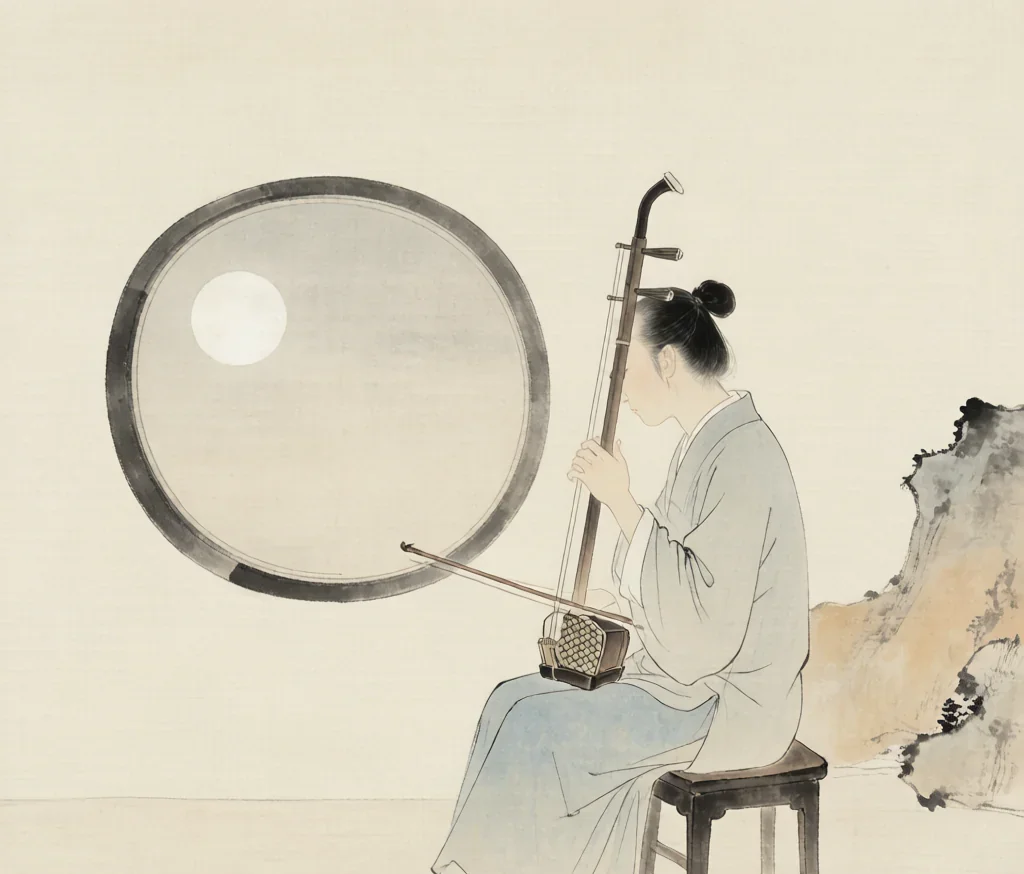
There is a sound in Chinese music that, once heard, is never forgotten. It is the voice of the erhu — a two-stringed fiddle whose haunting, vocal quality seems to bypass the ears and speak directly to the heart. With only two strings and a bow that is permanently threaded between them, the erhu produces one of the most expressive and emotionally direct sounds in all of music. Western listeners often call it the "Chinese violin," but this comparison fails to capture the instrument's unique soul. The erhu does not merely play melodies — it sings, it weeps, it tells stories.
From the Nomadic Steppes
The erhu belongs to the huqin family of bowed string instruments, a group that originated among the nomadic peoples of Central and Northern Asia. The word huqin literally means "barbarian instrument," reflecting its foreign origins. Bowed instruments first appeared in China during the Tang Dynasty (618–907 CE), introduced by traders, migrants, and musicians traveling along the Silk Road. Over time, Chinese craftsmen refined the design, and by the Song Dynasty (960–1279 CE), the erhu had become a standard instrument in court and folk ensembles alike.
For much of its history, the erhu was considered a folk instrument — the music of villages, teahouses, and street performers — rather than a refined art form like the guqin. It accompanied regional operas, storytelling traditions, and community celebrations. The erhu's humble status meant that its repertoire was passed down orally from master to student, with little written documentation. Yet this very quality — its closeness to everyday life and ordinary people — is what gives the erhu its extraordinary emotional power.
Anatomy of a Voice
The erhu's design is deceptively simple. A long wooden neck, usually made of rosewood or sandalwood, passes through a small hexagonal or octagonal resonator box. The front of the resonator is covered with a membrane of python skin, stretched taut like a drumhead. Two steel strings — tuned a fifth apart, typically to D and A — run from tuning pegs at the top to a small bridge resting on the skin. The bow, strung with horsehair, is permanently threaded between the two strings, meaning the player can bow either string or both simultaneously.
There are no fingerboards, no frets, no visual guides for the left hand. The player stops the strings by pressing them with the fingertips, but because the strings float in the air rather than pressing against a fingerboard, the player can vary the pressure and angle of the finger to produce an extraordinary range of tone colors and microtonal inflections. This is the secret of the erhu's vocal quality: like a human voice, it can slide continuously between pitches, swell and fade, and inflect each note with emotional nuance.
The python-skin membrane is another crucial element. When the strings vibrate, the bridge transmits those vibrations to the skin, which acts as an amplifier and filter, giving the erhu its distinctive warm, slightly nasal tone. The quality of the skin — its thickness, tension, and age — profoundly affects the instrument's sound. Master players spend years breaking in a new skin, coaxing it toward the perfect balance of resonance and clarity.
Moon Reflected on Erquan Pool
Every culture has its musical icons — pieces so deeply embedded in the national consciousness that they seem to define the very soul of a people. For China, one such piece is "Moon Reflected on Erquan Pool" (Er Quan Ying Yue), composed by the blind erhu player Ah Bing in the mid-20th century. The story of this piece is as moving as the music itself.
Ah Bing, born Hua Yanjun in 1893, was the son of a Daoist priest in Wuxi, Jiangsu Province. He learned the erhu and pipa from his father and became a skilled musician, but his life was marked by tragedy. He lost his sight to illness, fell into poverty, and spent his days wandering the streets of Wuxi, playing for coins. In 1950, a team of musicologists from Beijing visited Ah Bing to record his playing. They captured six pieces, including "Moon Reflected on Erquan Pool" — a melody that Ah Bing had never written down, never titled, and played differently each time. He died just months after the recording session.
The piece they preserved is a masterpiece of understated grief and transcendent beauty. It begins with a short, sighing introduction, then unfolds into a series of variations on a simple, aching melody. The erhu's voice rises and falls, sometimes whispering, sometimes crying out, as if recounting a lifetime of sorrow and endurance. Despite its title, which evokes a peaceful moonlit scene, the music carries a weight of melancholy that has moved listeners around the world to tears. It is a testament to the erhu's power that a blind street musician, with just two strings and a bow, could create something so universally profound.
The Erhu in Modern Music
Today, the erhu occupies a position of honor in Chinese music. It is a standard instrument in the modern Chinese orchestra, which blends traditional instruments into a Western symphonic format. Conservatories train virtuoso erhu players who perform concertos with symphony orchestras, and composers continue to write challenging new works for the instrument.
The erhu has also crossed over into global popular culture. It appears in film scores — most famously in the soundtracks of "Crouching Tiger, Hidden Dragon" and "Hero" — where its vocal quality perfectly complements the emotional weight of the storytelling. Pop and rock musicians have incorporated the erhu into their arrangements, drawn by its distinctive voice. The instrument has even found a home in video game music, anime soundtracks, and electronic music, where producers sample and process its sound in creative new ways.
What makes the erhu so universally appealing? Perhaps it is the instrument's closeness to the human voice. Unlike the piano, which strikes notes and lets them decay, the erhu can sustain and shape a tone with the continuity of breath. It can slide, weep, and sing with an intimacy that feels less like a performance and more like a confession. To hear the erhu is to feel that someone is speaking to you — not in words, but in a language older and deeper than words.
The Erhu in Chinese Regional Opera
Although best known as a concert soloist, the erhu first earned its living in the theater. Nearly every regional opera tradition of China employs a huqin relative to lead its melody, and the erhu or its local cousins sit beside the percussion in the orchestra pit. In forms such as the clapper operas of the north and various southern genres, the fiddle shadows the singers, underlining their phrasing and heightening moments of passion or grief. Because each opera has its own preferred tuning, repertoire, and timbre, players adapt the instrument to many styles. This theatrical work demands the same vocal-like responsiveness that makes the erhu moving in solo music, and many of today's concert masters began by accompanying opera troupes on the road.
Bowing and the Art of Expression
What gives the erhu its singing quality is not the strings alone but how the player works the bow. The hair is fixed between the two strings, so the right hand chooses which string sounds by the angle and pressure of the stroke, producing seamless changes from one string to the other. The left hand, meanwhile, slides along the strings without a fingerboard, executing portamento, vibrato, and subtle pitch bends that imitate the contours of the human voice. A single sustained bow can swell or fade to suggest a breath; a quick retake can spark a laugh-like staccato. Mastery lies in coordinating both hands so that technique disappears into feeling — the reason the erhu can sound as if it were weeping, whispering, or declaring rather than merely playing notes.
Liu Tianhua and the Modern Erhu
In the early twentieth century the erhu was lifted from the teahouse and the opera pit onto the concert stage largely through the efforts of Liu Tianhua, a musician and teacher who believed the instrument deserved serious study. He composed solo pieces that explored its lyrical and dramatic range, wrote etudes to train students systematically, and adapted aspects of Western notation and pedagogy without abandoning the erhu's Chinese character. His brother Liu Bannong, a scholar, helped argue for the instrument's cultural value at a time when many reformers dismissed native music. Thanks to this work, the erhu entered the new music conservatories, gained a written repertoire, and became a symbol of modern Chinese instrumental art — a folk fiddle retooled as a vehicle for both tradition and innovation.
The Erhu in the Modern Chinese Orchestra
The founding of the modern Chinese orchestra in the twentieth century gave the erhu a new home. Modeled loosely on the Western symphony but built entirely from Chinese instruments, this ensemble groups the huqin family into a bowed-string section, with the gaohu singing above, the erhu carrying the main melody, and the lower zhonghu and related basses below. Arranged in rows like a string section, the erhu players read a single part and produce a blended, song-like line that often states the principal theme. Composers have written concertos that pair the erhu with the full orchestra, and star soloists now tour internationally. The instrument thus bridges its folk past and a contemporary classical present, its two strings at home in both.
❓ Frequently Asked Questions
The erhu is a two-stringed bowed instrument with a python-skin resonator. Its haunting, vocal-like tone makes it one of China's most expressive instruments.
The erhu is held upright on the player's lap. The bow is permanently threaded between the two strings. There is no fingerboard — the player stops strings by fingertip pressure alone.
'Moon Reflected on Erquan Pool' (二泉映月) by blind musician Ah Bing is the most famous erhu piece, a masterpiece of grief and beauty composed in the early 20th century.
The erhu is used in Chinese orchestras, traditional opera, folk music, and even film scores (Crouching Tiger, Hidden Dragon) and pop music.
The erhu has only two strings, no fingerboard, and a snakeskin soundboard instead of a wooden front; it is held vertically and its bow hair is permanently threaded between the strings, so the bow cannot be lifted away as on a violin.
Because the strings are stopped without frets or a fingerboard, the player can slide smoothly between pitches and shape each note with vibrato and bow pressure, producing the portamento and expressiveness that make the erhu seem to sing or speak.
📝 Chinese Vocabulary
- 二胡 (èr hú) — The erhu; "er" means two (for its two strings), "hu" refers to its barbarian origins
- 二泉映月 (èr quán yìng yuè) — "Moon Reflected on Erquan Pool"; Ah Bing's immortal masterpiece
- 阿炳 (ā bǐng) — Ah Bing, the blind street musician who composed the erhu's most famous piece
- 胡琴 (hú qín) — The huqin family of bowed instruments, of which the erhu is the most prominent member
🎉 Fun Facts
- The erhu's python-skin membrane is traditionally made from the skin of the Burmese python, and the quality of the skin is crucial to the instrument's tone.
- Because the bow is trapped between the two strings, the erhu is one of the few instruments where the bow and instrument are inseparable — you cannot remove the bow without unstringing the instrument.
- Ah Bing's recording of "Moon Reflected on Erquan Pool" was made on a wire recorder in 1950, just months before his death, preserving a piece that might otherwise have been lost forever.
- The erhu became a concert solo instrument largely through the early-twentieth-century work of Liu Tianhua, who composed pieces such as 'Birds on the Branch' and wrote the first systematic etudes for it.
- In the modern Chinese orchestra a section of erhu often carries the principal melody, supported by higher gaohu and lower zhonghu relatives of the same family.
- The erhu's two strings are traditionally tuned a fifth apart and are stopped directly by the fingers, which is what allows its characteristic sliding tones.