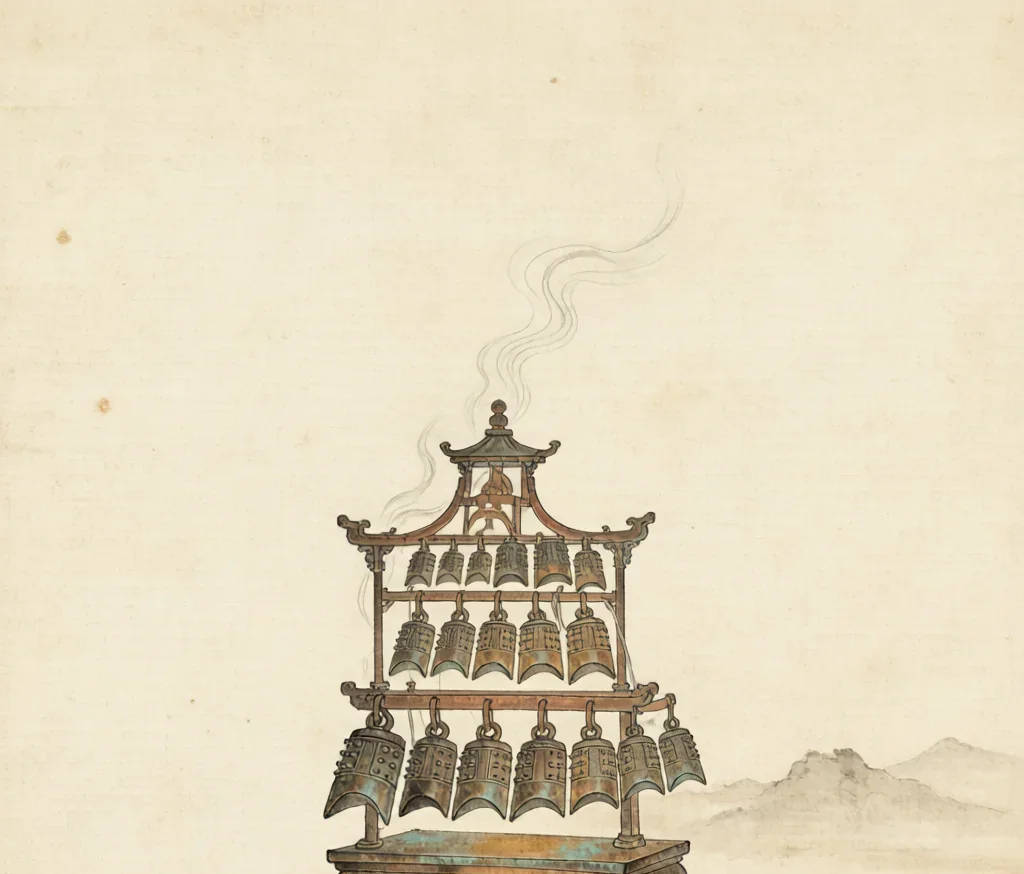
In the summer of 1977, soldiers digging a factory foundation in Hubei Province made a discovery that would rewrite the history of music. Buried deep underground, undisturbed for nearly 2,500 years, lay the tomb of Marquis Yi of Zeng. Inside that tomb, suspended on massive lacquered wooden frames, hung 65 bronze bells — the largest and most sophisticated set of musical bells ever found from the ancient world. When archaeologists tapped the first bell and it rang out clear and true after 24 centuries of silence, they knew they had found something extraordinary.
The Tomb of Marquis Yi
Marquis Yi ruled the small state of Zeng during the Warring States period, dying around 433 BCE. His tomb, discovered intact and unlooted, was a time capsule of Bronze Age China. Among the thousands of artifacts — bronze vessels, jade ornaments, lacquerware, weapons, and chariot fittings — the bianzhong bells were the crown jewel. The 65 bells were arranged in three tiers on an L-shaped frame, with the largest bell standing over 1.5 meters tall and weighing more than 200 kilograms. The entire set weighed approximately 4,500 kilograms.
But the true wonder was not the size or the weight. It was the sound. Each bell, when struck in different locations, produced two distinct, precisely tuned pitches. This "two-tone" technology was a feat of acoustic engineering that Western musicologists once believed impossible — and the Chinese had achieved it over two millennia ago.
The Science of Two-Tone Bells
A Western church bell produces a single fundamental pitch (along with a complex series of overtones). The bianzhong bells are different. Their almond-shaped cross-section — pointed at both ends rather than circular — creates two distinct vibrational modes. When struck at the center of the bell's face, one pitch sounds. When struck at the side, near the bell's edge, a different pitch emerges. On most of the Marquis Yi bells, these two pitches are separated by a minor third or major third, giving the set an effective range of five octaves with a fully chromatic scale in the middle register.
The ancient bronze casters achieved this precision through a sophisticated understanding of metallurgy and acoustics. By varying the bell's shape, the thickness of its walls, and the ratio of copper to tin in the bronze alloy, they could tune each bell with extraordinary accuracy. Inscriptions on the bells describe their musical functions in detail, specifying the pitch names, the scales they belonged to, and how they fit into the overall tonal system. These inscriptions are the oldest known written texts on musical theory in China.
Music for the Afterlife
Why did Marquis Yi commission such an extraordinary musical instrument for his tomb? The answer lies in the ritual culture of ancient China. Music played a central role in court ceremonies, ancestral worship, and state rituals. The bianzhong were not entertainment — they were instruments of cosmic significance. Their sounds were believed to communicate with the spirit world, to harmonize heaven and earth, and to affirm the political and moral order of the state.
The Marquis Yi bells were accompanied by other instruments found in the tomb: stone chimes, drums, wind instruments, and string instruments — a complete court orchestra for the afterlife. The ensemble could perform the complex ritual music of the Zhou Dynasty, known as yayue (elegant music), which was considered essential to the proper governance of the realm. Confucius himself taught that music and ritual were the twin pillars of a well-ordered society, and the bianzhong were the sonic embodiment of that philosophy.
The Bells Today
Since their discovery, the Marquis Yi bells have been housed in the Hubei Provincial Museum in Wuhan, where they are displayed in a specially designed chamber. The original bells have been played only a handful of times since their excavation — on significant national occasions, including the handover of Hong Kong in 1997 — because each strike, however gentle, causes microscopic wear. But replicas of the bells have been cast and are performed regularly, giving modern audiences a chance to hear the sounds that once filled the halls of ancient kings.
The bianzhong have become a symbol of China's ancient cultural achievements. Their image appears on stamps, in textbooks, and in museums around the world. Composers have written new music for the bells, blending their ancient tones with modern orchestration. In 2008, replicas of the bells were featured in the opening ceremony of the Beijing Olympics, introducing a global television audience of billions to the sound of Bronze Age China.
A Message Across Millennia
What makes the bianzhong so compelling, beyond their technical brilliance, is the message they carry across time. These bells were made by people who believed that music mattered — not as background noise or commercial product, but as a sacred art capable of ordering the cosmos and touching the divine. They invested enormous resources — years of labor, tons of precious bronze, the finest craftsmanship of their age — into creating an instrument that would speak for eternity.
And speak they do. When you stand before the Marquis Yi bells today and hear their deep, resonant tones, you are hearing the same sounds that echoed through a royal court in 433 BCE. The bronze has not forgotten its voice. The ancient kings still sing.
Casting the Bronze Bells
Bianzhong bells were products of the sophisticated bronze technology of ancient China. Each bell was cast in a carefully controlled alloy, typically of copper with a substantial amount of tin, which hardened the metal and gave the bells their clear, ringing tone. Foundries used piece-mold and lost-wax methods to form the complex curved bodies, and the two-tone property depended on precise control of the bell's thickness and profile so that the central and side striking points sounded different pitches. Decorative bands of motifs — coiled dragons, rice grains, and inscriptions — were modeled into the surface before casting. The largest bells could stand over a meter tall and weigh well over a hundred kilograms. Producing a full set therefore required not only musical knowledge but the organizational wealth of a court or a powerful lord.
Bianzhong in Imperial Ritual
Beyond their musical sound, bell sets were among the supreme symbols of political authority in ancient China. Possession of a bianzhong was restricted by rank: the number and size of bells a noble could own announced his standing, so a great set proclaimed both wealth and legitimacy. The bells sounded in state ceremonies — sacrifices to heaven and earth, ancestral rites, and banquets — where their measured tones belonged to yayue, the solemn 'elegant music' of the court. In this context music was less entertainment than a means of maintaining cosmic and social order, each pitch linked to a season, a direction, or a virtue. The Marquis Yi set, with its meticulous inscriptions naming tones and relationships, shows how seriously these courts treated the correspondence between sound, ritual, and power.
❓ Frequently Asked Questions
The bianzhong is a set of bronze bells suspended from a wooden frame, struck with mallets. It is one of the most important ritual instruments of ancient China.
The bianzhong dates back over 2,500 years to the Zhou Dynasty. The most famous set, from the tomb of Marquis Yi of Zeng, was made about 433 BCE.
Each bell produces two distinct pitches when struck at different spots (center vs. side), thanks to its unique almond-shaped cross-section — a sophisticated acoustic design.
The most famous discovery is the 65-bell set from Marquis Yi's tomb (1978 in Hubei), which spans five octaves and can still be played accurately today.
The bells hung from a substantial wooden frame, usually in two tiers, and were struck with wooden mallets rather than rung. Players struck either the central boss or the side of a bell to sound its two different pitches, reading the inscriptions to choose the correct note.
The more than two thousand characters cast on the bells form a kind of musical treatise: they name pitches, lay out tuning relationships, and record how the tones correspond across the set, giving scholars rare direct evidence of ancient Chinese music theory.
The Instrument's Voice
Distinctive in both form and sound, this instrument occupies a special place in Chinese musical tradition. Its repertoire, passed down through generations of master musicians, captures a wide range of human emotions — from the solemnity of court ceremonies to the joy of village celebrations. Today, contemporary musicians are finding new ways to incorporate its timbre into modern compositions, ensuring that its voice continues to evolve while honoring its ancient roots.
📝 Chinese Vocabulary
- 编钟 (biān zhōng) — The set of bronze bells; "bian" means arranged or compiled, "zhong" means bell
- 曾侯乙 (zēng hóu yǐ) — Marquis Yi of Zeng, the Warring States ruler whose tomb contained the most famous bianzhong
- 雅乐 (yǎ yuè) — "Elegant music"; the ritual court music of ancient China, performed on instruments like the bianzhong
- 青铜 (qīng tóng) — Bronze; literally "blue-green copper," referring to the patina that forms on aged bronze
🎉 Fun Facts
- The Marquis Yi bells span a range of five octaves, with a fully chromatic 12-tone scale in the middle register — centuries before Western music developed chromaticism.
- Each bell produces two distinct pitches depending on where it is struck, a feat of acoustic engineering that requires an almond-shaped (rather than circular) cross-section.
- The inscriptions on the bells, totaling over 2,800 characters, form the oldest surviving text on musical theory in China, describing pitch names, scales, and tuning systems.
- The Marquis Yi bianzhong lay sealed in its tomb for over two thousand years, undisturbed until archaeologists excavated it in 1978, when the bells were found still able to sound their tones.
- In ancient China, owning a set of bells was a mark of rank: only the highest nobility could commission large bell ensembles, so a grand bianzhong advertised political power as much as musical taste.
- Modern musicians have made playable replicas of the Marquis Yi set and performed on them in concerts, letting modern audiences hear the sound of a court orchestra from more than two millennia ago.