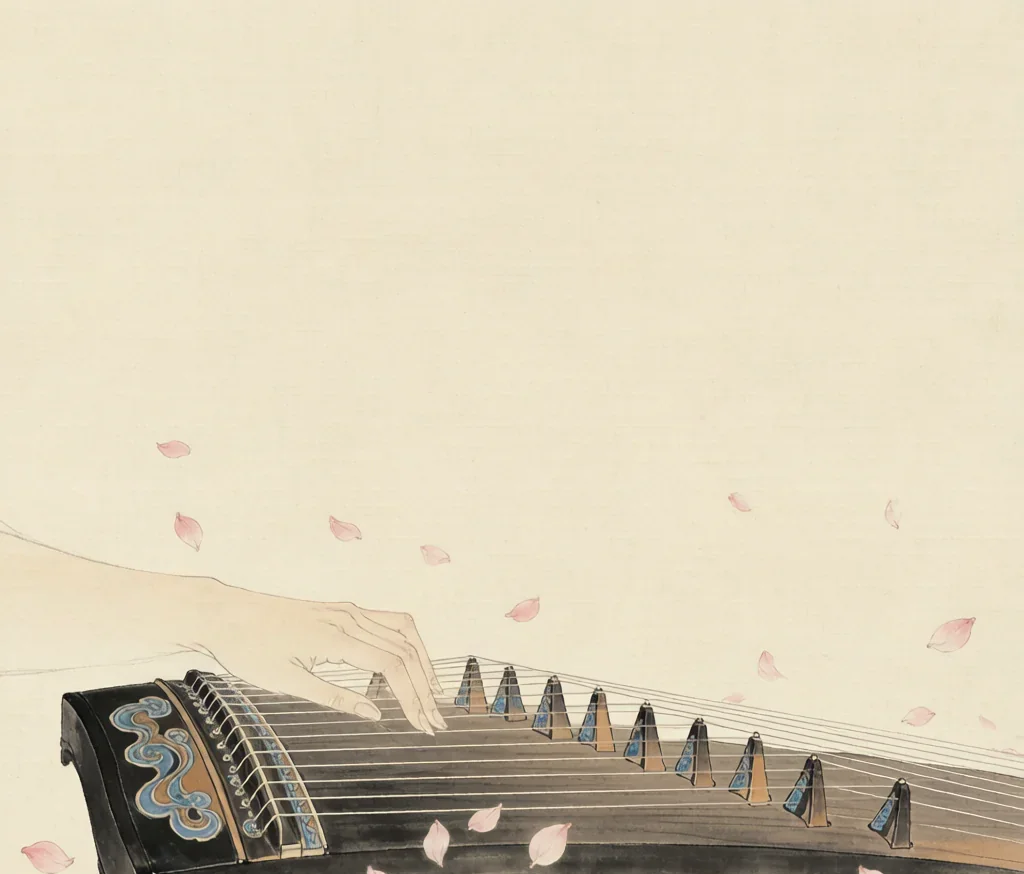
When you hear a guzheng for the first time, you might feel as though you have stumbled upon a waterfall of sound. Cascading arpeggios, shimmering glissandi, and a rich, resonant tone pour from the instrument like liquid silver. The guzheng is the most widely played traditional Chinese instrument today, beloved for its dramatic expressiveness and visual elegance. With its 21 strings stretching across a gracefully curved body, it is both a feast for the ears and a work of art for the eyes.
Origins in the Warring States
The guzheng traces its lineage back approximately 2,500 years to the Warring States period (475–221 BCE). Historical texts from the Qin state, in what is now Shaanxi Province, contain the earliest references to the instrument. One ancient account describes how two brothers, quarreling over a 25-string se zither, broke it in half — creating a 12-string instrument and a 13-string instrument. The latter became the zheng. While this story is likely apocryphal, it captures something true about the guzheng's character: it was born from transformation and has never stopped evolving.
Over the centuries, the guzheng migrated from its northwestern origins to every corner of China, developing distinct regional schools along the way. The Shandong school emphasized powerful, masculine strokes. The Henan school was known for its lyrical, singing quality. The Chaozhou school in Guangdong developed a sophisticated system of modal variations. Each region added its own flavor to the guzheng tradition, creating a rich tapestry of styles that continues to thrive today.
The Modern 21-String Configuration
If you could travel back in time to the Tang Dynasty (618–907 CE), you would find guzhengs with 12 or 13 silk strings. By the Qing Dynasty (1644–1912), the standard had grown to 16 strings. The modern 21-string guzheng was developed in the mid-20th century, driven by the demands of concert performance and ensemble playing. Today's instruments feature steel or steel-wrapped nylon strings, which produce a brighter, louder, and more stable sound than traditional silk — essential for projecting in large concert halls.
The strings are tuned to a pentatonic scale, the five-note scale that forms the backbone of traditional Chinese music. The most common tuning corresponds roughly to the black keys on a piano: D, E, F-sharp, A, B. This pentatonic foundation gives guzheng music its distinctive "Chinese" sound — open, resonant, and free of the harmonic tension that characterizes Western diatonic music. By pressing the strings on the left side of the movable bridges, players can bend notes, create vibrato, and produce the microtonal inflections that give the music its expressive depth.
The Art of Playing
Watching a skilled guzheng player perform is like watching a dancer. The right hand, fitted with tortoiseshell or plastic plectra attached to the fingers, plucks the strings with precision and power. The left hand presses, bends, and vibrates the strings behind the bridges, shaping each note with subtle inflections. Together, the hands create a constant dialogue — the right hand producing the sound, the left hand giving it life and emotion.
The guzheng's technical vocabulary is vast. Players employ sweeping glissandi that evoke rushing wind or flowing water, rapid tremolos that build tension like a gathering storm, and harmonics that float like distant bells. The instrument can whisper or roar, weep or celebrate. In the hands of a master, it becomes a voice capable of telling any story, expressing any emotion.
High Mountain Flowing Water
Every guzheng student eventually encounters "High Mountain Flowing Water" (Gao Shan Liu Shui), one of the most famous pieces in the Chinese classical repertoire. The piece exists in versions for both guqin and guzheng, and it tells the story of Boya, a legendary qin player, and Ziqi, a humble woodcutter who could understand every nuance of Boya's music. When Boya played about high mountains, Ziqi exclaimed, "How majestic, like Mount Tai!" When he played about flowing water, Ziqi said, "How vast, like the Yangtze River!" When Ziqi died, Boya smashed his qin, believing that no one would ever understand his music again.
The guzheng version of "High Mountain Flowing Water" is a tour de force of technique and expression. The piece opens with a majestic, sweeping passage that paints a portrait of towering peaks against the sky. Then the tempo quickens, and the music transforms into cascading runs and rippling arpeggios — the sound of water tumbling down a mountainside, gathering force, becoming a river. The piece is both a musical masterpiece and a meditation on the nature of friendship, understanding, and the fleeting beauty of human connection.
The Guzheng Renaissance
In recent decades, the guzheng has experienced an extraordinary renaissance. Once considered old-fashioned, it has been embraced by a new generation of Chinese musicians who are pushing the instrument in bold new directions. Contemporary composers write concertos for guzheng and Western symphony orchestra. Pop stars incorporate guzheng riffs into their songs. Rock musicians amplify the instrument and run it through effects pedals, creating sounds that the ancient masters could never have imagined.
The instrument's popularity has also spread far beyond China's borders. Guzheng schools can be found in the United States, Canada, Australia, Japan, Singapore, and across Europe. The instrument's visual beauty — its long, elegant form and the graceful movements of the player — makes it a natural showpiece for cultural events and concerts. More importantly, its music speaks a universal language. You do not need to understand Chinese culture to be moved by the sound of a guzheng. The cascading notes, the singing melodies, and the profound emotional range transcend language and culture entirely.
Whether played in a traditional teahouse, a modern concert hall, or a YouTube video watched by millions, the guzheng continues to soar — a 2,500-year-old voice that sounds as fresh and vital today as it ever has.
Regional Schools of Guzheng
Over centuries the guzheng developed distinct regional schools, each with its own tunings, favored techniques, and repertoire. The Henan and Shandong schools of the north are known for vigorous, percussive strokes and folk-derived melodies, while the Zhejiang school favors a smoother, singing line. In the south, the Guangdong (Cantonese) style is elegant and lyrical, and the Chaozhou school preserves its own modal system and delicate ornaments. These traditions grew from local opera, folk song, and dialect melody, and they were passed from teacher to student within specific regions. In the twentieth century players began to synthesize the schools, borrowing techniques across boundaries and writing new concert works, yet the regional identities remain a living part of guzheng culture and a source of its rich variety of sound.
Guzheng Construction and Materials
The guzheng is built around a long, slightly curved soundboard traditionally made from paulownia wood, chosen because it is light and resonant. The body may be a single slab or a hollow chamber, and its surface is drilled with holes through which the strings pass to tuning pegs at one end. Across the board stand the movable bridges, usually of wood or ivory-colored plastic, that raise each string and determine its pitch; sliding a bridge changes the tuning. Modern strings are steel cores wound with nylon, but older instruments used silk. The left end of each string lies open for the player's pressing hand, while the right side is plucked. The whole instrument is both sturdy enough for travel and responsive enough to carry subtle tonal color.
Tuning and the Pentatonic Modes
The guzheng is tuned to the pentatonic, or five-note, scale that underlies much Chinese music, and its bridges make this tuning easy to change. By shifting a bridge a little toward the pegs or the player, a string can be raised or lowered, allowing the instrument to move between different modal colors — the gong, shang, jue, zhi, and yu of traditional theory — within a single piece or between pieces. Players often begin by tuning all strings to one pentatonic arrangement, then retune specific bridges to suit a particular melody's mode. This flexibility, combined with the bridges' ability to produce a quick vibrato when the left hand presses behind them, gives the guzheng both its characteristic open sound and its capacity for expressive, mode-shifting performance.
❓ Frequently Asked Questions
The guzheng is a Chinese plucked zither with 21 strings and movable bridges. Its bright, cascading sound is one of the most popular Chinese instruments today.
The guzheng dates back over 2,500 years to the Warring States period. The earliest versions had only 5 strings, evolving to 12-16 by the Tang Dynasty.
The player wears picks (made from plastic, bone, or tortoiseshell) on the right-hand fingers, while the left hand presses the strings to create pitch bends and vibrato.
The modern 21-string guzheng has a range of over four octaves, making it one of the most versatile Chinese instruments.
The guzheng has many strings stretched over movable bridges and is plucked with finger picks, giving a bright, harp-like tone, whereas the guqin has seven strings with no bridges, is played with the bare hand, and is quieter and more intimate.
Many find it approachable: the bridges lay out a clear pentatonic scale so melodies are easy to locate, and simple pieces can be learned quickly, though fluent use of vibrato, glissando, and rapid finger techniques takes sustained practice.
📝 Chinese Vocabulary
- 古筝 (gǔ zhēng) — The ancient zither; the character 筝 is onomatopoeic, imitating the instrument's sound
- 高山流水 (gāo shān liú shuǐ) — "High Mountain Flowing Water"; both a famous musical piece and an idiom for deep friendship
- 五声音阶 (wǔ shēng yīn jiē) — The pentatonic scale; literally "five-sound musical scale"
- 琴码 (qín mǎ) — The movable bridges on a guzheng, each one supporting a single string
🎉 Fun Facts
- Modern guzheng strings are typically made of steel wrapped with nylon, giving them a bright, powerful tone that can fill a concert hall.
- The guzheng is sometimes called the "Chinese harp" by Westerners, though it is technically a zither — harps have strings that are perpendicular to the soundboard.
- The world's largest guzheng ensemble record was set in 2019 with over 2,000 players performing together in China's Shandong Province.
- Guzheng players traditionally wear artificial fingernails, often of plastic or shell, on the right hand to pluck the strings with clarity and volume.
- The instrument's bridges are movable, so players can quickly retune strings to different pentatonic modes between or even within pieces.
- The guzheng belongs to a family of long zithers across East Asia, with close relatives including the Japanese koto and the Korean gayageum.