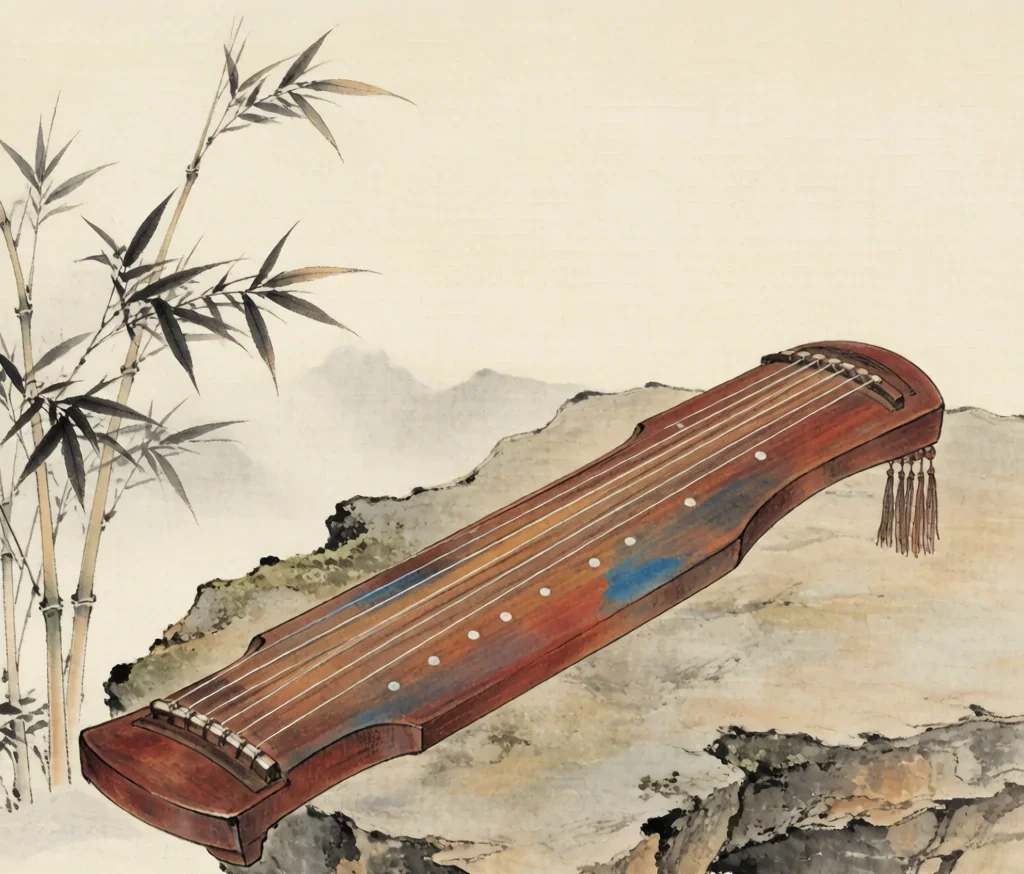
Of all the musical instruments ever created by human hands, few carry the weight of history and philosophy quite like the guqin. This ancient seven-string zither has been the companion of sages, poets, and emperors for over three millennia. It is not merely a musical instrument — it is a vessel for meditation, a tool for self-cultivation, and a bridge between the earthly and the divine. The guqin is the sound of Chinese civilization itself.
A History Written in Silk and Wood
The guqin's origins stretch back to the very dawn of Chinese history. Archaeological evidence and ancient texts suggest the instrument emerged during the Zhou Dynasty (1046–256 BCE), though legend places its invention even earlier, crediting the mythical emperors Fuxi and Shennong with its creation. The instrument's design is deeply symbolic: its length of 3 chi 6 cun 5 fen (approximately 120 cm) represents the 365 days of the year, while the rounded top and flat bottom mirror the ancient Chinese conception of a round heaven and square earth.
Originally strung with five strings representing the five elements — metal, wood, water, fire, and earth — two additional strings were added during the Zhou Dynasty. One was added to mourn the death of King Wen, and another to honor his son King Wu. Together, these seven strings formed the instrument we know today, each one capable of producing a universe of tonal color through a sophisticated system of over 100 harmonic positions marked by inlaid mother-of-pearl dots called hui.
Confucius and the Qin
No figure is more intimately associated with the guqin than Confucius (551–479 BCE). The great philosopher considered music essential to moral education and personal cultivation. For Confucius, playing the qin was not entertainment but a form of ritual practice — a way to align one's inner character with the harmonies of the cosmos. He is said to have been a skilled player himself, and the Analects record that he once became so absorbed in the music of the sage-king Shun that he forgot the taste of meat for three months.
Throughout Chinese history, the guqin became one of the "Four Arts" that every cultivated scholar-gentleman was expected to master, alongside the board game weiqi (Go), calligraphy, and painting. To play the qin was to demonstrate refinement, sensitivity, and moral depth. The instrument was never intended for public performance or mass entertainment. Instead, it was played in solitude or for a small audience of kindred spirits, often in a natural setting — beneath a pine tree, beside a stream, or in a moonlit pavilion. This intimate context gave rise to the Chinese phrase zhi yin, meaning "to know the tone," which describes the rare and precious bond between true friends who understand each other's hearts.
The Silk Strings and Their Secrets
Traditional guqin strings were made from twisted silk, a material that produces a warm, subtle, and deeply resonant tone. Unlike the bright, projecting sound of Western string instruments, the guqin's voice is soft and introspective. Its dynamic range is remarkably wide, from the faintest whisper of a harmonic to a bold, percussive pluck. The player uses a rich vocabulary of techniques — over 50 distinct fingerings — to coax an astonishing variety of sounds from the instrument: glissandi that slide like water over stones, harmonics that float like starlight, and stopped notes that hum with earthy warmth.
Modern players often use metal-wrapped nylon strings for greater volume and stability, but purists maintain that only silk can capture the instrument's true soul. Silk strings respond to the player's touch with an organic sensitivity, their tone shifting with humidity, temperature, and the mood of the performer. They require constant tuning and careful maintenance, but for the dedicated player, this relationship with the instrument is part of the discipline.
"Flowing Water" and the Voyager Mission
In 1977, NASA launched the Voyager 1 and Voyager 2 spacecraft on a mission to explore the outer solar system and beyond. On board each craft was the Golden Record, a phonograph disc containing sounds and images selected to represent the diversity of life and culture on Earth. Among the 27 musical selections — which included Bach, Beethoven, and Chuck Berry — was a seven-minute recording of the guqin piece "Flowing Water" (Liu Shui), performed by the master musician Guan Pinghu.
The choice was profoundly fitting. "Flowing Water" is one of the most celebrated pieces in the guqin repertoire, dating back at least to the 3rd century BCE. Its cascading melodies evoke the movement of water — from a gentle mountain spring to a mighty river — and it carries the philosophical weight of Daoist ideas about the nature of existence. Just as water flows without effort yet overcomes all obstacles, the sage moves through life with effortless grace. The piece is also connected to the story of Boya and Ziqi, the legendary musician and his woodcutter friend whose deep understanding of music became the ultimate symbol of friendship in Chinese culture. Today, Guan Pinghu's "Flowing Water" travels through interstellar space, a message from ancient China to the stars.
Playing the Guqin Today
In 2003, UNESCO recognized the guqin as a Masterpiece of the Oral and Intangible Heritage of Humanity. This designation has sparked a revival of interest in the instrument among young Chinese, who are rediscovering its meditative qualities in an age of constant digital stimulation. Guqin societies and schools have sprung up in cities across China and around the world, from Beijing to New York to Paris.
Learning the guqin is a journey unlike any other musical education. Students begin not with scales or exercises but with learning to sit properly, breathe calmly, and approach the instrument with reverence. The traditional notation system, known as jianzipu, does not indicate rhythm or tempo — only finger positions and techniques — leaving interpretation to the player's understanding and sensitivity. This open-ended quality makes every performance a unique act of creation, a conversation between the musician, the instrument, and the moment.
To hear the guqin is to hear silence as much as sound. Its quiet power invites the listener to slow down, to breathe, to reflect. In a world of noise, the guqin offers something increasingly rare: a space for stillness and contemplation. It is the voice of ancient wisdom, still singing after three thousand years.
Symbolism in the Qin's Form
The guqin is built as a small cosmos. Its long body is slightly arched on top and flat beneath, the rounded upper surface said to represent heaven and the level underside the earth. The seven strings are traditionally linked to the seven stars of the Big Dipper or to the seven tones of an ancient scale, and players sometimes speak of them as standing for the virtues of the gentleman. Along the surface sit thirteen studs, or hui, inlaid usually of mother-of-pearl; these mark the node points where the strings sound pure harmonics, and they are traditionally said to correspond to the twelve months plus an intercalary month. Even the length of the instrument, a little over three feet, was given cosmic measurements in old texts. The qin thus embodies, in wood and silk, a vision of order shared between humanity and the universe.
The Jianzipu Notation
Unlike Western staff notation, the guqin is written in jianzipu, a unique 'reduced-character' tablature that has served players for over a thousand years. Rather than recording pitches to be sung, it tells the player exactly what to do: which string to sound, where to stop it, which hand position to use, and what plucking or sliding technique to apply. Each instruction is compressed into a single composite character assembled from the radicals of the original words, so a page of jianzipu looks like a column of dense logographs. The system preserves not melody alone but the physical gestures of performance, allowing a piece to be reconstructed on any qin. Because it encodes fingering rather than absolute pitch, the same tablature can be realized in different tunings, a flexibility that has helped the repertoire survive across centuries.
The Guqin as a Solo Meditative Art
For most of its history the guqin was not a public instrument. It was played in private, often alone or before a handful of friends, its quiet voice suited to a small room rather than a hall. The player might sit by a window, near incense and a cup of tea, treating the music as a form of self-cultivation and reflection rather than entertainment. Listening was considered as demanding as playing, since the subtle tones ask for close attention. In this setting the qin joined meditation and study as part of the learned person's inner life, a way to calm the mind and express feeling that need not be shown to an audience. Even today many players value the instrument precisely for this intimacy, preferring the disciplined solitude of practice to the spotlight of the stage.
❓ Frequently Asked Questions
The guqin is a seven-stringed zither that has been played for over 3,000 years. It was the instrument of Confucius and the sages, central to Chinese scholarly life.
Guqin music emphasizes silence, subtlety, and introspection. It was never meant for public performance but for personal cultivation and intimate gatherings.
The Four Arts (四艺, sì yì) are guqin, weiqi (Go), calligraphy, and painting — the essential accomplishments of the cultivated scholar-gentleman.
Yes! The guqin piece 'Flowing Water' (流水, Liú Shuǐ) was included on the Voyager Golden Record in 1977, representing Earth's music to any intelligent life beyond.
It uses jianzipu, a reduced-character tablature that records finger positions, strings, and techniques rather than pitches. A player reads the composite characters to know exactly how to sound each phrase, so the notation preserves the gestures of performance.
Tradition links the seven strings to the seven stars of the Big Dipper or to the seven tones of an ancient scale, and they are sometimes associated with the virtues of the gentleman, though their musical role is simply to sound the pentatonic-based repertoire.
📝 Chinese Vocabulary
- 古琴 (gǔ qín) — The ancient zither; "gu" means ancient, "qin" is the instrument itself
- 知音 (zhī yīn) — "To know the tone"; a kindred spirit or bosom friend who truly understands you
- 流水 (liú shuǐ) — "Flowing Water"; the famous guqin piece sent into space on the Voyager Golden Record
- 徽 (huī) — The mother-of-pearl position markers on the guqin's surface, indicating harmonic nodes
- 减字谱 (jiǎn zì pǔ) — The traditional tablature notation system for guqin music
🎉 Fun Facts
- The guqin is one of the oldest continuously played musical instruments in the world, with a documented history of over 3,000 years.
- A guqin can have up to 119 harmonic positions, far more than any Western string instrument, allowing for an extraordinary palette of ethereal sounds.
- The oldest surviving guqin, known as "Jiuxiao Huanpei," dates from the Tang Dynasty (618–907 CE) and is still playable today.
- The guqin is traditionally played quietly for oneself or a few close listeners, its soft tone unsuited to large concert halls.
- A large repertoire survives in jianzipu notation, with thousands of titled pieces preserved in historical manuscripts and still studied today.
- The thirteen inlaid studs, or hui, mark the guqin's harmonic nodes and are traditionally said to represent the twelve months plus one intercalary month.