On the fifteenth day of the seventh lunar month, the gates of the underworld swing open. For one month — the entire seventh lunar month, in many traditions — the spirits of the dead are allowed to walk the earth, to visit the homes of their descendants, to enjoy offerings of food and paper money, and, if they are lost or forgotten, to wander. The fifteenth itself is the climax: Zhongyuan (中元节, Zhōngyuán Jié), the Ghost Festival, also known as Yulanpen (盂兰盆, YúLánPén) in its Buddhist form, or simply Guijie (鬼节), "Ghost Festival."
Of all the festivals in the Chinese calendar, Zhongyuan is the most solemn. There are no firecrackers, no red couplets, no joyous lion dances. The mood is quiet, respectful, and tinged with sorrow. It is a festival about the dead — about the bonds of love that outlast death, about the duties of the living toward those who have gone before, and about a question that haunts every culture: What do we owe our parents, even after they are gone?
The heart of the festival is one of the most powerful stories in all of Buddhist literature: the story of Mu Lian (目连, Mù Lián, in Chinese; Maudgalyayana in Sanskrit), the monk who descended into hell to save his mother's soul.
The Story of Mu Lian and His Mother
Mu Lian was one of the ten great disciples of the Buddha, renowned above all for his supernatural powers. Of all the Buddha's followers, he was said to possess the greatest mastery of the divine eye — the ability to see across vast distances, into other realms, into the heavens and the hells. He was a saint of extraordinary spiritual accomplishment. And he loved his mother.
His mother, whose name is given as Lady Qingti (青提夫人), had been a wealthy, proud, and skeptical woman in life. She had been stingy and greedy. She had hoarded her wealth, refused to give to monks or beggars, and spoken scornfully of the Buddhist teachings. When she died, her karma — the consequences of her actions — carried her spirit to a terrible destination: the realm of hungry ghosts (饿鬼道, è guǐ dào), one of the six realms of rebirth in Buddhist cosmology.
The realm of hungry ghosts is a place of perpetual, unbearable hunger and thirst. Its inhabitants have enormous, swollen bellies and tiny, needle-thin mouths. They are surrounded by food and water, but whenever they reach for it, it turns to fire or filth before their eyes. They can never satisfy their craving. It is a realm of frustrated desire, of endless wanting without fulfillment — and Lady Qingti had fallen into it.
Mu Lian, using his divine eye, searched for his mother after her death. He looked through the heavens, through the human realm, through the animal realm. And then he looked down — into the darkness of the hungry ghost realm. There he saw her. She was gaunt, wretched, her throat like a thread, her belly swollen with hunger. She reached for a bowl of rice that a fellow ghost had discarded, but before she could bring it to her lips, the rice burst into flames.
Mu Lian wept. Here was the woman who had given him life, who had nursed him, who had raised him — and she was suffering beyond endurance. He could not bear it. Using his supernatural power, he flew down into the hungry ghost realm, filled his alms bowl with food from the human world, and offered it to his mother.
The Bowl That Caught Fire
But karma is not so easily overcome. The moment Lady Qingti took the food from her son's hand and lifted it toward her mouth, the rice erupted into flames. The food she needed to sustain her became fire that burned her. This was the fruit of her greed in life: even when her own son, a saint, brought her nourishment, her own karma turned it to fire. She fell back, wailing, more wretched than before.
Mu Lian was devastated. His great powers — powers that could move mountains, that could walk through walls, that could see across the cosmos — were useless against the weight of karma. He could not save his mother by force. He could not save her alone. In his grief, he returned to the Buddha and begged for guidance.
The Buddha told him the truth: one person's power, however great, cannot liberate a soul from the weight of its karma. But the combined power of all the monks of the ten directions — the entire community of the awakened — gathered together on the fifteenth day of the seventh month, at the close of the summer retreat, could offer a collective merit so vast that even the deepest hells could be opened. If Mu Lian would prepare a great Yulanpen — a basin or vessel filled with food, incense, oil, and offerings — and present it to the assembly of monks on that day, the merit generated would release not only his mother but all the hungry ghosts who had suffered for seven generations.
Mu Lian did as the Buddha instructed. On the fifteenth day of the seventh month, he prepared the great basin of offerings and presented it to the assembled monks. The merit of their collective devotion rose like a wave. And in the hungry ghost realm, the chains of karma loosened and broke. Lady Qingti was freed. The flames that had tormented her died. She was released from the realm of hungry ghosts and reborn into a better existence. The gates of the underworld opened, and countless suffering spirits found relief.
From that day, the Buddha declared, the fifteenth of the seventh month would be the day of Yulanpen — the festival of offering for the dead. The word Yulanpen means "the basin that saves those hanging upside down," a metaphor for the tormented souls of the underworld, and the vessel of merit that can release them.
Three Traditions, One Festival
Zhongyuan is remarkable because it unites three different religious traditions around a single day. In Buddhism, it is Yulanpen, the day of offering to the monks on behalf of the dead. In Taoism, the same day is the birthday of the Official of Earth (地官大帝, Dì Guān Dà Dì), one of the Three Great Officials who govern heaven, earth, and water. On this day, the Earth Official descends to pardon the sins of the dead and reduce their suffering in the underworld. In folk religion, it is simply the day the gates of hell open, and the spirits come home.
The three traditions reinforce each other. Whether the spirits are released by Buddhist merit, by Taoist pardon, or by the simple opening of the gates, the result is the same: the dead walk among the living, and the living must care for them.
Offerings for the Dead
The customs of Zhongyuan are devoted to one purpose: feeding and caring for the spirits. Families prepare elaborate meals and set them out on tables — often outdoors, at a crossroads or before the family altar. The meal typically includes the deceased's favorite foods in life: roast meats, fish, fruit, wine, tea, and especially a bowl of rice. Incense is lit. Paper money — zhǐqián (纸钱), "spirit money" — is burned in great piles, sending smoke and ash into the sky. The smoke, it is believed, carries the offerings to the spirit world, where they become real nourishment and real wealth for the dead.
In modern times, families also burn paper replicas of everyday goods: paper houses, paper cars, paper smartphones, paper clothing, paper credit cards. The paper items, consumed by fire, are believed to transform into real objects in the spirit world. It is a poignant blend of ancient belief and contemporary life — the dead, it seems, still need their phones.
For the wandering ghosts — those spirits who have no living descendants to make offerings, who are lost and forgotten — families set out additional plates of food and burn extra paper money. These are the "good brothers" (好兄弟, hǎo xiōngdì), as they are gently called in Taiwan and southern China. The term is deliberately familiar, even affectionate: one speaks of the homeless dead not with fear but with a kind of kinship. They are, after all, someone's family too.
The River Lanterns
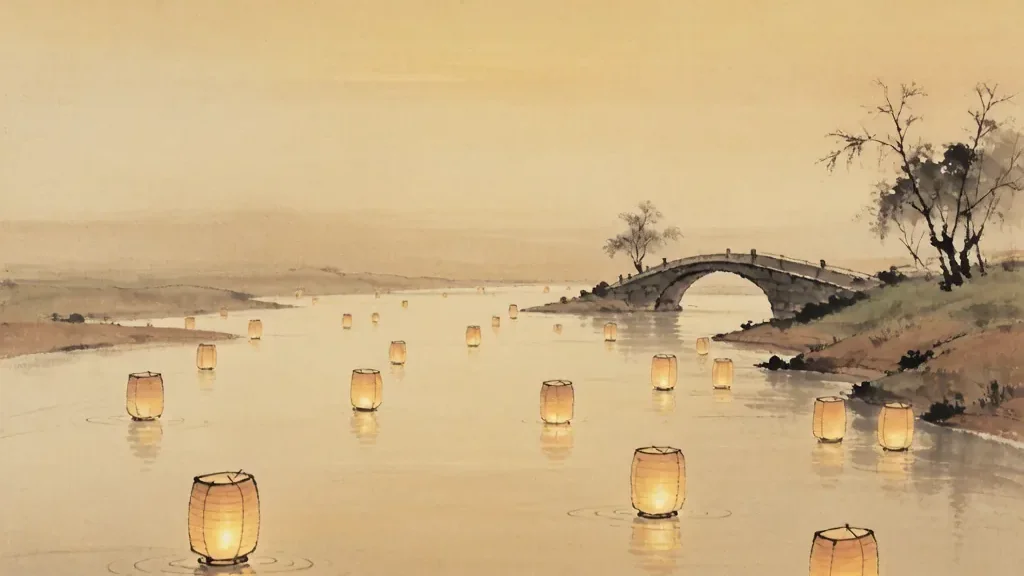
Perhaps the most hauntingly beautiful Zhongyuan custom is the floating of river lanterns (放河灯, fàng hé dēng). On the night of the fifteenth, families gather at rivers, lakes, and ponds and set small lanterns afloat on the water. The lanterns are traditionally made of paper or lotus leaves, with a small candle inside, and shaped like lotus flowers — the lotus being the Buddhist symbol of purity rising from the mud.
As darkness falls, hundreds — sometimes thousands — of tiny lights drift out onto the water, their reflections doubling the stars. It is a breathtaking sight. The lanterns serve two purposes: they light the way for the spirits to find their way home to visit their families, and, at the end of the month, they guide the spirits back to the underworld when the gates close. A lantern that drifts far and disappears is said to carry a soul safely to its next rebirth.
The river lanterns are also offered especially for the wandering ghosts — the drowned, the lost, the forgotten. The water, in Chinese cosmology, is the boundary between the world of the living and the world of the dead. A lantern set on the water is a bridge between the two, a small flame of compassion offered to those who have no one else to remember them.
A Festival of Filial Love
At its core, Zhongyuan is a festival about filial piety (孝, xiào) — the central virtue of Chinese moral life. Mu Lian's story is not really about ghosts or hells. It is about a son's love for his mother, a love so fierce that it would descend into the deepest darkness to find her. And it is about the humbling truth that love alone is not enough — that we need community, we need the help of others, we need the accumulated merit of many good acts to accomplish what one person cannot.
The festival reminds the living that the dead are not truly gone. They are present in the smoke of the paper money, in the food on the offering table, in the drifting lanterns on the water. And the living are not truly separate from the dead. We carry them in our memory, in our names, in the duties we fulfill on their behalf. On Zhongyuan, the boundary between the worlds thins, and love flows across it — from son to mother, from the living to the dead, like a lantern set gently on dark water, drifting toward a shore we cannot see.
The Hungry Ghost Realm in Buddhist Cosmology
Zhongyuan draws its deepest meaning from the Buddhist map of the afterlife, in which beings are reborn across six realms. The realm of hungry ghosts, the egui dao, is a place of endless craving: its inmates have swollen bellies and needle-thin mouths, surrounded by food that turns to fire the moment they reach for it. This vivid image was never only about the dead; it served as a parable of greed and attachment for the living. Understanding the realm explains why the festival's central act is feeding and freeing spirits, an effort to relieve a suffering that Buddhist teaching says can touch any soul bound by desire.
Caring for the Wandering Dead
Not every spirit has descendants to remember it, and Zhongyuan makes special room for these forgotten dead, called the good brothers. Families set out extra plates of food and burn extra paper money at crossroads, while whole communities in the south lay banquet tables and stage operas for an audience of empty chairs. The paper offerings have grown with the times, now including miniature houses, cars, and phones, all meant to comfort the dead in the next world. This widening circle of care shows the festival's quiet lesson: that compassion should reach even those no one claims as their own.
❓ Frequently Asked Questions
📝 Chinese Vocabulary
中元节 — : The Ghost Festival, on the 15th day of the 7th lunar month. "Zhongyuan" means "middle origin," referring to the Taoist Official of Earth who pardons sins on this day.
鬼节 — : "Ghost Festival," the common folk name for Zhongyuan, when the gates of the underworld open and spirits walk the earth.
目连 — : Mu Lian (Maudgalyayana), the Buddha's disciple renowned for supernatural powers, who descended into the hungry ghost realm to rescue his mother's soul.
放河灯 — : "Releasing river lanterns," the Zhongyuan custom of floating paper lotus lanterns on water to guide spirits home and back to the underworld.
盂兰盆 — : Yulanpen, the "basin of salvation," the Buddhist name for the festival and the offering vessel that Mu Lian prepared to free his mother.
饿鬼道 — : The realm of hungry ghosts, one of the six realms of rebirth in Buddhist cosmology.
好兄弟 — : Good brothers, the gentle folk term for wandering ghosts who have no living family to honor them.
纸钱 — : Paper spirit money burned as an offering so the dead may use it in the underworld.
🎉 Fun Facts
- The entire seventh lunar month is often called "Ghost Month" (鬼月, guǐ yuè), during which the gates of hell are open. The 15th is simply the peak day, but spirits are believed to wander the whole month.
- During Ghost Month, many Chinese people avoid swimming, getting married, moving house, or starting a business, fearing that water spirits may drag the living under and that new beginnings may be cursed by wandering ghosts.
- The Mu Lian story was adapted into one of the oldest surviving Chinese operas, "The Mulian Rescues His Mother" (目连救母), performed during Zhongyuan for over a thousand years — sometimes lasting for seven days and nights.
- The "hungry ghost" with its swollen belly and needle-thin mouth has become a universal metaphor in psychology for insatiable craving — the endless wanting that can never be satisfied, no matter how much one consumes.
- In Taiwan, Zhongyuan is celebrated with elaborate "zhongpu" feasts (中普) — community banquets laid out for the wandering ghosts, with stages for Chinese opera performed for an audience of spirits who sit in empty chairs.
- In some homes a bowl of rice and an extra chair are set at the family table on the fifteenth, inviting departed relatives to 'join' the meal before the offerings are burned.