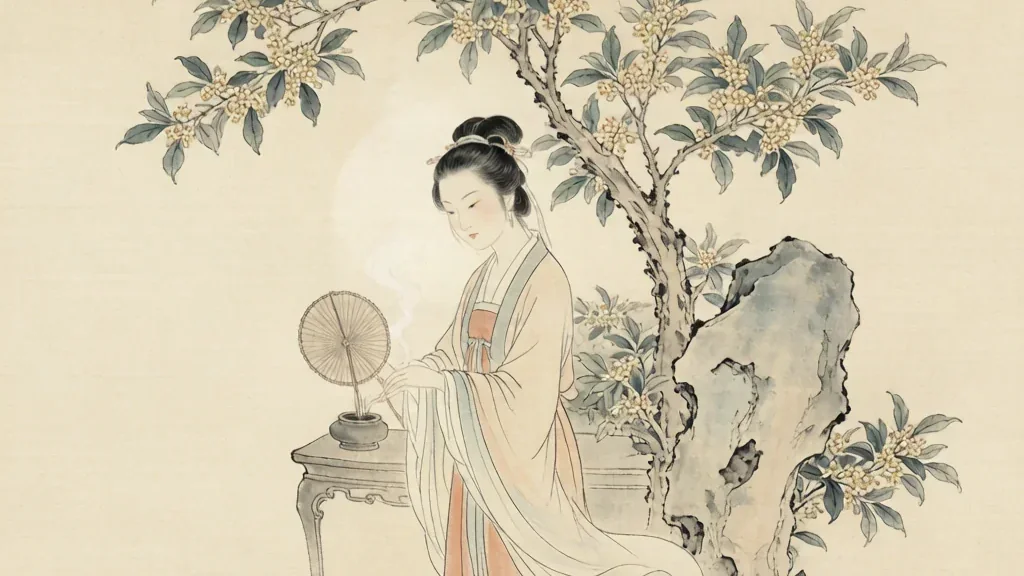
Among the Four Great Beauties of ancient China, Diao Chan occupies a unique position—she is the only one whose historical existence remains a matter of scholarly debate. Unlike Xi Shi and Wang Zhaojun, who appear in early historical records, Diao Chan emerges primarily from the pages of the fourteenth-century novel Romance of the Three Kingdoms, one of China's greatest literary masterpieces. Yet whether she was a real woman or a brilliant literary creation, her story has captivated the Chinese imagination for centuries, embodying the perfect fusion of beauty, intelligence, and patriotic sacrifice.
Diao Chan's name is forever linked to the idiom "闭月"—shaming the moon. According to legend, when she prayed in the garden one night, the moon itself hid behind clouds, embarrassed to be compared with such radiance. This poetic image sets the tone for her entire story: a woman whose beauty was so extraordinary that it seemed to bend the very laws of nature, and whose actions would reshape the political landscape of a fractured empire.
The Collapse of the Han Dynasty
To understand Diao Chan's role, one must first grasp the chaos into which she was thrust. By the late second century CE, the once-glorious Han Dynasty had decayed into corruption and weakness. The imperial court was dominated by eunuchs who manipulated child emperors, provincial warlords who carved out personal fiefdoms, and generals who answered to no authority but their own ambition. The dynasty that had ruled China for four centuries was crumbling, and in the power vacuum, a particularly monstrous figure rose to dominance.
Dong Zhuo was a warlord from the northwest who seized control of the capital, Luoyang, in 189 CE. He deposed the reigning emperor, installed a puppet replacement, and ruled with unprecedented brutality. His soldiers looted the city, massacred civilians, and desecrated imperial tombs. Dong Zhuo himself was described by contemporaries as gluttonous, cruel, and utterly without restraint. He reportedly feasted while watching prisoners being tortured and thought nothing of executing officials who displeased him.
The empire's loyal ministers watched in horror but found themselves powerless. Dong Zhuo was protected not only by his army but by his adopted son, Lü Bu—a warrior of legendary prowess whose martial skills made him the most feared fighter of his generation. Lü Bu was described as unmatched in combat, capable of defeating dozens of opponents single-handedly. His famous weapon, the "Sky Piercer" halberd, and his horse, the "Red Hare," became as legendary as the man himself. As long as Lü Bu stood at Dong Zhuo's side, any attempt to remove the tyrant seemed doomed.
The Minister's Desperate Plan
Among the officials who despaired at Dong Zhuo's tyranny was Wang Yun, the Minister of the Interior. An elderly statesman who had served the Han Dynasty faithfully, Wang Yun could not bear to watch the empire disintegrate. Yet he had no army to challenge Dong Zhuo and no authority that the warlord would respect. Late one night, walking alone in his garden, Wang Yun wept at his helplessness—and it was there that he encountered the young woman who would change everything.
Diao Chan was a singer and dancer in Wang Yun's household, raised by him since childhood and treated as an adopted daughter. When she found the minister weeping in the garden, she too began to cry, declaring that she would do anything to help him. In that moment, Wang Yun conceived his plan—a plan so audacious that it would become one of the most famous stratagems in Chinese history.
The "Chain-Linked Stratagem" was elegant in its simplicity. Wang Yun would use Diao Chan's beauty to drive a wedge between Dong Zhuo and Lü Bu. He would promise Diao Chan to Lü Bu in marriage, then offer her to Dong Zhuo as a concubine. Caught between two powerful men who both desired her, Diao Chan would manipulate their jealousy and suspicion until the bond between father and son was shattered beyond repair.
The plan required Diao Chan to be not merely beautiful but extraordinarily skilled in the arts of deception. She would need to play two roles simultaneously: the devoted bride-to-be with Lü Bu and the willing concubine with Dong Zhuo, all while ensuring that each man believed she loved only him. It was a performance that demanded courage, intelligence, and emotional control of the highest order. Wang Yun explained the plan to Diao Chan, and she accepted without hesitation, declaring that she would gladly give her life if it meant saving the empire.
The Trap Is Set
The execution of the stratagem began with a carefully orchestrated banquet. Wang Yun invited Lü Bu to his home, treating the warrior with elaborate courtesy. As the wine flowed, Wang Yun summoned Diao Chan to serve the guest. The moment Lü Bu laid eyes on her, he was captivated. Diao Chan, for her part, played her role to perfection—demure, graceful, and clearly attracted to the handsome warrior. Wang Yun, pretending to be moved by their mutual attraction, offered Diao Chan to Lü Bu as his future bride. Lü Bu, overjoyed, accepted eagerly.
Days later, Wang Yun invited Dong Zhuo to a similar banquet. Again, Diao Chan was summoned to entertain the guest, and again, the effect was immediate. Dong Zhuo, a man of unrestrained appetites, was overwhelmed by her beauty. When Wang Yun offered her as a gift, Dong Zhuo accepted without hesitation and had her carried to his residence that very night.
When Lü Bu learned what had happened, he was enraged. He confronted Wang Yun, who feigned helplessness, explaining that Dong Zhuo had simply taken what he wanted and that a mere minister could not refuse the Prime Minister. Lü Bu's fury now had a target, but his loyalty to his adoptive father still held. The trap had been sprung, but the kill required one more delicate manipulation.
The Art of Seduction and Deception
Within Dong Zhuo's household, Diao Chan executed the most dangerous phase of her mission. To Dong Zhuo, she was the perfect concubine—affectionate, attentive, and apparently devoted. She soothed his suspicions, catered to his desires, and made herself indispensable to his comfort. But whenever Lü Bu appeared, her performance changed. She would steal glances at him, tears streaming down her face, her expression one of desperate love and silent suffering.
Lü Bu, watching from a distance, was tormented by what he saw. The woman he loved was in the arms of his adoptive father—a father who, Lü Bu increasingly believed, had stolen her deliberately. Diao Chan fed this narrative at every opportunity. In private moments with Dong Zhuo, she would weep and claim that Lü Bu had made improper advances toward her. To Lü Bu, she would weep and claim that Dong Zhuo had forced her against her will. Each man believed her completely, for each saw only what he wanted to see.
The tension between father and son reached its breaking point in a dramatic confrontation. According to the Romance of the Three Kingdoms, Lü Bu caught sight of Diao Chan through a window, and their eyes met in a moment of anguished longing. Dong Zhuo, noticing the exchange, flew into a rage and hurled a halberd at his adopted son. Lü Bu dodged the weapon, but the symbolic break was complete. The man who had been Dong Zhuo's most loyal protector now had reason to fear for his life.
Diao Chan's manipulation of this crisis was masterful. She convinced Dong Zhuo that Lü Bu was plotting against him and simultaneously convinced Lü Bu that Dong Zhuo would eventually kill him. She played on each man's fears and desires with surgical precision, never appearing to do anything but suffer nobly. Her performance was so convincing that neither man suspected they were being manipulated by a young woman who had been a household entertainer only months before.
The Fall of the Tyrant
In 192 CE, the conspiracy reached its climax. A group of officials, led by Wang Yun and now joined by Lü Bu, plotted Dong Zhuo's assassination. They lured the tyrant to the palace under the pretense of an abdication ceremony, where the reigning emperor would formally surrender the throne to him. Blinded by ambition and the confidence that Lü Bu still protected him, Dong Zhuo walked into the trap.
As Dong Zhuo entered the palace, the conspirators struck. Soldiers surrounded him, and when he called out for Lü Bu to save him, his adopted son appeared—not to rescue him but to deliver the killing blow. According to the novel, Lü Bu personally drove his halberd through Dong Zhuo, declaring that he was acting on imperial orders to punish a traitor. The tyrant who had terrorized the empire was dead, brought down not by armies but by the love and jealousy of two men for one extraordinary woman.
The aftermath was chaotic. Wang Yun briefly took control of the government but was soon killed by Dong Zhuo's former generals, who returned with their armies to sack the capital. The empire descended into full-scale civil war, the very conflict that would eventually give rise to the Three Kingdoms period. Lü Bu himself would die a few years later, betrayed and executed by the warlord Cao Cao. The peace that Diao Chan's sacrifice had purchased proved tragically brief.
The Mystery of Diao Chan's Fate
What happened to Diao Chan after Dong Zhuo's death is one of the great mysteries of Chinese literature. The Romance of the Three Kingdoms does not provide a clear resolution to her story. She is mentioned as following Lü Bu during his subsequent campaigns, but after his death in 199 CE, she vanishes from the narrative entirely. This silence has spawned countless theories and alternative endings.
Some traditions hold that Diao Chan died alongside Lü Bu, either killed in the chaos of his final battle or choosing death over capture. Others suggest she was taken by Cao Cao, who recognized her value as a political asset and used her in similar schemes. A particularly romantic version claims she escaped the violence and lived out her days in peaceful anonymity, her mission accomplished and her identity hidden. The most tragic accounts say she was simply discarded—a tool that had served its purpose and was no longer needed.
The historical reality is equally mysterious. There is no mention of a woman named Diao Chan in the official Records of the Three Kingdoms, the primary historical source for the period. Some scholars suggest she may have been based on a real person—perhaps a servant in Dong Zhuo's household with whom Lü Bu had an affair. Others argue she is entirely fictional, a literary device created to dramatize the psychological dynamics of power, loyalty, and betrayal. The ambiguity of her existence only deepens her legend.
Diao Chan in Culture and Imagination
Regardless of her historical reality, Diao Chan has become one of the most powerful archetypes in Chinese culture. She represents the figure of the woman who uses beauty and intelligence as weapons in a world dominated by male violence—a recurring theme in Chinese literature that reflects the limited options available to women in traditional society. Her story asks uncomfortable questions: can manipulation be virtuous if it serves a righteous cause? Is a woman who uses her body for political purposes a hero or a victim?
In Chinese opera, Diao Chan is a staple character, particularly in the famous repertoire piece "Lü Bu and Diao Chan." Her role is technically demanding, requiring the actress to convey multiple layers of deception while maintaining the audience's sympathy. The character must be simultaneously seductive and innocent, calculating and vulnerable—a paradox that makes her one of the most challenging and rewarding roles in the classical repertoire.
Modern interpretations have reexamined Diao Chan through contemporary lenses. Feminist scholars have debated whether she represents female agency or patriarchal exploitation. Was she an active participant in her own destiny, or merely a pawn moved by Wang Yun? The novel suggests both possibilities: she volunteers for the mission but has no control over what happens afterward. Her silence after Lü Bu's death can be read as either freedom or erasure.
In popular culture, Diao Chan has appeared in countless films, television series, and video games. The Dynasty Warriors franchise, which adapts the Romance of the Three Kingdoms for global audiences, presents her as a graceful warrior who fights alongside Lü Bu. These modern adaptations keep her legend alive for new generations, ensuring that the woman who shamed the moon continues to captivate audiences more than eighteen centuries after her story was first told.
Ultimately, Diao Chan's enduring power lies in the questions she embodies rather than the answers she provides. Her story is a meditation on the relationship between beauty and power, the moral complexity of political action, and the human capacity for both manipulation and sacrifice. She remains, like the moon she was said to shame, simultaneously visible and mysterious—a figure whose true nature can never be fully grasped, only admired from a distance.
Diao Chan Among the Four Great Beauties
Chinese tradition names four peerless beauties: Xi Shi, Wang Zhaojun, Diao Chan, and Yang Guifei. The others are remembered largely as objects of fate, Xi Shi was lent to a rival state, Wang Zhaojun was sent as a peace bride, Yang Guifei perished in a mutiny. Diao Chan is different. She is the only one defined by action, a woman who used her beauty as a deliberate instrument to divide two powerful men and save a collapsing dynasty. That distinction makes her both admired and uneasy, for she complicates the image of the passive beauty. Among the four, she alone is a strategist, which is precisely why her historicity is debated and why her legend endures.
❓ Frequently Asked Questions
📝 Chinese Vocabulary
- 貂蝉 (Diāo Chán) — Diao Chan, one of the Four Great Beauties of ancient China
- 闭月 (Bì yuè) — "Shaming the moon," the idiom describing Diao Chan's legendary beauty
- 连环计 (Liánhuán jì) — The "Chain-Linked Stratagem," Wang Yun's plan to divide Dong Zhuo and Lü Bu
- 吕布 (Lǚ Bù) — Lü Bu, the mighty warrior who fell in love with Diao Chan
- 三国演义 (Sānguó Yǎnyì) — Romance of the Three Kingdoms, the novel that immortalized Diao Chan's story
🎉 Fun Facts
- Diao Chan's name is not a real personal name—"Diao" refers to the sable-tail ornaments worn by high officials, and "Chan" refers to cicadas, suggesting her name was a poetic title rather than a birth name.
- In Chinese opera, Diao Chan is one of the most technically demanding female roles, requiring mastery of singing, dance, and the subtle facial expressions that convey layers of deception.
- Unlike the other three beauties, Diao Chan has no historical tomb or memorial site—a fact that has led some scholars to conclude she was entirely fictional, while others insist this only deepens her mystery.
- Diao Chan is counted among the Four Great Beauties, yet she is the only one whose historical existence is openly doubted by scholars.
- In some regional operas her singing shifts between a maiden's softness and a widow's grief to show the two roles she played at once.
- The name Diao Chan is sometimes used in Chinese as shorthand for a woman who wields charm as a political weapon.