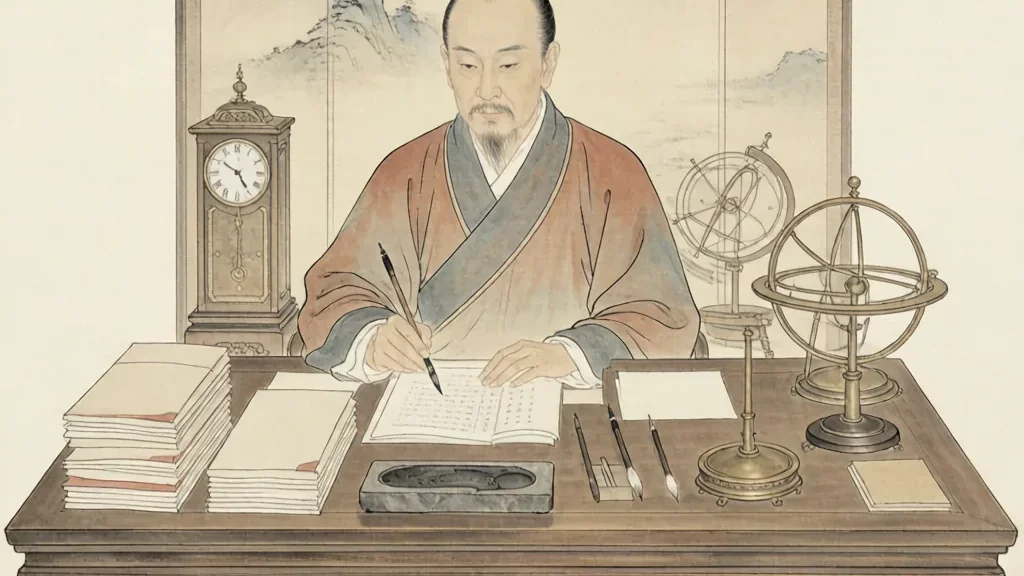
In the long history of China, no emperor ruled longer than the Kangxi Emperor. For sixty-one years — from 1661 to 1722 — he sat on the Dragon Throne, guiding the Qing Dynasty through its most formative and prosperous period. He was eight years old when he became emperor, and he grew into one of the most capable, intellectually curious, and culturally significant rulers China has ever known. Under his reign, the Qing Empire reached its greatest territorial extent, the economy flourished, and Chinese culture experienced a renaissance that produced dictionaries, encyclopedias, and artistic masterpieces.
What makes Kangxi particularly fascinating is his dual identity. He was a Manchu — a member of the ethnic group from the northeast that had conquered China and established the Qing Dynasty just a generation before his birth. Yet he became more thoroughly Chinese in his education and cultural sympathies than many native-born Chinese emperors. He mastered the Confucian classics, composed poetry in classical Chinese, and practiced Chinese calligraphy with genuine skill. At the same time, he maintained his Manchu identity, preserving the language, martial traditions, and customs of his ancestors. This ability to bridge two cultures made him uniquely qualified to rule a multi-ethnic empire.
The Boy Emperor
Xuanye, as Kangxi was known before his enthronement, was born in 1654, the third son of the Shunzhi Emperor. His father died of smallpox when Xuanye was only seven years old. The dying emperor chose Xuanye as his successor partly because the boy had already survived smallpox and would therefore be immune to the disease that had killed his father. On his deathbed, Shunzhi appointed four regents to govern until the young emperor came of age.
The regency was dominated by Oboi, a powerful Manchu general who quickly marginalized the other regents and ruled as a virtual dictator. The young Kangxi watched and learned, biding his time. In 1669, at the age of fifteen, he made his move. He trained a group of young Manchu bannermen in wrestling, using their training sessions as cover for plotting Oboi's arrest. When the moment came, Kangxi summoned Oboi to court and had his young wrestlers seize the unsuspecting regent. Oboi was imprisoned, his faction was purged, and the fifteen-year-old emperor took control of his empire.
This dramatic coup revealed qualities that would define Kangxi's entire reign: patience, strategic thinking, and the courage to act decisively when the time was right. A lesser ruler might have challenged Oboi prematurely and been crushed. Kangxi waited until he was ready and then struck with precision. It was the first of many challenges he would overcome.
Consolidating the Empire
When Kangxi took power, the Qing Dynasty was far from secure. The conquest of China was still within living memory, and many Han Chinese regarded the Manchu rulers as foreign invaders. In the south, three former Ming generals who had surrendered to the Qing had been granted semi-independent fiefdoms. These "Three Feudatories" controlled vast territories and maintained their own armies, posing a constant threat to central authority.
In 1673, the feudatories rebelled. The revolt, led by Wu Sangui, quickly spread across southern China and threatened to topple the young dynasty. Kangxi, still only nineteen, responded with determination and strategic skill. He refused to negotiate or compromise, declaring that the rebellion must be crushed. The war lasted eight years and devastated much of southern China, but Kangxi's forces ultimately prevailed. The Three Feudatories were eliminated, and centralized imperial control was firmly established.
Next, Kangxi turned his attention to Taiwan, where Ming loyalists under the Zheng family had established an independent kingdom. In 1683, Qing naval forces under Admiral Shi Lang defeated the Zheng fleet and incorporated Taiwan into the empire for the first time in Chinese history. Kangxi then faced the threat of Russian expansion in the north. After a series of military engagements, he negotiated the Treaty of Nerchinsk in 1689 — China's first treaty with a European power — which defined the border between the two empires and established a framework for trade and diplomatic relations.
The greatest military challenge of Kangxi's reign came from the Dzungar Mongols, who threatened to create a new steppe empire on China's northwestern frontier. Kangxi personally led three military campaigns against the Dzungars, riding at the head of his armies into the harsh terrain of Mongolia and the Gobi Desert. By the end of his reign, the Qing Empire had expanded to include Mongolia, Tibet, and much of Central Asia, reaching its greatest territorial extent in Chinese history.
The Scholar Emperor
Kangxi was not merely a warrior. He was one of the most intellectually accomplished emperors in Chinese history. He rose at dawn every day to study the Confucian classics, and he maintained this rigorous schedule of self-education throughout his life. He mastered Manchu, Chinese, and Mongolian, and had a working knowledge of Tibetan. He studied mathematics, astronomy, geography, and medicine with genuine passion.
One of Kangxi's most enduring cultural achievements was the Kangxi Dictionary, a monumental work of lexicography completed in 1716. The dictionary contained 47,035 Chinese characters, each with detailed definitions, pronunciations, and examples of usage. For more than two centuries, it was the standard reference for the Chinese language, and it remains an invaluable resource for scholars of classical Chinese today.
Kangxi also sponsored the compilation of the Complete Tang Poems, a collection of all surviving poetry from the Tang Dynasty — nearly 49,000 poems by over 2,200 poets. He commissioned the History of the Ming Dynasty, a comprehensive official history of the preceding dynasty. And he ordered the creation of the Huangyu Quanlan Tu, the most detailed atlas of China ever produced up to that time, based on surveys conducted by Jesuit missionaries using Western cartographic techniques.
The Emperor and the Jesuits
Kangxi's relationship with the Jesuit missionaries at his court is one of the most fascinating chapters in the history of cross-cultural exchange. The Jesuits had been present in China since the late Ming Dynasty, and Kangxi, with his insatiable curiosity, welcomed them into his inner circle. They taught him Western mathematics, astronomy, and geography. They designed and built astronomical instruments for the imperial observatory. They served as translators and diplomats in his dealings with European powers.
The emperor's engagement with Western science was not superficial. He personally studied Euclidean geometry under the Jesuit Ferdinand Verbiest, working through proofs and problems with the dedication of a serious student. He used Western surveying techniques to map his empire. He took Western medicines when he was ill, and he promoted smallpox inoculation — a practice that had originated in China but was refined through contact with Western medicine. Kangxi's openness to foreign knowledge, combined with his deep grounding in Chinese tradition, made him one of the most cosmopolitan rulers of his age.
However, Kangxi's relationship with the Jesuits was eventually strained by the Chinese Rites Controversy. The Vatican, responding to complaints from rival Catholic orders, condemned the Jesuit practice of accommodating Chinese ancestral rites and Confucian ceremonies. Kangxi, who saw these rites as essential to Chinese civilization, was outraged by what he perceived as foreign interference in Chinese affairs. He declared that missionaries who did not follow the Jesuit policy of accommodation would be expelled. The controversy damaged Sino-European relations and contributed to the eventual restriction of Christian missionary activity in China.
The Philosophy of Rule
Kangxi articulated his philosophy of governance in the Sacred Edict, a set of sixteen moral maxims that he issued in 1670 and that were read aloud in every village throughout the empire. The maxims emphasized filial piety, respect for elders, peaceful relations with neighbors, diligence in agriculture, frugality, and education. They represented Kangxi's vision of a harmonious society governed by moral principles rather than force alone.
The emperor practiced what he preached. He was famously frugal in his personal life, refusing the elaborate luxuries that many emperors had indulged. He conducted regular tours of inspection throughout the empire, visiting provinces to observe conditions firsthand and to demonstrate that the emperor was not a distant figure but a concerned ruler who cared about his people's welfare. These tours were expensive and disruptive, but Kangxi believed they were essential for good governance.
Kangxi was also notably tolerant by the standards of his time. He proclaimed that the Qing Empire would respect the customs and beliefs of all its peoples — Manchus, Chinese, Mongols, Tibetans, and Muslims alike. He patronized Confucian temples, Buddhist monasteries, and Daoist shrines. He protected the rights of Muslims to practice their faith and of Tibetans to maintain their religious traditions. This policy of cultural pluralism helped hold the multi-ethnic empire together during a period of rapid expansion.
The Shadow of Succession
For all his achievements, Kangxi's final years were darkened by a bitter succession struggle. He had more than fifty children, and the competition among his sons for the succession became increasingly vicious. The emperor had originally designated his second son, Yinreng, as heir apparent, but Yinreng proved unstable and was eventually deposed. The ensuing power struggle among the princes poisoned the atmosphere of the court and deeply distressed the aging emperor.
Kangxi never publicly named a successor. On his deathbed in December 1722, he is said to have designated his fourth son, Yinzhen, who became the Yongzheng Emperor. The circumstances of the succession have been debated ever since, with some historians suggesting that Yongzheng manipulated events to seize the throne. Whatever the truth, the succession crisis cast a shadow over Kangxi's otherwise glorious reign and contributed to the eventual decline of the Qing Dynasty.
Kangxi died at the age of sixty-eight, having ruled for sixty-one years — the longest reign of any emperor in Chinese history. He was buried in the Eastern Qing Tombs, where his magnificent mausoleum can still be visited today. His posthumous name honored him as "the Benevolent Emperor," a title that reflected the genuine affection he had inspired in many of his subjects.
Legacy of the Great Kangxi
Kangxi's legacy is complex and enduring. He transformed the Qing Dynasty from a fragile conquest state into a stable, prosperous, and culturally vibrant empire. He expanded China's borders to their greatest historical extent. He fostered a cultural renaissance that produced lasting works of scholarship and art. He engaged with the wider world in ways that no previous Chinese emperor had done, opening China to new ideas while maintaining the integrity of its traditions.
Yet Kangxi's reign also contained the seeds of problems that would later afflict the Qing Dynasty. The succession crisis weakened the institution of imperial rule. The Rites Controversy poisoned relations with the West at a crucial moment when China could have benefited from continued engagement with European science and technology. The costs of military expansion and imperial tours strained the treasury. And the Qing policy of ethnic separation, while preserving Manchu identity, created tensions that would persist throughout the dynasty.
For modern China, Kangxi remains a complex figure — a symbol of both imperial greatness and the challenges of governing a vast, multi-ethnic state. His reign demonstrated that strong, enlightened leadership could create prosperity and stability. But it also showed that even the greatest rulers cannot fully control the forces of history. The empire Kangxi built would endure for nearly two more centuries, but the seeds of its decline were already present in the very successes he achieved.
Kangxi as Patron of the Arts
Kangxi's reign was a cultural renaissance as much as a political one. The imperial workshops produced porcelain of remarkable quality, the famous Kangxi blue and white and famille verte wares that are still prized by collectors. Court painters worked in both Chinese and Western styles, some taught by the Jesuits at Beijing, and the emperor's own calligraphy was sought after across the realm. He commissioned vast scholarly projects, the Kangxi Dictionary, the Complete Tang Poems, and the History of the Ming, which fixed texts for later generations. By sponsoring craft, painting, and learning together, he turned the throne into a patron of civilization and gave the Qing its cultural confidence.
❓ Frequently Asked Questions
📝 Chinese Vocabulary
- 康熙字典 (Kāngxī Zìdiǎn) — The Kangxi Dictionary; the monumental work of lexicography completed during his reign
- 康熙大帝 (Kāngxī Dàdì) — "The Great Emperor Kangxi"; his popular title
- 三藩之乱 (Sān Fān zhī Luàn) — The Revolt of the Three Feudatories; the rebellion Kangxi crushed
- 圣谕 (Shèng Yù) — The Sacred Edict; Kangxi's sixteen moral maxims for his subjects
- 尼布楚条约 (Níbùchǔ Tiáoyuē) — The Treaty of Nerchinsk; China's first treaty with a European power
🎉 Fun Facts
- Kangxi's 61-year reign is the longest of any emperor in Chinese history and one of the longest reigns of any monarch in world history — he was eight when he ascended the throne and sixty-eight when he died.
- The Kangxi Dictionary, completed in 1716, contained 47,035 Chinese characters and remained the standard reference work for the Chinese language for over 200 years.
- Kangxi personally studied Western mathematics and astronomy under Jesuit missionaries, working through Euclidean geometry proofs as seriously as any university student today.
- Kangxi learned Manchu as his first language and used it for secret communications with trusted officials.
- He survived smallpox as a child, the very disease that killed his father and helped win him the throne.
- His southern tours were lavish affairs that doubled as displays of Manchu authority over the wealthy Yangtze delta.