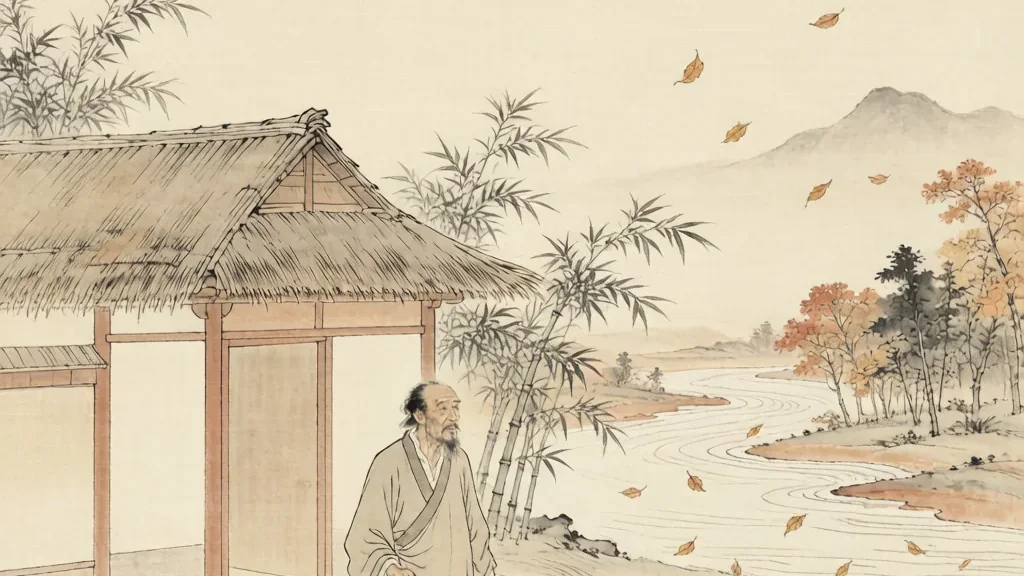
If Chinese poetry has a conscience, it is Du Fu. More than any other figure in the vast landscape of Chinese literature, Du Fu represents the union of technical mastery and moral seriousness, of artistic perfection and human compassion. His poetry captures the full range of human experience—the joy of reunion, the agony of separation, the beauty of the natural world, and the horror of war—with a depth and honesty that has earned him the title "Sage of Poetry," one of the highest honors in the Chinese literary tradition.
Unlike his contemporary and friend Li Bai, whose poetry soars into the heavens on wings of imagination and wine, Du Fu's verse is firmly rooted in the earth. He wrote about the real world—about poverty and hunger, about the suffering of ordinary people, about the collapse of an empire and the destruction of everything he loved. His work represents the fullest expression in Chinese literature of what might be called poetic realism: the commitment to bearing witness to the truth of human experience, however painful that truth might be.
A Child of the Golden Age
Du Fu was born in 712 CE in Gong County, near Luoyang, into a family with a distinguished literary and governmental tradition. His grandfather, Du Shenyan, was a noted poet and high official, and the young Du Fu grew up in an atmosphere of learning and ambition. Like all educated men of his class, he was trained from childhood in the Confucian classics, poetry composition, and the arts of calligraphy—the foundation of a career in the imperial bureaucracy.
The Tang Dynasty into which Du Fu was born was at the height of its power and cultural achievement. The reign of Emperor Xuanzong had brought unprecedented prosperity, and the capital city of Chang'an was the most sophisticated urban center in the world. Poets, painters, musicians, and scholars from across Asia gathered there, creating a cultural efflorescence that has never been surpassed in Chinese history. For a young man of talent and ambition, it seemed that all doors were open.
Du Fu's early life was shaped by the two great pillars of Tang elite culture: travel and the imperial examination system. As a young man, he journeyed widely through the empire, visiting famous mountains, rivers, and historical sites. These travels, common among educated men of the period, served to broaden the mind, develop poetic skill through exposure to inspiring landscapes, and build the social networks essential for a political career. Du Fu's early poetry from this period reflects the optimism and expansiveness of youth: poems about climbing mountains, viewing waterfalls, and contemplating the heroes of the past.
Failure and the Examination System
The defining frustration of Du Fu's early career was his failure in the imperial examinations. The examination system was the primary pathway to government service, and success required not only literary skill but also the right connections, the right political alignments, and a fair measure of luck. Du Fu took the highest-level examination in 735 CE and failed. He would take it again later, and fail again—a pattern that would haunt his entire life.
The reasons for his failure tell us much about both Du Fu and the system he sought to enter. The examinations of this period emphasized a particular style of ornate, allusive prose and poetry that rewarded formal elegance over genuine feeling. Du Fu's natural style—direct, emotionally honest, morally serious—was not what the examiners were looking for. He was, in a sense, too good a poet for the system that was supposed to identify poetic talent.
This failure had profound consequences. Without examination success, Du Fu could not obtain the regular bureaucratic appointments that would have provided financial security and social status. Instead, he was forced to seek patronage from powerful officials, sending them poems of praise and supplication in hopes of recommendation. These poems of self-promotion, which Du Fu himself found degrading, represent one of the sadder aspects of his career—a great poet reduced to flattery by the necessities of survival.
Friendship with Li Bai
In 744 CE, Du Fu met the man who would become the other great pole of Chinese poetry: Li Bai. Li Bai was already famous—a celebrity poet whose wild genius, love of wine, and disdain for convention had made him a legend. Du Fu was still obscure, a struggling examination candidate who had published little. Yet the two recognized something in each other, and their brief period of friendship became one of the most celebrated relationships in literary history.
They traveled together, drank together, and wrote poems to and about each other. Li Bai's influence on Du Fu is visible in the freer, more imaginative style of some of Du Fu's poems from this period. But their friendship also highlighted their fundamental differences. Li Bai was a Daoist dreamer who sought transcendence in wine and nature; Du Fu was a Confucian moralist who could never forget the suffering of the world. Li Bai could write about flying to the moon on a celestial crane; Du Fu could not look away from the hungry child on the street.
After they parted, Du Fu would write some of his most moving poems about his absent friend—poems that express not only personal affection but also a deep appreciation for Li Bai's unique genius. "A hundred poems per gallon of wine—that's Li Bai," he wrote, capturing both the admiration and the gentle bewilderment of the sober moralist for the drunken immortal. These poems have become classics in their own right, preserving the image of Li Bai that subsequent generations would cherish.
The An Lushan Rebellion: Poetry of Catastrophe
The event that transformed Du Fu from a talented but obscure poet into the voice of his age was the An Lushan Rebellion of 755 CE. The rebellion, which shattered the peace and prosperity of the Tang golden age, gave Du Fu the subject that would define his greatest work: the suffering of ordinary people in a world torn apart by war and political collapse.
Du Fu was caught in the chaos of the rebellion's early months. He was separated from his family, captured by rebels, and held in the occupied capital of Chang'an. During this period of captivity and flight, he witnessed horrors that would haunt his poetry for the rest of his life. He saw cities burned, fields abandoned, and refugees dying by the roadside. He experienced hunger, cold, and the terror of a world where all order had collapsed.
The poems Du Fu wrote during and immediately after the rebellion represent one of the most extraordinary bodies of war poetry in any language. "Spring View" captures the desolation of the occupied capital in just eight lines: "The state is destroyed, but hills and streams remain; spring comes to the city, and grass and trees grow thick." The poem's famous closing couplet—"Hairpins grow shorter, barely hold my hair; I scratch my head, and it is white with grief"—condenses the personal and political catastrophe into a single, devastating image.
"The Recruiting Officer at Stone Moat" is perhaps Du Fu's most famous narrative poem, and it exemplifies his gift for bearing witness to suffering without sentimentality or self-dramatization. The poem describes a night spent in a village where recruiting officers have come to press men into military service. There are no young men left—they have all been taken or have fled—so the officers seize an old woman instead. Du Fu records the scene with documentary precision, letting the facts speak for themselves. The poem ends not with a moral or a cry of outrage but with silence: the poet leaves at dawn, and only the old man remains to see him off.
Other poems from this period describe the suffering of specific individuals with heartbreaking particularity. In "Ballad of the War Wagons," he imagines the grief of mothers and wives watching their sons and husbands march off to die on distant frontiers. In "Facing Snow," he contrasts the hunger of the poor with the indifference of the rich. Throughout these poems, Du Fu's characteristic voice emerges: compassionate, morally serious, technically brilliant, and utterly without self-pity.
The Chengdu Years: A Brief Peace
After years of wandering as a refugee, Du Fu found a measure of stability in the city of Chengdu, in modern-day Sichuan Province. With the help of friends and patrons, he built a modest thatched cottage on the outskirts of the city, beside a stream called the Huanhua. The cottage, which still stands today as a pilgrimage site for poetry lovers, became the setting for some of Du Fu's most beloved poems.
The Chengdu period produced a different kind of poetry—not the apocalyptic visions of the war years but quieter, more personal works that find profound meaning in the details of everyday life. Du Fu wrote about his garden, his children, his neighbors, the changing seasons, and the simple pleasures of a roof that did not leak and a meal that filled the stomach. These poems are often described as pastoral, but they are pastoral with an edge—the peace they celebrate is always shadowed by the memory of chaos, and the poet's gratitude is deepened by his knowledge of how easily everything can be lost.
"My Thatched Cottage Is Destroyed by Autumn Wind" is one of the masterpieces of this period. The poem begins with a comic touch—the wind steals the thatch from Du Fu's roof, and village boys run off with it, laughing—but it builds to a moment of extraordinary moral vision. Shivering in the cold, Du Fu imagines a vast mansion with thousands of rooms where all the poor of the world could find shelter. "If I could see that house," he writes, "I would freeze to death in my ruined cottage content." The movement from personal discomfort to universal compassion is characteristically Du Fu: the moral imagination transforming private suffering into public sympathy.
During these years, Du Fu also wrote some of his most formally innovative poetry. He experimented with the regulated verse forms that were becoming the standard for Tang poetry, pushing the boundaries of what could be expressed within strict metrical and tonal constraints. His technical mastery was such that he could make the most artificial form feel completely natural, as if the poem had always existed and he had merely discovered it. This combination of formal perfection and emotional authenticity is the hallmark of Du Fu's mature style.
The Final Years and Enduring Legacy
Du Fu left Chengdu in 765 CE, and his final years were spent wandering again—through the Yangtze River region, increasingly ill, increasingly impoverished, but writing poetry of undiminished power until the very end. His last poems reflect on death, memory, and the meaning of a life devoted to art. They are the work of a man who has seen too much, suffered too much, and somehow continued to write.
Du Fu died in 770 CE, at the age of fifty-eight, on a boat on the Xiang River in Hunan Province. The exact circumstances of his death are unclear, but the traditional account says that he died after eating spoiled food following a period of starvation caused by flooding. It is a grimly appropriate end for a poet whose life had been defined by poverty and displacement, and who had made the suffering of the hungry and homeless the central subject of his art.
During his lifetime, Du Fu was not widely recognized. His poetry circulated in small circles of friends and connoisseurs, but he never achieved the celebrity of Li Bai. It was only in the generations after his death that his reputation began to grow. By the Song Dynasty, he was acknowledged as the greatest of all Chinese poets—a judgment that has been largely sustained for a thousand years. The title "Sage of Poetry" reflects not only his technical mastery but also his moral authority: Du Fu was seen as a poet whose work embodied the highest ideals of Confucian humanism.
Du Fu's influence on subsequent Chinese poetry is immeasurable. Every major poet of the Song, Yuan, Ming, and Qing dynasties studied his work and sought to emulate his fusion of formal perfection and moral seriousness.
In the modern era, Du Fu has been rediscovered by readers around the world. Translations into English, French, German, and other languages have introduced his work to audiences who find in his poems a voice that speaks directly to contemporary concerns. His unflinching depictions of war's human cost, his sympathy for refugees and the displaced, and his insistence on the moral responsibility of the artist have made him one of the most relevant of classical poets for the modern world. The thatched cottage in Chengdu, faithfully reconstructed and preserved, receives hundreds of thousands of visitors each year—pilgrims who come to pay homage to a man who, more than twelve centuries ago, proved that poetry could be both beautiful and true.
Du Fu's Language and Form
Du Fu's greatness rests as much on craft as on feeling. He worked most closely in regulated verse, a form that fixes the number of lines, the count of characters, and a strict pattern of tonal contrasts between paired lines. Within these tight rules he achieved a rare naturalness, as if the form were invisible and only the scene remained. He paired allusion with plain speech, could be lapidary in a couplet and sprawling in a long ballad, and tuned every image to moral weight. Later poets studied his technique as a discipline, for in his hands regulation became freedom. To read Du Fu is to see how technical mastery can carry grief without ever raising its voice.
Du Fu's Reception Through the Ages
Du Fu died in obscurity, his poems circulating among friends while Li Bai shone as the celebrity of the age. Recognition came slowly. By the Song dynasty he was honored as the supreme realist and the Sage of Poetry, and his collected works were edited, annotated, and taught as a model. Yuan, Ming, and Qing writers measured themselves against him, and the thatched cottage in Chengdu became a place of pilgrimage. In the modern era translators carried him into English, French, and German, where his witness to war and refugees speaks to contemporary readers. Few classical poets have traveled so far from neglect to canonical reverence, and fewer still feel so current.
❓ Frequently Asked Questions
📝 Chinese Vocabulary
- 杜甫 (Dù Fǔ) — Du Fu, the "Sage of Poetry" and one of China's greatest poets
- 诗圣 (Shī Shèng) — "Sage of Poetry," the honorific title given to Du Fu
- 李白 (Lǐ Bái) — Li Bai, Du Fu's friend and contemporary, the other great poet of the Tang Dynasty
- 安史之乱 (Ān Shǐ zhī luàn) — The An Lushan Rebellion, the catastrophic civil war that shaped Du Fu's greatest poetry
- 草堂 (Cǎo táng) — "Thatched Cottage," referring to Du Fu's famous residence in Chengdu, now a museum and pilgrimage site
🎉 Fun Facts
- Du Fu wrote approximately 1,500 poems that survive to the present day, but scholars believe this represents only a fraction of his total output—most of his early work has been lost.
- Du Fu's thatched cottage in Chengdu has been rebuilt and preserved for over 1,200 years, making it one of the oldest continuously maintained literary shrines in the world.
- Unlike Li Bai, whose death was romanticized (drowning while trying to embrace the moon's reflection), Du Fu's death from food poisoning after starvation is a grim testament to the poverty that defined much of his life.
- Du Fu's poems were little known in his lifetime; his standing as the greatest Tang poet grew only generations later, during the Song dynasty.
- He wrote in many forms, from eight-line regulated verse to long narrative ballads and prose-poems of social complaint.
- A well-known line contrasts the frozen rags of the poor with the warm dancers of the rich, summing up his social conscience.