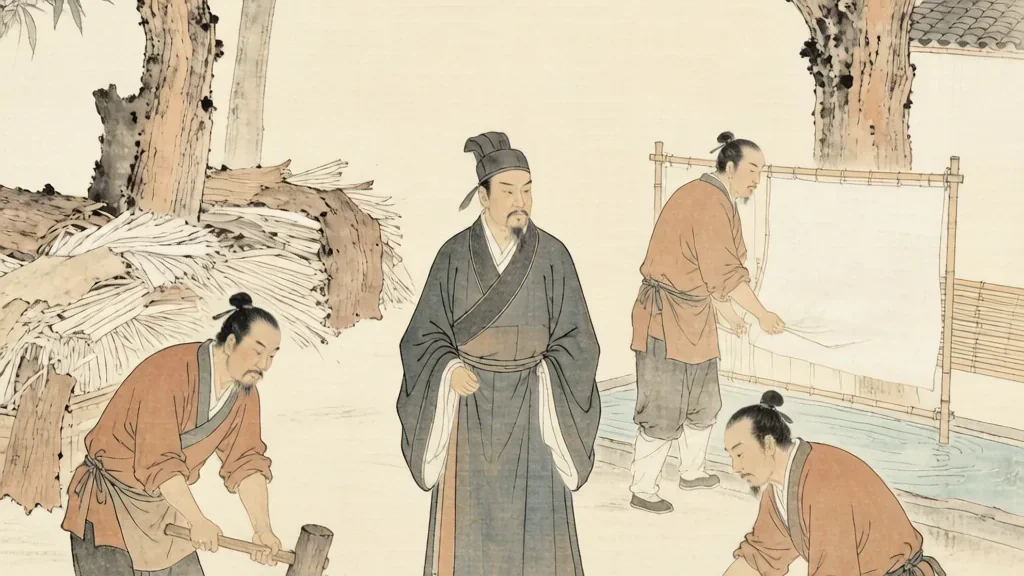
Imagine a world without paper. A world where every book must be laboriously copied onto bamboo strips or expensive silk, where a single text weighs as much as a small child and costs as much as a house. A world where knowledge is the exclusive possession of the wealthy and powerful, because the medium of its transmission is simply too costly for ordinary people. This was the world before Cai Lun—and it was Cai Lun, a eunuch official in the Han Dynasty imperial court, who changed it forever. His refinement of papermaking technology in 105 CE is widely regarded as one of the most consequential inventions in human history, earning him a place among the Four Great Inventions of ancient China alongside the compass, gunpowder, and printing.
The story of Cai Lun is not merely the story of a technological breakthrough. It is a story about the democratization of knowledge. Before affordable paper, literacy and learning were largely confined to the elite. After paper, books became accessible to scholars, merchants, and eventually ordinary citizens. The great intellectual efflorescence of the Tang and Song dynasties—the poetry, the philosophy, the scientific discoveries—would have been impossible without the cheap, abundant writing surface that Cai Lun's innovation made available. In a very real sense, every book ever printed, every letter ever written, every scientific paper ever published owes a debt to the Han Dynasty eunuch who figured out how to make paper from rags, tree bark, and fishing nets.
From the Palace to the Workshop
Cai Lun was born around 50 CE in Guiyang Commandery, in what is now Leiyang, Hunan Province. Little is known about his early life, but records indicate he entered the imperial palace as a eunuch around 75 CE, during the reign of Emperor Zhang. The practice of employing eunuchs in the imperial bureaucracy was well established by this time, and talented eunuchs could rise to positions of considerable power and influence. Cai Lun proved to be exceptionally capable, and by 89 CE he had been promoted to the position of Shangfang Ling—the director of the imperial workshops, where the finest craftsmen in the empire produced weapons, instruments, and luxury goods for the court.
This position was pivotal. As director of the imperial workshops, Cai Lun had access to the best materials, the most skilled artisans, and the resources to experiment on an industrial scale. He could observe every stage of production, from raw material processing to finished product, and he had the authority to demand perfection. It was the ideal environment for an innovator, and Cai Lun made the most of it.
At the time, writing in China was done primarily on bamboo or wooden slips (简牍, jiǎndú) bound together with cords to form scrolls. These were heavy, cumbersome, and time-consuming to produce. Silk (帛, bó) was sometimes used for important documents, but it was prohibitively expensive—far beyond the reach of ordinary scholars. Both materials had been in use for centuries, and while they had served Chinese civilization well, they were clearly inadequate for the needs of a growing, increasingly literate empire. The Han Dynasty was producing vast quantities of administrative documents, historical records, and literary works, and the limitations of existing writing materials were becoming an obstacle to the efficient functioning of the state itself.
The Invention That Changed the World
In 105 CE, Cai Lun presented his breakthrough to Emperor He. According to the Book of the Later Han (后汉书, Hòu Hàn Shū), the official history of the period, Cai Lun "submitted a memorial to the emperor reporting his method of making paper from tree bark, hemp remnants, rags of cloth, and fishing nets." The emperor was so impressed that he issued an imperial decree promoting the use of paper throughout the empire. Cai Lun was elevated to the nobility, receiving the title of Marquis of Longting.
The genius of Cai Lun's process lay in its use of cheap, widely available raw materials. Earlier forms of paper-like material had existed in China for at least two centuries before Cai Lun—archaeological evidence shows that a crude form of hemp paper was being made as early as the 2nd century BCE. But these early papers were thick, coarse, and unsuitable for writing. Cai Lun's innovation was to refine the manufacturing process: he discovered that by soaking plant fibers in water, beating them into a pulp, then spreading the pulp on a screen and pressing out the water, he could produce a thin, smooth, uniform sheet that absorbed ink beautifully.
The key steps in Cai Lun's papermaking process—soaking, beating, screening, pressing, and drying—remain the fundamental principles of papermaking to this day, even in modern industrial production. He understood that different fiber sources produced papers with different qualities: tree bark fibers yielded a strong, durable paper; hemp produced a softer, more absorbent sheet; rags and old fishing nets contributed flexibility. By blending different fibers in different proportions, Cai Lun could produce papers tailored to specific purposes—some for writing with brush and ink, others for wrapping or packaging.
The economic implications were staggering. A bamboo scroll that might have cost a scholar months of income could now be replaced by a paper book at a fraction of the cost. Government documents that once required carts to transport could now be carried in a satchel. The material foundation of Chinese civilization had been transformed, and the effects would ripple outward for centuries.
Paper and the Spread of Civilization
The impact of Cai Lun's invention was not confined to China. Papermaking technology spread along the Silk Road, reaching Central Asia by the 3rd century and the Islamic world by the 8th century. According to historical accounts, the secret of papermaking was revealed to the Arabs when Chinese papermakers were captured at the Battle of Talas in 751 CE. From Samarkand, the technology spread to Baghdad, Damascus, and eventually to Europe, where the first paper mill was established in Spain in the 12th century.
Everywhere paper went, it transformed the societies that adopted it. In the Islamic world, paper enabled the great translation movements that preserved Greek philosophy and science for future generations. In Europe, the arrival of affordable paper in the 14th and 15th centuries was a necessary precondition for the printing revolution—Gutenberg's movable type would have been far less revolutionary without cheap paper to print on. The Renaissance, the Reformation, the Scientific Revolution, the Enlightenment—each of these epochal transformations in Western history was facilitated, in part, by the availability of paper.
Within China, the effects were even more profound. Paper enabled the flourishing of calligraphy as a fine art, as artists explored the expressive possibilities of brush and ink on the new medium. It made possible the civil service examination system, which tested candidates on their knowledge of Confucian classics—texts that could now be widely distributed in paper editions. It fueled the growth of literature, from the poetry of Li Bai and Du Fu to the great novels of the Ming and Qing dynasties. And it revolutionized administration, allowing the imperial bureaucracy to function with a scale and efficiency that would have been impossible with bamboo slips.
The Tragic End and Enduring Legacy
Despite his monumental achievement, Cai Lun's personal story ended in tragedy. The politics of the Han court were treacherous, and palace eunuchs were frequently caught up in the factional struggles that wracked the dynasty. Around 121 CE, Cai Lun became entangled in a power struggle involving Empress Dowager Deng and her rivals. Facing disgrace and execution, he took his own life—a tragic end for one of history's greatest benefactors.
Yet Cai Lun's legacy could not be erased. In the centuries after his death, he was honored as the patron of papermaking. Temples were built in his name, and papermakers throughout China performed rituals to honor his spirit. The town of Leiyang, his birthplace, became a center of papermaking and a pilgrimage site for those in the paper trade. In 1962, on the 1,857th anniversary of his death, the Chinese government officially designated Cai Lun as one of the greatest scientists and inventors in Chinese history.
Today, in an age of digital screens and electronic communication, it is easy to forget how revolutionary paper was. Yet consider: for over 1,800 years, virtually every significant human thought was recorded on paper. Every love letter, every scientific formula, every peace treaty, every poem, every novel, every symphony score—all of it entrusted to a technology invented by a Han Dynasty eunuch. Even in the 21st century, global paper production exceeds 400 million tons annually, and paper remains essential to education, commerce, and culture worldwide. The next time you write a note, read a book, or receive a paper receipt, you are participating in a tradition that traces directly back to Cai Lun's workshop in 105 CE.
Paper and the Birth of Printing
Cheap paper did more than replace bamboo and silk; it made printing possible. Once a writing surface was abundant and inexpensive, Chinese craftsmen could carve whole texts onto wooden blocks and press many copies at once. By the Tang dynasty, Buddhist sutras were being printed from blocks, and in the Song dynasty Bi Sheng developed movable clay type. None of this would have been practical on bamboo slips or costly silk. Cai Lun's sheet was the quiet foundation beneath China's print culture, and through printing his invention reached its fullest social power, carrying literature and learning far beyond the palace that first sponsored it.
A New Surface for Calligraphy
Before paper, Chinese writing lived on bone, bronze, bamboo, and silk, each limiting the brush's movement. Paper gave calligraphers a responsive ground that absorbed ink yet allowed fluid strokes, and the art flourished as a result. Masters of the Wei, Jin, and Tang periods explored rhythm, density, and gesture on the new medium, turning handwriting into one of China's highest arts. The very qualities Cai Lun refined, thinness, smoothness, and even ink take, shaped the look of Chinese script for the next two thousand years. In giving writers a better page, he also gave artists a new voice.
Paper in the Imperial Bureaucracy
The Han state was among the first great beneficiaries of Cai Lun's paper. Reports, tax rolls, and legal files that once filled carts of wooden slips could now be folded and carried in a satchel, letting central government reach deeper into the countryside. Paper also fed the civil service examinations, because classics could be copied and distributed widely enough to train candidates across the realm. A uniform written culture, anchored by cheap books, helped bind a vast empire together. Cai Lun never held a brush in administration, but his sheet became the connective tissue of Chinese government.
Cai Lun as Patron Saint of Craft
Within centuries of his death, Cai Lun was honored as the patron spirit of papermakers. Workshops and temples raised in his name held annual rites in which craftsmen offered thanks and sought his blessing on their vats and screens. In Leiyang, his birthplace, the cult survived into the modern era as a local identity as much as a religion. In 1962 Chinese authorities formally named him among the nation's greatest scientists, and museums now present his method to schoolchildren. Few inventors are so thoroughly enshrined; Cai Lun passed from court official to folk deity to national symbol.
❓ Frequently Asked Questions
📝 Chinese Vocabulary
- 蔡伦 (Cài Lún) — Cai Lun, the Han Dynasty eunuch who refined papermaking into a practical technology
- 造纸术 (Zàozhǐ Shù) — Papermaking technology, one of the Four Great Inventions of ancient China
- 四大发明 (Sì Dà Fāmíng) — The Four Great Inventions: papermaking, printing, gunpowder, and the compass
- 简牍 (Jiǎndú) — Bamboo and wooden slips, the writing medium used before paper became widespread
- 尚方令 (Shàngfāng Lìng) — Director of the Imperial Workshops, the position Cai Lun held when he developed papermaking
🎉 Fun Facts
- Cai Lun's papermaking process is so robust that paper made using his basic method can last for over 1,000 years—far longer than modern acidic wood-pulp paper, which often becomes brittle after just a few decades.
- The oldest surviving piece of paper in the world was discovered in a Han Dynasty tomb in Gansu Province, dating to the early 2nd century CE—around the same time Cai Lun was perfecting his technique.
- Paper money, first issued in China during the Tang Dynasty (7th century), was a direct result of Cai Lun's innovation—it was the first time in world history that currency was printed on paper rather than minted from metal.
- Cai Lun's paper traveled the Silk Road and reached the Islamic world, where craftsmen later built the first paper mills outside China using his technique.
- His birthplace, Leiyang in Hunan, still calls itself the hometown of papermaking and holds memorial rites for him each year.
- Archaeologists have found Han dynasty paper bearing writing in sites across China, showing the technology spread beyond the court soon after 105 CE.