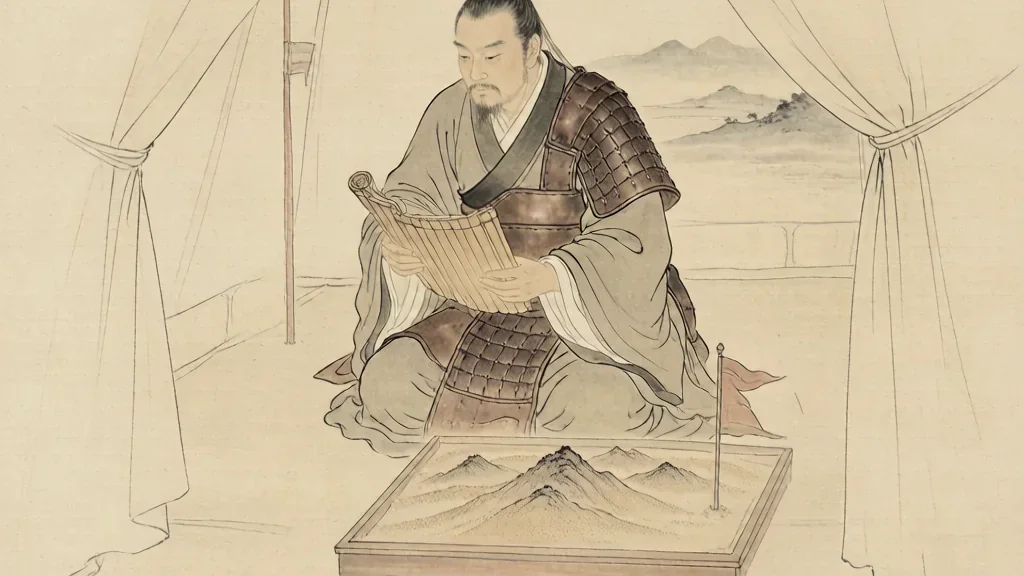
More than two and a half millennia after his death, the name Sun Tzu still commands immediate respect in military academies, business schools, and sports locker rooms around the world. His slim volume of thirteen chapters, known simply as The Art of War (孙子兵法), has become the most influential treatise on strategy ever written. Yet the man behind the masterpiece remains one of history's most fascinating enigmas — a philosopher who taught that the greatest victory is the one won without fighting.
Sun Tzu, whose given name was Sun Wu, lived during the late Spring and Autumn Period of ancient China, roughly around the 6th century BCE. He served as a military general and strategist for the state of Wu, helping King Helü transform a minor kingdom into a formidable power that would challenge even the mighty state of Chu. But it was not his battlefield exploits that earned Sun Tzu immortality — it was his profound understanding that war is not primarily about fighting, but about thinking.
The Man Behind the Legend
The historical record of Sun Tzu's life is remarkably sparse. The most famous account comes from the Han Dynasty historian Sima Qian, who recorded a story that has become legend. According to Sima Qian, when King Helü of Wu first interviewed Sun Tzu, he asked the strategist to demonstrate his military principles using the palace women. Sun Tzu divided 180 concubines into two companies, appointing the king's two favorite concubines as commanders. When he gave the order to face right, the women merely giggled.
Sun Tzu calmly observed: "If the orders are unclear, it is the general's fault." He repeated the instructions carefully, then gave the command again. The women giggled once more. This time, Sun Tzu declared: "If the orders are clear but the soldiers do not obey, it is the officers' fault." He ordered the two concubine-commanders executed. The horrified king protested, but Sun Tzu was unmoved: "A general on the battlefield is not bound by the commands of his sovereign." After the execution, the remaining women drilled with perfect discipline. King Helü, though grieving, recognized Sun Tzu's genius and appointed him general.
Whether this dramatic story is historical fact or instructive legend, it encapsulates Sun Tzu's core philosophy: discipline, clarity of command, and the general's independence from political interference are essential to military success. The story also reveals something deeper about Sun Tzu's worldview — that authority must be earned through competence, not merely granted by position.
Know Yourself and Know Your Enemy
Perhaps the most famous line in all of strategic literature comes from the third chapter of The Art of War: "If you know the enemy and know yourself, you need not fear the result of a hundred battles. If you know yourself but not the enemy, for every victory gained you will also suffer a defeat. If you know neither the enemy nor yourself, you will succumb in every battle." This deceptively simple formula contains layers of wisdom that have been applied far beyond the battlefield.
The concept of knowing yourself — self-awareness — was revolutionary for military thinking. Sun Tzu taught that a commander must honestly assess his own strengths and weaknesses, the morale of his troops, the quality of his supplies, and the terrain on which he fights. Without this foundation of self-knowledge, even the most brilliant tactical maneuvers are built on sand. In modern terms, this is the essence of strategic planning: before you can compete with others, you must first understand your own capabilities and limitations.
Knowing the enemy, meanwhile, requires a deep commitment to intelligence gathering and psychological insight. Sun Tzu devoted an entire chapter to the use of spies, describing five different types of intelligence agents and emphasizing that foreknowledge is the key to victory. "What enables the wise sovereign and the good general to strike and conquer, and achieve things beyond the reach of ordinary men, is foreknowledge," he wrote. This emphasis on information warfare was centuries ahead of its time.
The interplay between these two forms of knowledge creates what Sun Tzu called the "Tao" of warfare — a holistic understanding that transforms conflict from a crude clash of forces into an elegant exercise in prediction and positioning. When you truly know both yourself and your opponent, victory becomes not a matter of chance but of calculation.
The Supreme Art of War
Sun Tzu's most counterintuitive and profound teaching is that the highest form of warfare is not to fight at all. "To subdue the enemy without fighting is the acme of skill," he declared. "The supreme art of war is to subdue the enemy without fighting." This principle elevates Sun Tzu above mere tacticians to the realm of true philosophy. For him, battle was always a last resort — a sign that strategy had already failed.
How does one win without fighting? Sun Tzu described several methods. The best approach is to attack the enemy's strategy — to foil their plans before they can be executed. Next best is to attack their alliances — to isolate them diplomatically. Next is to attack their army, and the worst approach of all is to attack walled cities, which he considered a costly and desperate measure. This hierarchy of preferred actions reveals Sun Tzu's deep preference for psychological and strategic warfare over brute force.
The idea of winning through maneuver and deception rather than destruction resonated deeply with Chinese military tradition. Unlike Western military thinkers who often emphasized decisive battle and the annihilation of enemy forces, Sun Tzu championed the indirect approach. He compared a skilled general to water: "Water shapes its course according to the nature of the ground over which it flows. The soldier works out his victory in relation to the foe whom he is facing. Therefore, just as water retains no constant shape, so in warfare there are no constant conditions."
Influence on Business and Sports
In the modern era, The Art of War has found an entirely new audience far removed from battlefields. Business executives have embraced Sun Tzu's principles as guides for corporate strategy and competitive positioning. The concept of knowing your market (the enemy) and your company's capabilities (yourself) has become a cornerstone of strategic management. The idea of winning without fighting translates naturally into business contexts: acquiring market share through innovation rather than price wars, or negotiating partnerships rather than engaging in hostile takeovers.
In Silicon Valley and Wall Street alike, Sun Tzu's maxims are quoted in boardrooms and strategy sessions. His emphasis on speed — "Speed is the essence of war" — resonates in industries where being first to market can determine success or failure. His warning against protracted campaigns — "There has never been a protracted war from which a country has benefited" — speaks to the dangers of prolonged corporate battles that drain resources and morale.
Sports coaches have also discovered Sun Tzu. The competitive dynamics of athletics map remarkably well onto his strategic framework. Coaches study opponents' game films to "know the enemy," while analyzing their own team's strengths and weaknesses to "know themselves." The concept of attacking where the opponent is weak rather than strong underlies countless game plans in football, basketball, and soccer. Even individual athletes use Sun Tzu's principles: a tennis player studying an opponent's tendencies, or a boxer looking for openings in an opponent's defense.
Sun Tzu in Popular Culture
The Art of War has permeated global popular culture to an extraordinary degree. It has been referenced in countless films, from Oliver Stone's Wall Street (where Gordon Gekko quotes Sun Tzu) to The Godfather and numerous martial arts movies. Television shows from The Sopranos to The Office have featured characters reading or quoting the ancient strategist. Professional athletes, hip-hop artists, and politicians have all claimed Sun Tzu as an influence.
This cultural ubiquity speaks to the universality of Sun Tzu's insights. His principles transcend the specific context of ancient Chinese warfare to address fundamental questions about human conflict, competition, and cooperation. Whether you are navigating office politics, negotiating a business deal, or simply trying to understand the dynamics of any competitive situation, Sun Tzu offers a framework for thinking strategically.
Yet there is an irony in Sun Tzu's modern popularity. The strategist who taught that the greatest victory is the one won without fighting is now celebrated in a world of hyper-competition. The philosopher who emphasized moral character and wise governance is often reduced to a collection of motivational quotes stripped of their ethical context. Perhaps the truest modern application of Sun Tzu's teachings would be to apply his wisdom not just to winning, but to knowing when winning isn't worth the cost.
The Enduring Mystery
Despite his enormous influence, Sun Tzu remains a shadowy figure. Some scholars have questioned whether he existed at all, suggesting that The Art of War may be a composite work compiled over generations rather than the product of a single mind. The discovery of the Sun Bin's Art of War — a separate military treatise by a supposed descendant of Sun Tzu — in a 1972 archaeological excavation added complexity to the historical record, confirming that there were at least two military strategists surnamed Sun in ancient China.
But the question of Sun Tzu's historical identity is ultimately less important than the living legacy of his ideas. Whether the book was written by one man or many, whether Sun Wu was a real general or a literary invention, the thirteen chapters that bear his name have earned their place among humanity's greatest intellectual achievements. They have been translated into dozens of languages, studied in institutions from West Point to the Harvard Business School, and applied in contexts their author could never have imagined.
Sun Tzu's ultimate teaching may be his most personal: the strategist who perfected the art of winning without fighting has achieved a victory that no army could ever undo. He has conquered time itself, remaining as relevant and read today as he was when the Warring States battled for control of ancient China. In the end, the philosopher of war may have won the only war that truly matters — the battle for the human mind.
The Five Factors of Victory
Before any battle, Sun Tzu insists, a commander must weigh what he calls the five factors: the Way, Heaven, Earth, Command, and Discipline. The Way is the unity of purpose between ruler and people; Heaven is the climate and seasons; Earth is the terrain, distance, and ground; Command is the general's character and ability; Discipline is the organization, training, and control of the army. By scoring these against the enemy's, a leader can foresee victory or defeat without fighting. This framework is remarkable because it treats war as a total calculation of politics, nature, and leadership rather than mere courage. Modern strategists still use versions of it, and the five factors explain why Sun Tzu's book reads less like a manual of bloodshed and more like a guide to decision under uncertainty.
Sun Tzu in the Warring States World
Sun Tzu is set in the late Spring and Autumn and early Warring States period, an age when competing states fought for survival and rewarded clever counsel. In that brutal marketplace of ideas, the military school of thought flourished alongside Confucian and Daoist teachings, and generals could rise from obscurity on the strength of a plan. The turbulence helps explain the book's cold pragmatism: with states vanishing overnight, rulers wanted results, not ceremony. Sun Tzu's emphasis on saving the state intact, on outthinking rather than obliterating the foe, answered a real need. Although later imperial China prized civil virtue over the soldier's craft, the Art of War never lost its authority among those who actually commanded. Its roots in a fragmented, dangerous era are precisely why its lessons about calculation and restraint still travel so well.
❓ Frequently Asked Questions
📝 Chinese Vocabulary
- 孙子兵法 (Sūnzǐ Bīngfǎ) — The Art of War; the classic military treatise
- 知己知彼 (zhī jǐ zhī bǐ) — Know yourself and know your enemy
- 不战而屈人之兵 (bù zhàn ér qū rén zhī bīng) — To subdue the enemy without fighting
- 兵者,诡道也 (bīng zhě, guǐ dào yě) — All warfare is based on deception
- 道 (Dào) — The Way; moral law and harmony with the universe
🎉 Fun Facts
- The Art of War consists of only about 6,000 Chinese characters — roughly the length of a long magazine article — yet its influence spans two and a half millennia.
- Sun Tzu's teachings were studied by Napoleon Bonaparte, Douglas MacArthur, and Ho Chi Minh — leaders on all sides of history's conflicts.
- In Japan, The Art of War was a closely guarded secret of the Takeda clan of samurai for centuries before becoming widely known.
- The Art of War is counted among the most widely translated works in the world, appearing in dozens of languages from ancient Chinese.
- Its opening line frames war as a matter of life and death for the state, warning that it must never be begun lightly or for glory alone.
- In the Chinese classification of thought, Sun Tzu belongs to the military school of philosophers, ranked alongside the Confucian, Daoist, and Legalist traditions.