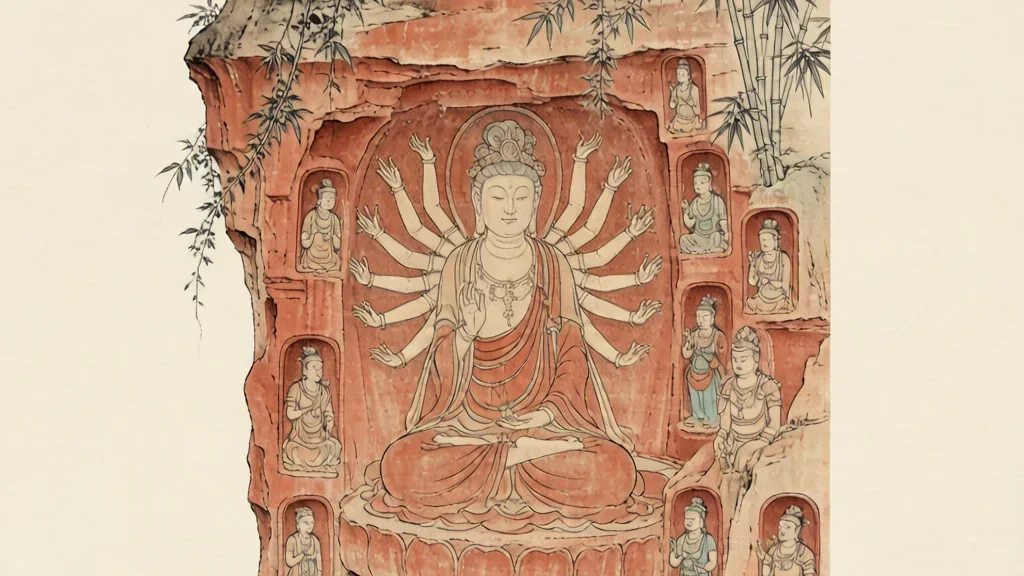
Carved into the soft sandstone cliffs of Chongqing's Dazu district are some of the most extraordinary religious sculptures in the world. Known in Chinese as 大足石刻 (Dàzú Shíkè), the Dazu Rock Carvings are a vast ensemble of more than fifty thousand figures cut into the rock between the ninth and thirteenth centuries, during the late Tang and the Song dynasties. Unlike the remote cave temples of the north, the Dazu carvings were made close to where people lived, and they blend Buddhist, Daoist, and Confucian themes into a single popular art of devotion. UNESCO has called them the culmination of Chinese rock art, and a walk among their grottoes is like reading a stone scripture illustrated for ordinary villagers rather than remote monks.
A Late Flowering of Chinese Stone Art
China's great cave-temple tradition began centuries earlier at sites such as Yungang and Longmen in the north. By the time the Dazu carvings were begun, in the late Tang period, that northern tradition was waning. Dazu represents its southern and final great phase, created when political and cultural gravity had shifted toward the Yangzi region and the southwest. The carvings span roughly four centuries, with the most intense activity under local patrons in the Song dynasty.
What makes Dazu historically important is that it captures Chinese religious art at a moment of synthesis. Earlier cave art was overwhelmingly Buddhist. At Dazu, Buddhism appears alongside Daoist deities and Confucian scenes of filial piety, often within the same cliff face. This reflects the lived reality of later imperial China, where ordinary people honored several traditions at once. The carvings are thus a snapshot of popular religion as it was actually practiced, not as doctrine prescribed it.
The Two Great Clusters: Baoding and Beishan
The Dazu carvings are scattered across dozens of sites, but two dominate. The Baoding Shan cluster is the largest and most famous, a planned religious landscape with a grand narrative program, including the celebrated "Nirvana of the Buddha" and the enormous "Thousand-Armed Guanyin." The Beishan cluster, closer to the old town, preserves hundreds of small niches carved over centuries, with exquisite Tang- and Song-style figures of bodhisattvas whose gentle smiles are considered masterpieces of Chinese sculpture.
Baoding was the work of a single visionary monk, Zhao Zhifeng, who in the twelfth century organized its construction as a complete pious project meant to teach and convert. Its layouts are didactic: processions of judgment, scenes of hell and paradise, and images of the heavens are arranged so that a pilgrim walking the path receives a carefully ordered lesson. The scale and coherence of Baoding set it apart from the more piecemeal Beishan carvings, and together they show both the popular and the programmatic sides of Dazu art.
Themes: From Hell to Compassion
The subject matter of Dazu is strikingly varied. Buddhist themes dominate — the life of the Buddha, the bodhisattva Guanyin in her many forms, the guardians of the law — but the carvings also depict the Six Realms of rebirth, the torments of the hells, and the rewards of devotion. One famous tableau shows the consequences of earthly conduct in vivid, almost cinematic detail, functioning as a visual moral code for a largely non-literate audience.
Alongside these stand Daoist immortals and Confucian parables of filial devotion. The "Filial Piety" carvings, showing children caring for parents, encode the Confucian virtue of 孝 (Xiào) in stone, while Daoist scenes present the gods of thunder, wind, and the kitchen in a thoroughly Chinese idiom. This mixing is Dazu's signature: a single cliff that teaches the ethics of three traditions at once, addressed to the farmer and the merchant as much as to the monk.
The Artistry of the Carvers
The Dazu masters worked in a fine-grained sandstone that, while easy to carve, is vulnerable to weathering — which makes their survival a minor miracle of climate and care. Their achievement is not only religious but aesthetic. The figures have a relaxed naturalism rare in earlier, more rigid cave art: rounded bodies, flowing robes, and faces of remarkable tenderness. The Thousand-Armed Guanyin at Baoding, with its radiating array of hands each holding a different implement, is a feat of both devotion and composition.
Part of the carvers' genius lay in adapting relief to the contours of the rock. Rather than forcing a uniform style onto the cliff, they let the stone's shape dictate the pose and gesture of each figure, so that the sculpture seems to emerge from the mountain rather than to be imposed upon it. The result is an art that feels at home in its landscape, a conversation between human hands and a living geology that has weathered, cracked, and endured for a thousand years.
Preservation and World Heritage
For centuries the Dazu carvings were known mainly to local people, sheltered by their relative remoteness from the wars that damaged other sites. Systematic scholarly study began in the twentieth century, and conservation work accelerated after the site was inscribed on the UNESCO World Heritage List in 1999. Specialists now monitor the sandstone for the effects of humidity, pollution, and biological growth, and visitor access is managed to limit wear on the most fragile niches.
The World Heritage inscription recognized Dazu as the high point of Chinese rock carving, notable for its scale, its integration of multiple traditions, and its popular, didactic character. Unlike a museum, the carvings remain in their original open-air settings, exposed to weather but also to the everyday life of the surrounding countryside. Preserving them means balancing access against fragility, a task that has become a model for the care of similar sites across China.
Why the Dazu Carvings Endure
The Dazu Rock Carvings endure because they are, at heart, a people's theology. They were commissioned not by emperors alone but by local officials, monks, and commoners who pooled their resources to leave a prayer in stone. That grassroots devotion gave the site a warmth and intimacy absent from many grander monuments. Each niche is a small act of hope, a thousand-year-old wish for mercy, long life, and a good rebirth.
To stand before the serene face of a Song-dynasty Guanyin at Dazu is to meet a civilization's tenderness made visible. The carvings remind us that Chinese religion was never only a matter of doctrine; it was a daily practice of images, stories, and gestures shared by an entire society. In the cliffs of Dazu, that practice survives, patient and weathered, still teaching anyone who takes the time to look.
Patrons and Pilgrims
Dazu was a people's project. While the monk Zhao Zhifeng shaped the grand plan at Baoding, the smaller niches at Beishan and elsewhere were funded by local officials, merchants, monks, and ordinary families who pooled money for a single image or a short inscription. A pilgrim's path through Baoding was arranged as a moral journey, moving from scenes of hell and judgment to visions of paradise, so that walking the cliffs was itself a lesson in conduct. The carvings thus record not only theology but the hopes of named individuals who wanted merit, long life, or a good rebirth. That grassroots devotion, rather than imperial command alone, is what gives Dazu its intimate, human voice. Reading the inscriptions today, one hears not the voice of emperors but of ordinary people who wanted, above all, to be remembered kindly by the gods and by their neighbors.
Dazu Among China's Rock Arts
China's rock-carved art began in the north at Yungang and Longmen and reached its southern and final great phase at Dazu. Where the earlier sites are overwhelmingly Buddhist and often tied to the court, Dazu shows the tradition turning outward to ordinary village life and to a blended popular religion. Its naturalism — tender faces, flowing robes, relaxed poses — marks a late, confident maturity of the sculptors' craft. UNESCO singled out Dazu as the culmination of Chinese rock carving precisely because it gathers scale, multiple traditions, and a didactic, popular character in one place. Seen beside the northern caves, Dazu shows how far the art had traveled, both geographically and in spirit, by the Song dynasty. Standing before its gentle faces, a visitor senses the confidence of artisans who no longer needed royal patronage to carve something that would outlast every dynasty that employed them.
❓ Frequently Asked Questions
📝 Chinese Vocabulary
大足石刻 — : The Dazu Rock Carvings, a vast ensemble of cliff sculptures in Chongqing.
宝顶山 — : Baoding Shan, the largest and most famous cluster of Dazu carvings.
北山 — : Beishan, the hillside cluster near the old town with hundreds of small niches.
观音 — : Guanyin, the bodhisattva of compassion frequently depicted at Dazu.
孝 — : Filial piety, the Confucian virtue illustrated in some Dazu carvings.
赵智凤 — : Zhao Zhifeng, the twelfth-century monk who organized the Baoding carvings
六道 — : the Six Realms of rebirth depicted in the carvings' moral tableaux
涅槃 — : nirvana, the state shown in the Baoding reclining-Buddha scene
🎉 Fun Facts
- The Dazu carvings include more than fifty thousand figures across dozens of cliff sites.
- The Baoding cluster was largely the vision of a single twelfth-century monk, Zhao Zhifeng.
- UNESCO inscribed Dazu in 1999 as the culminating achievement of Chinese rock art.
- Dazu's Baoding cluster was laid out as one coordinated program, so its cliffs form a deliberate walking lesson rather than a scatter of separate niches.
- The site preserves not only Buddhist art but also rare large-scale Daoist and Confucian cliff carvings from the Song period.
- Because the carvings sit in open gullies near farms, local villagers have lived alongside them for centuries, unlike the remote monastery caves of the north.