Nothing is sadder than a task abandoned just short of its reward, and the Chinese idiom bàn tú ér fèi names that loss with precision. Written 半途而废 and pronounced , it means "to give up halfway" — to stop a journey, a project, or a vow before it is finished. English has "quit while you're ahead" and "throw in the towel," but this phrase carries a particular shame: the work was underway, the end was reachable, and still the traveller turned back. For readers exploring Chinese culture, the idiom opens a window onto a civilization that has long prized endurance as a moral virtue. In this article we trace the phrase to a wife's scissors and a loom, examine why stopping halfway is treated as a failure of character, and ask when quitting might actually be wise.
The Wife Who Cut the Silk
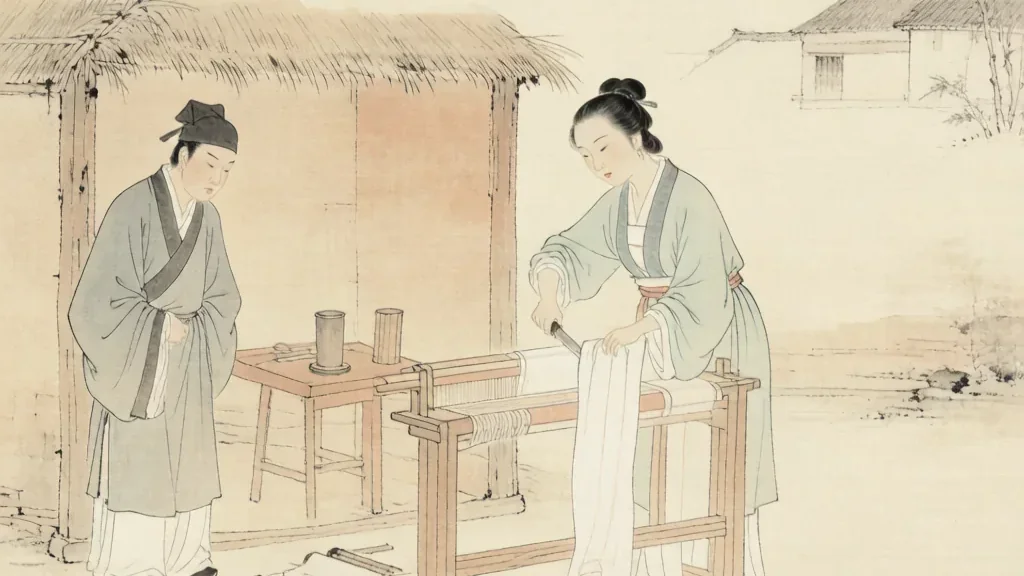
The story behind the idiom comes from the Book of the Later Han (后汉书), in its biographies of exemplary women. A man named Yue Yangzi (乐羊子) left home to study under a teacher. After a year he grew homesick and returned. His wife was at her loom weaving silk. Without a word of scolding, she took up her scissors and cut the cloth she had been weaving thread by thread.
Yue Yangzi was shocked. The half-finished bolt of silk represented months of patient work, now ruined in an instant. His wife explained: a person who leaves study halfway is like this silk — all the earlier effort is wasted, and nothing finished remains. Ashamed, Yue Yangzi returned to his teacher and studied without coming home for seven years. The cut silk became the image of , and the wife became a model of how to teach perseverance without a single harsh word.
Literal Meaning and Structure
The four characters are clear. (半) is half; (途) is a road or journey; (而) is a connecting particle ("and then" or "thus"); and (废) means to abandon, nullify, or waste. Read as "half-road-and-abandon." The grammar is almost a sentence, which suits a phrase describing an action interrupted. A learner will notice , the "road," reminding us the idiom began as a metaphor for a journey cut short.
The character is strong — it implies not rest but ruin, the voiding of what was begun. To "abandon halfway" in Chinese is not merely to pause; it is to let the whole endeavour collapse. That weight is why the idiom feels moral rather than practical. It is not "I took a break" but "I threw away the work."
The Moral Weight of Persistence
Confucian culture placed enormous value on finishing what one starts, whether in study, virtue, or filial duty. To stop halfway was to show a weak will, and the weak will was a spiritual flaw, not just a practical one. The wife's silence and her scissors taught a lesson sharper than any lecture: the cost of quitting is paid by the self, in wasted potential, long after the relief of turning back has faded.
This moral framing explains why the idiom survives so vigorously. It is invoked by teachers, parents, and coaches whenever a student is tempted to drop a hard subject or an athlete to skip training. The phrase carries the authority of two thousand years of insistence that character is built at exactly the point where quitting becomes tempting. To endure there is to become someone trustworthy.
When Is Quitting Right?
A fair reader will ask whether "never stop" is always good advice. The idiom itself does not say a person must pursue a wrong or harmful goal forever; it describes abandoning a worthy, reachable one. Classical Chinese also honours knowing when to stop — 适可而止 (shì kě ér zhǐ, "stop when it is enough") praises restraint. The wisdom is to distinguish the foolish persistence that wastes a life from the worthy perseverance that builds one.
Modern psychology would add that some quitting is healthy: leaving a toxic job, ending a doomed project, walking away from a lost cause can be rational and brave. The cut-silk lesson targets specifically the person who quits from discomfort rather than judgment. Used with that nuance, remains a useful mirror rather than a chain.
Companions and Opposites
The idiom stands beside a whole family of perseverance phrases. 锲而不舍 (qiè ér bù shě, "carve without stopping") urges steady effort; 水滴石穿 (shuǐ dī shí chuān, "dripping water pierces the stone") promises that small persistence wins; and 持之以恒 (chí zhī yǐ héng, "sustain it with constancy") names the habit of continuation. Together they form a curriculum of endurance that Chinese education has long taught.
For learners, knowing both the vice () and its virtues lets you speak naturally about effort. You can warn a friend against quitting and then encourage them with its opposites, moving through the whole emotional range of commitment in a few well-chosen phrases. That range is part of what makes the idiom cluster so useful in real conversation.
A Closing Reflection
The cut silk of Yue Yangzi's wife still speaks to anyone who has abandoned a half-written book, a half-learned language, a half-kept promise. does not scold so much as remind: the road was being walked, the cloth was being woven, and the turn-back costs exactly what was already gained. To hear it is to feel the weight of the scissors and, perhaps, to pick up the journey again. In a culture that measures people by what they finish, the phrase is both warning and quiet invitation to go on.
Weaving as a Metaphor for Learning
The tale chooses its image with care: learning is like weaving silk, a craft built thread by thread across months, where a single cut undoes the whole. The wife does not argue that study is noble; she shows that abandoning it midway throws away every earlier hour, because a half-finished bolt is worth nothing. The loom thus becomes a picture of any long endeavor, from music to virtue, in which continuity is the only thing that converts effort into result. The metaphor is especially apt for the Confucian view of self-cultivation, which is incremental and cannot be rushed or resumed without loss. By grounding the lesson in a familiar household craft, the story makes an abstract claim about perseverance concrete enough for any listener to feel.
The Gender of the Lesson
It is worth noticing that the teacher in this parable is a woman, and a silent one at that. Drawn from the Biographies of Exemplary Women, the tale presents the wife as the moral authority of the home, whose restraint and quiet action reform her husband more surely than reproach could. Her scissors do the work that words would not, and her self-inflicted loss proves the point without humiliating him openly. In the terms of its own age, the story celebrates female virtue as the keeper of male resolve, a gendered framing modern readers may read critically even as they admire the economy of the lesson. Either way, the idiom shows how a domestic scene could carry the weight of a public moral, and why the cut silk has outlasted the dynasties that prized it.
❓ Frequently Asked Questions
📝 Chinese Vocabulary
半途而废 — : to give up halfway; to abandon a task before completion.
途 — : road, journey.
废 — : to abandon, nullify, waste.
乐羊子 — : the man who quit his studies and was shamed by his wife.
后汉书 — : the Book of the Later Han that records the tale.
丝 — : Silk, the cloth Yue Yangzi's wife was weaving when she cut it to teach her lesson.
劝 — : To admonish or urge, the silent persuasion the wife practiced with scissors rather than words.
持之以恒 — : To sustain something with constancy, a positive counterpart urging the habit of continuation.
🎉 Fun Facts
- The idiom's source is in the "Biographies of Exemplary Women" section of the Book of the Later Han.
- Yue Yangzi's wife taught her lesson without a single word of reproach, only the scissors and the cut silk.
- The story says he then studied away from home for seven years without returning.
- The phrase is still used by Chinese teachers and parents to discourage students from dropping hard subjects.
- The Biographies of Exemplary Women that preserves the tale was itself a didactic work, so the cut-silk story was designed from the start to teach through model behavior.
- Unlike many idioms drawn from battles or courts, this one comes from domestic life, a wife at her loom, which may explain its lasting power in everyday moral advice.