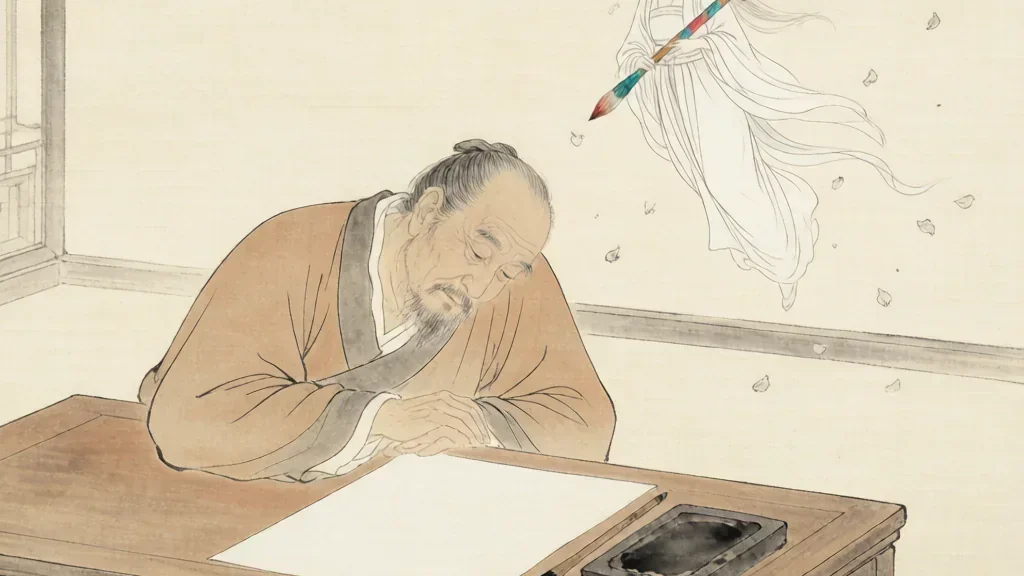
Every creator dreads the silent morning when the words will not come, and Chinese has a phrase that names that dread exactly. The idiom jiāng láng cái jìn, written 江郎才尽 and pronounced , means "Jiang Lang's talent is exhausted" — the moment a gifted writer loses the spark that once flowed freely. For English readers, it is the perfect entry point into a very Chinese anxiety about inspiration as something borrowed rather than owned. The story behind it is both tender and strange: a man who wrote like a god in his youth, then watched the god depart. In this article we meet Jiang Yan, trace the legend of the stolen brush, and explore why a culture that prizes learning also fears its loss so keenly.
Who Was Jiang Yan?
Jiang Yan (江淹, c. 444–505 CE) lived during the Southern Dynasties, a turbulent era of divided realms after the fall of the Han. As a young man he was celebrated for luminous prose and melancholy poetry, especially his "Fu on the Regret of Parting" (恨赋) and "Fu on the Feeling of Desolation" (别赋). His reputation rested on a rare music of language — precise, mournful, and unhurried. Contemporaries ranked him among the finest stylists of his age, and his early works are still anthologized today.
Yet as Jiang Yan grew older and rose to high office, his writing seemed to fade. The brilliance that marked his youth gave way to competent but flat official prose. Readers noticed; friends remarked; and the gap between the young genius and the elderly statesman became a puzzle the culture could not resist explaining. Out of that puzzle the idiom was born, blaming not laziness or politics but something more mysterious: the leaving of the muse.
The Legend of the Borrowed Brush
The most famous explanation is a dream. According to later anecdote, the aged Jiang Yan dreamed that a man — often identified as the earlier poet Guo Pu (郭璞) — approached him and said, "I once lent you a brush; now I have come to take it back." Jiang Yan reached into his robe and produced a splendid multicoloured writing brush, which he returned. From that night on, his writing lost its magic. A second, gentler version says he dreamed of the poet Zhang Jingyang (张景阳), who asked for the return of a handful of silk he had left in Jiang's care; once returned, Jiang's stock of words dried up.
These dreams are not mere folklore; they express a profound belief about creativity. In the Chinese imagination, talent () could be a loan from the spirit world, a gift held in trust rather than a possession. To "return the brush" was to lose what was never fully yours. The legend turns a biographical decline into a parable about the fragility of genius and the humility it demands of those who wield it.
The Meaning of the Idiom
is used whenever someone's gift runs dry — a novelist with one book left in him, a singer who can no longer hit the notes, a scholar whose last insight came years ago. here is an informal, slightly teasing word for "fellow" (the man Jiang), is talent, and is exhausted or used up. The phrase can be self-deprecating — an author joking that the well has run dry — or it can be a sharp critique of a once-great figure who has coasted on fame.
What makes it poignant is that it assumes the talent was real. No one says of a person who was never gifted. The idiom honours the early brilliance even as it laments its loss, which is why it carries none of the cruelty of mere failure. It is grief for a light that was, not scorn for a light that never was.
Burnout Across Cultures
Modern readers will recognize as an ancient name for burnout. The pressures Jiang Yan faced — political office, administrative burden, the expectation to perform on command — are exactly the conditions under which creative people today lose their edge. When writing becomes labour rather than longing, the brush may simply go quiet. The idiom thus speaks to any artist, programmer, or parent who has felt the reservoir empty under the weight of duty.
Yet the classical framing offers a consolation the modern one sometimes lacks. If talent is a loan, then its loss is not a verdict on your worth but a change in circumstance — perhaps temporary, perhaps not. The dream suggests that what leaves can, in legend at least, be given back. That openness keeps the idiom from despair; it leaves a door ajar for the return of the brush.
Companions in the Lexicon of Talent
This phrase sits naturally beside 才高八斗 (cái gāo bā dǒu, "eight dou of talent"), the boastful measure of poetic gift, and 学富五车 (xué fù wǔ chē, "learned enough to fill five carts"), the measure of erudition. Where those celebrate abundance, records its absence. Together they let a speaker move from praise to pity within a single conversation about a career.
For the language learner, the cluster is useful because it shows how Chinese measures the invisible. Talent is counted in (a grain measure), learning in cartloads, and exhaustion in the simple word . Mastering these lets you discuss achievement and its loss with the same ease a native speaker feels — and to name, without shame, the fear that every creator knows.
A Closing Reflection
Perhaps the deepest gift of is permission to be finite. We are not infinite sources; even the brilliant Jiang Yan had his season. To say the talent is exhausted is not to admit defeat but to tell the truth about a creative life, which rises and falls like weather. The idiom asks us to honour what we made when the brush was ours, and to wait, quietly, in case it returns. In a culture that honours persistence as much as gift, that patience is itself a kind of wisdom.
The Medieval Fu Rhapsody
To understand Jiang Yan's fame one must understand the fu, a sprawling prose-poem form that dominated Chinese literature for centuries. A good fu displayed erudition, parallel phrasing, and controlled emotion, and it was the centerpiece of a writer's reputation. Jiang Yan's Fu on Regret and Fu on Parting were admired precisely because they balanced grandeur with restraint, mourning without collapsing into complaint. When the idiom says his talent was exhausted, it means the man who could write such measured music had fallen silent. Knowing the form explains why his decline felt like a cultural event, not a private disappointment, and why later ages kept returning to the puzzle of a gift that simply stopped, pondering what it meant for genius to fade.
A Named Life, Not a Fable
Most Chinese idioms arise from anonymous parables or philosophical tales, which is what makes 江郎才尽 unusual. It is built around a documented historical individual, complete with dates and a career. This gives the phrase a peculiar intimacy: speakers are not invoking a generic everyman but a specific gifted person who faded. The naming also softens the judgment, because the audience knows Jiang Yan was real and once truly great. Where a fable might condemn, a biography can only lament. The idiom therefore occupies a tender space between moral lesson and human sympathy, and its durability may owe something to that warmth — we mourn Jiang Lang because we know he was, for a while, exactly as brilliant as the stories claim, and then the light dimmed.
❓ Frequently Asked Questions
📝 Chinese Vocabulary
江郎才尽 — : Jiang Lang's talent is exhausted; creative burnout.
江淹 — : the historical writer behind the idiom.
才 — : talent, gift.
尽 — : exhausted, used up.
郭璞 — : the poet who, in legend, reclaimed Jiang's brush.
江郎 — : The fellow Jiang — the informal, slightly rueful way the idiom names Jiang Yan himself.
恨赋 — : Fu on Regret — one of Jiang Yan's two celebrated rhapsodies still studied as a model of medieval prose.
别赋 — : Fu on Parting — the companion rhapsody whose melancholy tone made Jiang Yan's early reputation.
🎉 Fun Facts
- Jiang Yan's two most famous "fu" rhapsodies, on regret and on parting, are still studied as models of medieval Chinese prose.
- The "borrowed brush" dream treats talent as something lent by the spirit world, not owned by the person.
- Jiang rose to high political office, and many blame official duties — not a dream — for his creative decline.
- The idiom is the rare Chinese proverb built around a named historical individual rather than an anonymous parable.
- Some literary historians suspect rivals spread the 'lost the brush' story to explain why Jiang Yan's later official writings were bland, turning a political fact into a charming myth.
- The phrase is so established that Chinese dictionaries list 江郎才尽 as a standard entry, one of the few idioms named after a specific person rather than a fable.