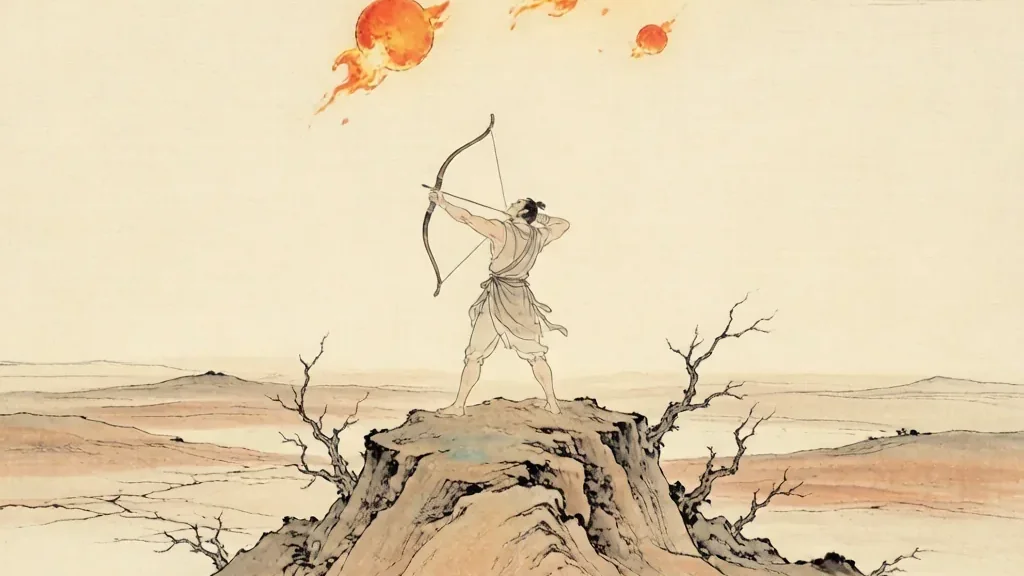
The myth of 后羿射日, pronounced , tells of the divine archer Houyi who shot down nine of ten suns to save the suffering world from scorching heat. The literal meaning is Houyi shoots the suns, and the tale belongs to the oldest layer of Chinese mythology, preserved in texts such as the 山海经 and elaborated in later writings. In the story, ten suns once rose together and baked the earth, withering crops and beasts, until the archer drew his bow and brought down all but one, restoring balance. This article explores the figure of Houyi, the catastrophe of ten suns, the act of shooting, the rescue of humanity, the later sorrow of his wife Chang'e, and the enduring image of the archer as a savior of order.
The Archer Houyi
Houyi is portrayed as a master archer of semi-divine standing, a cultural hero whose skill with the bow served the cosmos rather than mere hunting. In some traditions he is a historical or legendary ruler, in others a subordinate of the heavenly court sent to correct a disorder. What is constant is his unmatched accuracy and his role as the one who can strike what others cannot reach.
The name Yi carries the sense of excellence, and the title Hou marks him as a lord or champion. Together they designate a figure set apart by prowess, a being whose very identity is the perfect shot. Archery in early China was not only a military art but a ritual discipline linked to virtue, which suits Houyi's elevated status.
Later stories complicate him. The same archer who saved the world also suffers personal tragedy, and some versions show him growing proud or estranged from the divine. The myth thus gives us a hero who is both rescuer and flawed man, a combination that deepened his hold on the imagination.
The Catastrophe of Ten Suns
The premise is a cosmic malfunction: instead of one sun crossing the sky each day, ten appeared at once. In the mythic accounting, the suns were the sons of the sky god, perhaps birds or beings that took turns, but they rebelled and rose together, unleashing intolerable heat upon the world below.
The consequences were catastrophic. Rivers boiled, forests burned, crops failed, and both people and animals faced extinction. The earth became a furnace, and the established rhythm of day and season broke down. Such a scene expresses an ancient anxiety about the sun's power, which gives life in measure and destruction in excess.
This imbalance is the classic mythic structure of too much of a good thing. The sun is necessary, but ten suns are lethal. The tale thereby teaches that order depends on proportion, and that even celestial bodies must be kept within bounds by authority or hero.
The Drawing of the Bow
Houyi's response is direct and physical. He takes his bow and his divine arrows and, standing on the earth, looses shaft after shaft at the blazing suns. Each shot fells one, and the sky dims slightly with every fall. The image of a man shooting the sun is a supreme statement of human or semi-divine agency against cosmic forces.
The archery is described with awe because it requires hitting targets no ordinary hunter could approach. The suns are distant and radiant, yet Houyi's skill closes the gap. His bow becomes the instrument by which heaven is disciplined, and the arrow the mediator between earth and sky.
The restraint of stopping at one sun is as important as the shooting. Houyi does not abolish the sun but restores the single, life-giving orb. The hero's wisdom is shown in knowing the limit of correction: remove the excess, keep the necessity.
The Rescue of the World
With nine suns down, the remaining one resumes its proper course, and the earth cools. Crops can grow again, waters settle, and humanity is spared. The archer's deed is thus a founding act of rescue, the moment when civilization becomes possible because the environment returned to livable measure.
The saved people naturally honor Houyi as their deliverer. The myth grants him the gratitude that attends any figure who ends a catastrophe, and his name enters the roll of culture heroes alongside those who tamed floods or taught fire. His bow is remembered as the tool of survival.
This rescue motif recurs across world mythology, but the Chinese version is distinctive in its emphasis on proportion and restraint. The hero does not destroy the source of light but prunes it, a detail that reflects a cultural preference for harmony over elimination.
The Wife Chang'e
The later tradition ties Houyi to Chang'e, his wife, who in many versions consumes the elixir of immortality intended for them both and floats up to the moon, leaving Houyi alone on earth. This sorrowful sequel turns the solar hero into a figure of loss, complicating his triumph with personal grief.
The connection between the archer and the moon lady is one of the richest veins in Chinese myth. The mid-autumn festival, with its moon gazing and moon cakes, draws on the Chang'e story, and Houyi is remembered as the husband who looks up at the wife he lost. The sun shooter and the moon dweller become a separated cosmic pair.
Some tellings blame Houyi's own pursuit of immortality or his harsh rule for the rift, while others blame circumstance. The variations show how the myth absorbed moral reflection: even a world-saver is not exempt from the fragility of human happiness.
Houyi in Early Texts
References to Houyi appear in the 山海经 and in philosophic and poetic works of the Zhou and Han periods, where he is cited both as a historical archer king and as a mythic figure. The diversity of sources indicates that the legend was already old and contested when written down.
Confucian and other schools used Houyi differently. Some praised his service, others warned that even great strength needs wisdom, and still others treated him as a cautionary case of a capable man undone by pride or by longing for immortality. The archer was a flexible symbol.
The persistence of his name across texts confirms his centrality. Few mythic figures bridge the gap between the archaic Shanhaijing and later court poetry as smoothly as Houyi, whose bowshot remained a vivid image for decisive correction.
The Archer as Symbol of Order
Houyi embodies the principle that excess must be checked. The ten suns are a metaphor for any runaway force, natural or political, that threatens the many. The archer's role is to restore measure, and his example justifies the use of decisive power in service of the common good.
The bow itself is a symbol of disciplined force. Unlike fire or flood, the arrow goes where the shooter wills, making archery an image of controlled intervention. Houyi's shooting is thus not random destruction but precise correction aimed at the exact source of disorder.
In this light the myth supports a conservative cosmology: the world is good when balanced, and the hero is the one who defends balance against chaos. The single remaining sun is the proof that the hero served life, not vengeance.
The Myth in Later Art
Artists have depicted Houyi as a standing archer with the suns arranged in the sky like blazing discs, often showing the moment just before release. The composition lets the viewer feel the tension of the bow and the enormity of the task, with the small human figure facing ten fires.
Opera and festival performance retell the shooting alongside the Chang'e ascent, pairing the public rescue with the private loss. The combined story satisfies both the communal and the intimate registers of myth, which is why it remains popular in live performance.
In modern China the figure appears in children's books and animations as a bright champion who fixes the sky, and the name Houyi is used for projects that evoke precision and protection. The ancient archer now also stands for scientific or technological mastery over nature.
Why the Suns Endure
The image of ten suns is unforgettable because it takes a familiar comfort and multiplies it into terror. Everyone knows the sun; to imagine ten is to feel instantly the logic of the catastrophe. The myth needs no explanation because the dread is built into the premise.
The archer's reply is equally universal: a single person confronting an overwhelming force and winning through skill. Houyi satisfies the deep story wish that the right agent, properly armed, can set the world right. His bow is the hope that disorder is not permanent.
Finally, the tale's restraint gives it wisdom. By leaving one sun, the myth refuses total revolution and affirms that the goal is balance, not annihilation. That measured conclusion is why 后羿射日 reads as a story of harmony restored rather than mere conquest.
❓ Frequently Asked Questions
What does 后羿射日 mean?
It means Houyi shoots the suns, referring to the myth in which the archer shot down nine of ten suns to save the world.
Why were there ten suns?
In the myth the suns, sons of the sky god, rose together and scorched the earth, causing drought and ruin.
Why did he leave one sun?
He kept one so the world would retain light and warmth, restoring balance rather than destroying the sun entirely.
Who was Chang'e?
She was Houyi's wife, who in later legend rose to the moon, linking the archer to the mid-autumn festival.
Where is the story recorded?
Early references appear in the Shanhaijing and in Zhou and Han philosophic and poetic texts.
What does the myth symbolize?
It symbolizes the need to check excess and restore cosmic proportion through disciplined, targeted action.